On Sunday, November 16, the referendum and the Popular Consultation promoted by the Government of President Daniel Noboa were held in Ecuador, within which there were three questions on partial reform of the Constitution and one on promoting the establishment of a Constituent Assembly for the drafting of a new constitution.
In that Popular Consultation and Referendum and almost unexpectedly, President Daniel Noboa lost it in its entirety and in a resounding way, triumphing the “NO” option, showing with this result a resounding rejection of the citizens to the government initiative, with more than 60% over the “YES” option promoted by the Executive. this electoral defeat marks a turning point in the Noboa government and that will lead to the search for new alternatives and strategies to continue with its governmental agenda, which is influenced and conditioned by the interests of both national oligarchic power groups to which President Daniel Noboa himself and his family belong, as well as external actors, who seek to influence the key decision-making of the Ecuadorian State for the benefit of their own national and geopolitical interests, as is the case of the United States.
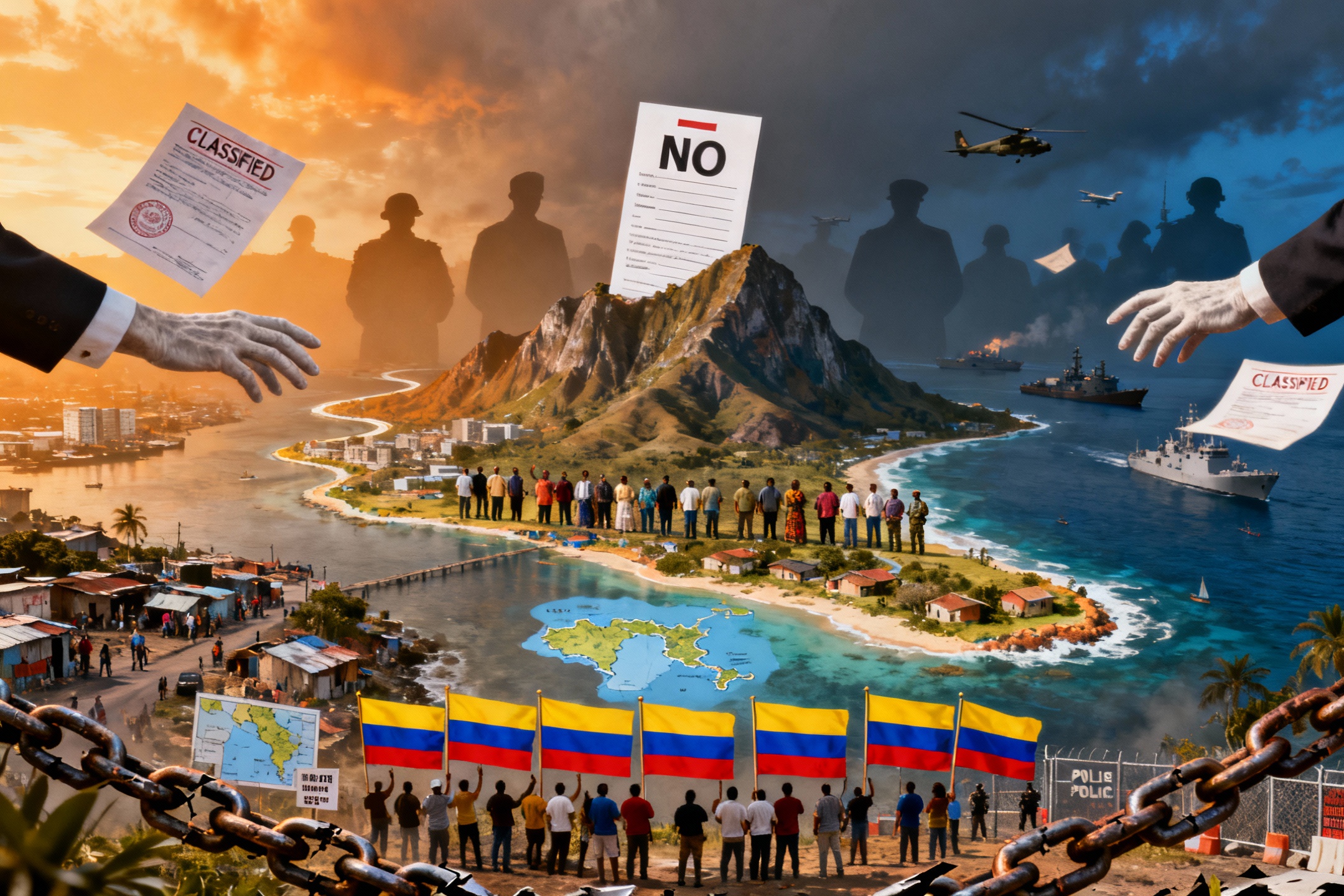
Within this Referendum and Popular Consultation, two key questions stand out, for the same and clear purpose, to allow, make viable and guarantee “THE ESTABLISHMENT OF FOREIGN MILITARY BASES IN ECUADORIAN TERRITORY” It is worth mentioning that in the current Constitution of Ecuador, in “Art. 5“ it expresses in a forceful way the DEFENSE OF NATIONAL SOVEREIGNTY, stating textually the following:
[“Ecuador is a territory of peace. The establishment of foreign military bases for military purposes shall not be permitted. It is prohibited to cede national military bases to armed forces to foreign armed or security forces.”]
A brief context. President Daniel Noboa, from the beginning, already showed in his first interim term, and now after his re-election, the total openness and strategic alignment with the geopolitics of the States and the International Monetary Fund (IMF), with the Ecuadorian State being highly indebted, controlled and limited in its fiscal management to the conditions subscribed in the various letters of intent with the Multilateral.
On the other hand, the importance that the current administration of President Trump has given to its bilateral relations with Ecuador has been solid and consistent, having sent to the South American country officials of its Government at the highest level, such as Mrs. Laura Richardson, former Chief of the United States Southern Command. Senator Marco Rubio, Secretary of State and Mrs. Kristi Noem, Secretary of Security of the United States.
It is clear then that Washington looks with approval and does not intend to waste the predisposition of the current Ecuadorian government to accede to its geopolitical plans. On the part of the Ecuadorian Government, it is also clear that it is willing to strengthen increasingly solid ties, proof of this are the many trips that President Noboa has made to the United States, more than ten of which have already been counted so far in his Government.
After the defeat of the Executive in the Referendum and Popular Consultation on Sunday, November 16, President Noboa made his first public act, being a last-minute trip to the United States, between November 18 and 20. It is very striking that for the purposes of this trip, President Noboa, by Executive Decree, travels in a delegation only with the Secretary General of Public Intelligence, José Julio Neira, whose agenda was classified as confidential.
It was announced that the reason for the trip was to “strengthen diplomatic ties with its commercial allies, in addition to security, international cooperation in the framework of the fight against organized crime”, but it is the way and time in which the presidential trip takes place, therefore this leads to generate doubts and perhaps contemplate other reasons that may have been the main reason for such a trip.
One of these reasons is very possibly related to the adverse results of the referendum and Popular Consultation, specifically the impossibility of being able to continue with Washington’s intention to establish military bases in Ecuadorian territory. That said, questions and doubts inevitably arise as to what President Noboa actually did on that trip and what will happen later, since it is clear that the Pentagon will not resign itself to dispensing with establishing its military presence in Ecuador, since it is imperative that Washington strengthen its projection of power in the South Pacific in the face of growing geopolitical tensions in the Asia Pacific with China.
Therefore, it is to be hoped that Washington will not sit idly by, and that it will pressure the Noboa government to be able to make viable a strategy and alternative that will enable the establishment of U.S. military bases in the short and long term.
The official narrative of the Ecuadorian government regarding the U.S. military bases is international cooperation to fight drug trafficking and transnational crime, but the real reason for the interest of the United States in strengthening its military presence in the region is to regain its control and presence on the continent, a kind of “Monroe Doctrine 2.0” to contain the growing Chinese and Russian influence. a strategy that has suffered a great setback after the defeat of Noboa and his initiative of Referendum and Popular Consultation.
There are several reasons and factors that led the Ecuadorian government to lose resoundingly in its initiative, among the main causes are the following; the work of official spokespeople who, instead of convincing the citizenry, warned and instilled fear regarding the regression of rights and the fear of the privatization of health, education and Social Security. Another determining factor was the erosion of the image and support for President Noboa after the national strike of September-October of this year, which took place in the Sierra Norte of Ecuador, the abuses, detentions, disappearances and deaths as a result of the days of popular insurrection, marked the indigenous population and a large part of Ecuadorian society. arousing rejection and condemnation.
All this, added to the terrible government management in every way, poverty, insecurity, violence and state abandonment, converged in a weariness and a vote to punish President Noboa.
As of the date of publication of this analysis, the Ecuadorian President has not made a single official statement after his electoral setback, what he has done are a series of changes in his cabinet, which between removals and controversial resignations, still does not seem to find the ideal formula within his work team to rectify and recover the management capacity that would allow him to recover his credibility and popular support.
This scenario has opened an opportunity for the forces of the Ecuadorian left to capitalize on this electoral setback of the Executive that personifies the right, the economic elites and US interests, it is therefore crucial for the Ecuadorian left to pave the way for a national concertation of unity to be able to confront the Ecuadorian establishment that today enjoys almost absolute power.