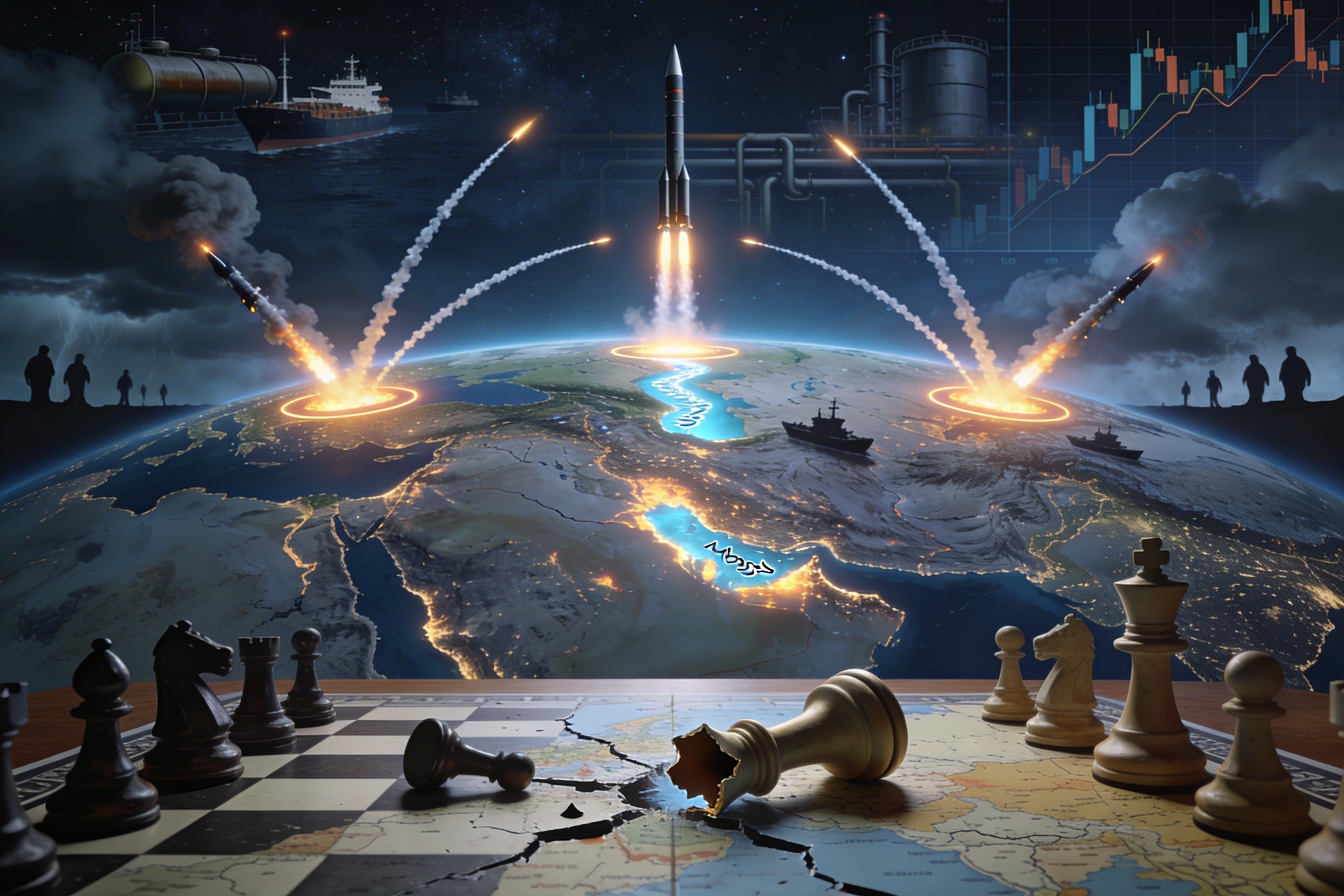
The long-awaited war between the Islamic Republic of Iran, the United States and Israel has begun, the real trajectory of which generates concerns and fears in much of the world due to the unforeseeable consequences it may contain and generates strategic calculations in the different halls of geopolitical thought and in international decision-making circles.
Below, and continuing with the opinion of the experts who make up Association “Sovereignty”, we publish the vision of another group of analysts who belong to different countries and cultures.
Leonardo Russo:
Khamenei was assassinated, but the Iranian government is still standing.
But it’s interesting to see how their neighbors reacted. The truth is that Iran’s enemy is not only Israel and the U.S., but also all of its neighbors who, directly or indirectly, support Israel and the U.S. against Iran.
Hei Sing Tso:
I think the military conflict will continue for a short time. Trump will not be dragged into long war. Iran will not collapse but Tehran will play the game with restraint and diplomacy. Trump just wants to have more bargain on nuclear talk and distract domestic pressure in view of the coming Midterm election.
Iran is important for Russia and China so that their support are important. Further, Turkey, Egypt and some Arabic nations do not want to have a pro-West Iran which will upset the balance against Israel.
Alexander Markovics:
The youngest attack of the Epstein-Coalition (USA and Israel) against Iran marks the newest chapter in the fight for the hegemony over the Middle East. Even more, it’s another chapter in the war on the emerging multipolar world. In the first hours, the professional war criminals murdered Iranian citiziens and martyred the leader of the revolution, Ali Khamenei in cold blood. But the planned shock-and-awe-operation for a regime change in Iran failed.
Immediately, Iran hit back and raised hell on the Epstein-Coalition from Tel-Aviv to Dubai, with massive results. The strait of Hormuz is closed and the energy prices at the stocket market exchange about to rise dramatically.
Last time Israel tapped out after 12 days – now Washington expects a full month of warfare. And Europe seems not to be ready for peace, but forced to join this war. Disaster looms on the horizon for the West – the transition from the unipolar chaos to a multipolar order will be forged by blood and iron.
Francisco Bendala Ayuso:
Trump has allowed himself to be swayed by Netanyahu, although the Israeli leader did not need to push him very hard, as both men share the same objectives in that area: a) Netanyahu is obsessed with eliminating, and then subjugating with a ‘friendly’ regime, his last remaining enemy, Iran, having already disposed of all the others through agreements, the ‘Arab Spring’, destruction (Gaza-Hamas and Hezbollah) or a puppet regime of ‘jihadists’ as in Syria; b) Trump craves control of Iranian oil, which, after taking over Venezuela, and together with his traditional allies in the area, he will exclusively dominate 80% of the world’s oil reserves, which will give the US enormous coercive power over Russia and especially China; also because with the fall of the Ayatollah regime, he will take revenge for the humiliation and undermining of US interests that the fall of the Shah in the 1979 Khomeini revolution meant for the US.
As for the possible outcome of this new crisis, and given that neither Russia nor China are going to come to Iran’s aid in the way that NATO has been doing for the past four years with Ukraine, Iran will probably be defeated by the exhaustion of its military resources, but not before causing serious losses to Israelis, Americans and neighbouring countries. However, after that, it will not be easy for the US and Israel to control the groups loyal to the Iranian regime, increasing instability in the area with possible attacks spreading to other parts of the world.
José María Manrique García:
On Saturday the 28th, the last day of February 2026, Israel, with the help of a Zionist supporter, the United States, led by a non-Nobel Peace Prize winner, and surely other NATO and Middle Eastern nations, began an Iranian attack. It was the umpteenth war unleashed by the Israeli state since its founding in 1948 and the clear continuation of the 12-Day War (13–24 June 2025), with a clear result unfavourable to Tel Aviv, and this, in turn, was part of the Seven-Front War that (Gaza Strip, West Bank, Syria, Lebanon, Iraq, Yemen and Iran). Israel unleashed the latter, under the barely concealed false flag of the October 7, 2023 attacks on Gaza, turning the area into the continued gallows of the Gazan people, a genocide that still remains and is broadcast live and direct in the face of the widespread passivity of the world’s political-religious elites.
This demonic nonsense can only be understood in its entirety, and pardon me for using a word that should only be linked to the relationship with the one true God, if one takes into account the “religious factor” of Talmudic Zionism, which, barely covertly, despises and attacks the Mosaic Law and Catholicism.
A Zionism in intimate symbiosis with the globalist plutocracy that tyrannizes the world.
A “tyrannical” Iran whose treacherously assassinated (in the midst of repeated and hopeful negotiations) president was the first, and practically the only, to publicly condemn the demonic blasphemy of the opening ceremony of the Paris Olympics in 2024.
In this founding context, it must be considered a coincidence, that this year the Hebrew feast of Purim is celebrated mainly around the night of March 2 to 3 (the 14th of the month “Adar”, the 15th “in walled cities”, celebrating on the 13th the previous fast of Queen Esther, new wife of Ahasuerus/Xerxes). It is the Jewish festival of joy/revenge that commemorates their salvation from the Persian-Achaemenid empire.
We are talking about a worldview that claims biblical passages such as that the Hebrew people are the chosen ones who will reign between the Euphrates and Nile rivers, and will dominate the rest of the nations after the coming of a “messiah” that Christian prophecies identify with the Antichrist. And in the Zionist acceleration of that coming we are.
Carlos Javier Blanco Martín:
The events already speak for themselves.
It is no longer observed, exactly, that a) the U.S. uses its creature, the Zionist Entity, as its own aircraft carrier, anchored in the Middle East, causing chaos all around. The issue has evolved a lot.
Nor is it accurate, if it ever was, that b) the U.S. and Israel are two countries closely united by an alliance. We must modify our schemes, and overcome hypotheses (a) and (b), which in the past could cover the geopolitical reality.
I believe that with the present U.S.-Zionist aggression against the Islamic Republic of Iran, we must seriously handle hypotheses (c), which are very different and better reflect the situation in the world, at least since the beginning of the intensification of the Gaza Genocide and since the aggression against the Persian country perpetrated last year. This hypothesis (c) goes like this: the Western Empire, which has the largest and most expensive army in the world, that of the United States, is a machine controlled by the Zionist Entity.
According to this hypothesis, only a chain of failures, such as those that began with its defeat in Vietnam last century and continued with the following failures (Iraq, Afghanistan, Ukraine), and foreseeably the resounding result against Iran in 2026, will make the American people force their Empire to abandon these adventures, given the high number of deaths among their own. The day when the “Westerners” themselves suffer with the same intensity the pain they have caused to the rest of the peoples, the Empire will begin to retreat. The tenacious response of the Persians can initiate that turnaround in the tables.
Jesús Alberto Erazo Castro:
The move by the United States and Israel was not improvised: it had been brewing for some time and had a clear objective, to decapitate the Iranian leadership and kill the Ayatollah. They succeeded. Now no one should pretend surprise about the fire.
Iran responded by escalating, as do states that do not intend to kneel. When you light matches in a gasoline tank, you can’t be escandalize by the explosion.
Any diplomatic settlement can come out of this war, but one lesson is engraved in fire: blind faith in the West is a high-risk sport. The fantasy that societies can be redesigned with bombs continues to be sold as a brilliant strategy. It didn’t work when Saddam Hussein invaded Iran in 1980, sacrificing more than 300,000 Iraqis. But in Washington they seem convinced that this time it will be different.
If the regime does not fall, the logic is simple: up the ante. And then they talk about international stability.
That Iran is tough? That its leadership is radical? Perhaps we should ask ourselves how much external asphyxiation a country needs to harden.
In recent days, not only did the ayatollah fall; The first attack also killed 200 girls in a school. The Iranian people are convinced of their cause.
The United States started this war. The difficult thing is to imagine that he will come out well. What happened is unprecedented. It’s a disaster.”
Mario Ramos:
The color of the turban of the murdered Ali Khamenei was black. He was a sayyid. This means that Khamenei was a direct descendant of Muhammad through his daughter
Fatima and her cousin Ali, the sayyid represents wisdom and respect, something to keep in mind because Khamenei was the one who issued the fatwa, the religious edict banning nuclear weapons in Iran that his successor may or may not keep.
And given the existential war that Iran is facing, I see it likely that things will change with the final election of the new spiritual leader, who will most likely be Ayatollah Ali Arafi. Iran has to look to the successful example of resistance that North Korea has followed. Moreover, in this multipolar world, non-proliferation hangs in the balance, I would say that in the medium term it is doomed since other nations have shown their intentions to develop nuclear weapons.
By assassinating Khamenei, the arrogant in the West murdered a sayyid and this makes it feasible for Iran to implement a war of medium or long duration, that is, not short as Trump and Zionism want. This will lead to several complications to the strategy planned by the aggressors. Such as, for example, logistical problems, pressure from its Persian Gulf allies since every day of war means that its bubble economies are at risk of implosion and war of attrition because AngloZionism has opened more fronts than it can manage, among others.
I hope that on this occasion in Iran strategic rationality will prevail over religious considerations, given the great threat that looms over the nation. I say this with great respect for Shiism.
Carlos Mamani Aliaga:
We began 2026 with a blow that confirms a trend: the West (the U.S. and Israel) is willing to carry out what it plans without hesitation, even at the cost of blowing up, in a single move, what little diplomacy remains—namely, its current phase of Systematic Nullification of Geopolitical Adversaries. The February 28 attack—presented as a joint operation (Washington called it “Operation Epic Fury”; Israel, “Operation Roaring Lion”)—was accompanied by an explicit discourse about “neutralizing” Iran’s strategic capabilities and, in practice, pushing regime change through faits accomplis, such as the assassination of Iran’s Supreme Leader, Ali Khamenei, while the world went into a state of alarm over immediate retaliation and the risk of regional escalation.
Indeed, there is a reality that is increasingly difficult for the main revisionist powers (Russia and China) to evade: in the struggle for a Multipolar World, the greatest strength is not only material capability, but the determination to use those capabilities. Eurasian revisionist powers still seem to cling to the expectation that agreements, “red lines,” or negotiations will be enough to restrain a logic that already operates in the language of force and power. But the dynamic now unfolding—with the Security Council convened on an emergency basis and global calls for restraint—suggests that war “moves toward” those who try to avoid it: if they truly want to consolidate themselves as sovereign poles in a multipolar world, history is making them pay the price of deciding in time, not of being right in the abstract.
It is time to take categorical decisions—sooner rather than later—because even if they try to elude their destiny, they will be dragged into doing so to preserve their survival as civilizations; for, as Trotsky warned: “You may not be interested in war, but war is interested in you.”
Patricio Santos:
Finally, on the morning of this Saturday, February 28, 2026, the much-announced and cheered threat of war that Washington and Tel Aviv had been declaring for weeks against Iran happened.
The United States and Israel are once again together in a war campaign against the Persian nation, a campaign that may take on increasingly complex and uncertain nuances, even more so now that Tehran has already recognized and announced the death of Iran’s supreme leader, Ayatollah Ali Khamenei.
The Iranian army and the Revolutionary Guards have said that the worst part has not yet begun, because within the extensive Iranian arsenal, it is believed that there are still weapons that have not been used so far.
This war could escalate into an all-out regional war, as the “Axis of Resistance,” a set of regional proxy forces linked to Tehran, could be activated at any time from Lebanon, Iraq, Yemen, and even Gaza to attack both Israeli and U.S. military targets in the region.
On the other hand, after the closure of the Strait of Hormuz, the global economic-energy impact will be chaotic.
Iran has a huge army, very well prepared and equipped to resist and strike hard. The “blitzkrieg” strategy that Washington expects may not materialize and its strategy will fail, since the elimination of the supreme leader and other high commands would not affect the Iranian command structure, which at this point knows what to do autonomously.
On the other hand, they are also trying to influence Iranian civil society to carry out a popular insurrection, and to pave the way so that, as happened in Venezuela, a transition is established, this so far seems to have no effect.
Having said this, the Pentagon would have to modify the strategy, and perhaps the need for a land campaign would be contemplated, but this would be almost suicide for the US, the human, economic and resource cost would be very high, the war would stagnate, Iran is a huge country with complex geography, a land campaign would be ruled out.
The final solution should be a negotiated solution to the conflict.
The Middle East after this conflict will never be the same again, nor must we forget the interests of other actors, regional powers and of course of other global powers such as Russia and China whose interests and security dilemmas are also immersed. The following hours are key to being able to calculate the real dimension that this conflict could acquire.