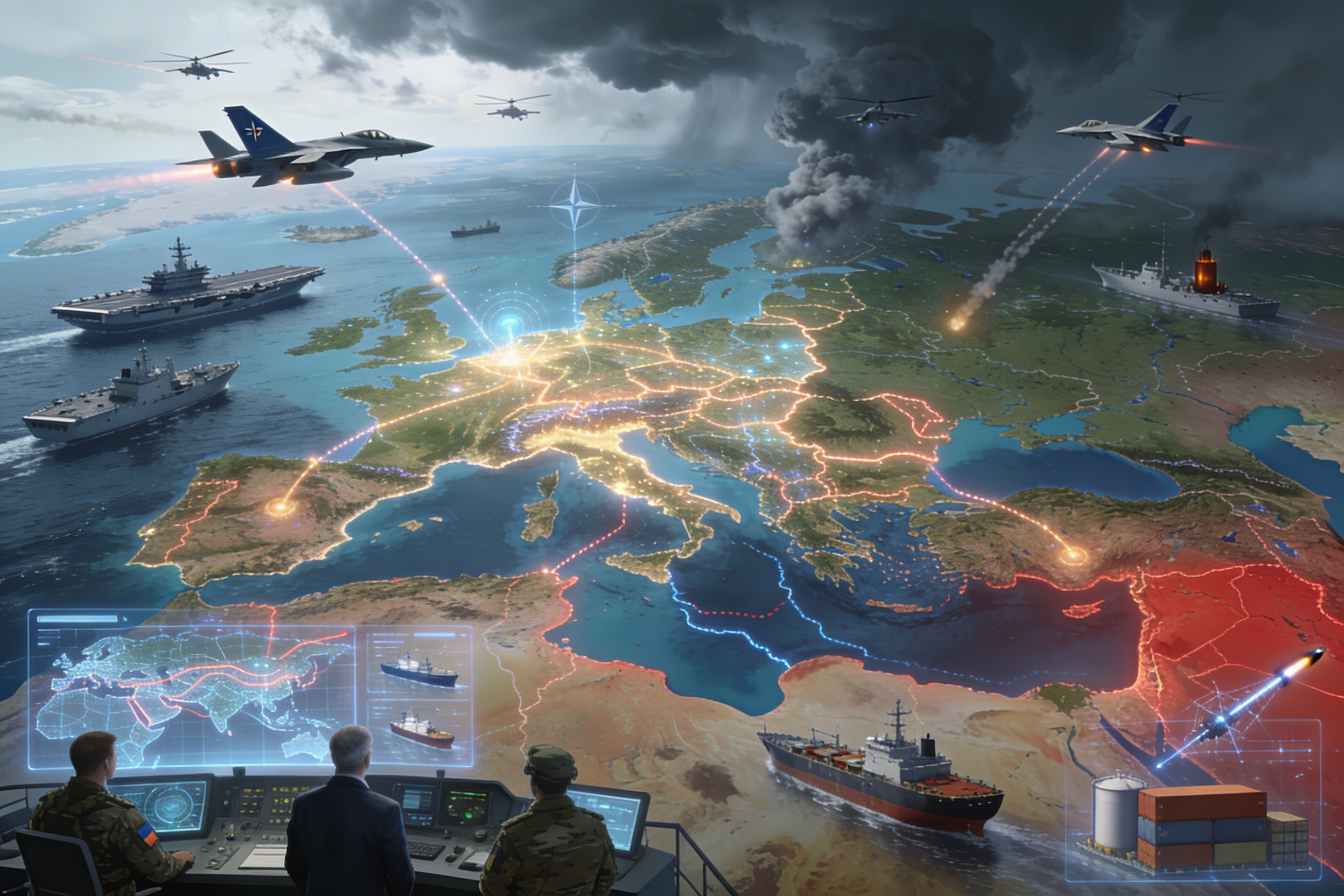
Once again, war looms over the European continent, and many of its leaders in the EU and key Member States are eager and willing to go to war, unable to explain their position beyond propaganda slogans designed to stir up emotion in their listeners. The issue of European participation in the war against Iran, which was started by the State of Israel and the United States of America, has several elements that warrant in-depth analysis: 1) strategic, 2) geo-economic and 3) political-institutional.
To begin this analysis, it is clear that Europe does not need to enter into a war against Iran to suffer a series of setbacks, starting with the interruption of energy flows (gas and oil) through the Strait of Hormuz (with the possibility of a blockade on the Red Sea side – Suez and Bab el Mandeb). Furthermore, the pressure exerted by Washington and Israel may include both active participation in attack operations on Iranian territory and indirect involvement in the protection of US and Israeli bases and naval escorts, as well as logistical and intelligence support, which they would try to present as “defence of navigation” and “regional containment”. In fact, the EU extended Operation Aspis to protect navigation in the Red Sea and monitor Hormuz.
Seen in this light, to the question of whether Europe should participate or not, we should ask ourselves about the consequences for Europe of military involvement of varying intensity, i.e. what it can gain and lose in terms of energy and trade, as well as strategic autonomy and internal stability. So what do we mean by participating with the United States and Israel in their war against Iran? One can participate directly with attacks, offensive deployments and the use of European bases for such operations. One can participate indirectly by providing intelligence, resupply, anti-aircraft systems and naval escorts. One could also participate economically and diplomatically, with more sanctions, financial closures and political isolation against Iran. And, of course, one could participate in the information war by adopting the narrative framework of a ‘defensive war’ by Washington and Tel Aviv against Tehran.
Continuing with the questions to analyse and understand the situation, would all European countries want to and be able to participate in the different possibilities raised? There are differences in geographical location, political mentalities and available military equipment. So far, President Macron’s France has confirmed the deployment of an aircraft carrier group led by its only aircraft carrier. Other European countries have joined this fleet, such as the Spanish government, which ordered the deployment of the frigate Cristobal Colon. So far, the common point to be protected by these European movements is Cyprus.
However, they do not clarify exactly which part of Cyprus they intend to defend with anti-aircraft systems. Let us remember that Cyprus is divided into three parts: the Turkish Republic of Northern Cyprus, which is only recognised by Turkey; the Republic of Cyprus, which is also a member of the EU; and the bases under British sovereignty. Therefore, if Iran attacked the British bases located there, they would not be the responsibility of the EU, but of NATO at most. Even so, the situation is only escalating on the French side, as since the outbreak of this war, President Macron has made strong statements about increasing French nuclear warheads and that he will increase them without adhering to nuclear control.
Furthermore, they intend to create a so-called nuclear umbrella by deploying French nuclear weapons in other countries such as Germany and Poland.
Next, we must address the social situation in Europe following intervention in favour of the United States and Israel. What is the general mood of the population? We find a political-media conspiracy that supports aggression against Iran and the coup d’état, that is, “regime change”. They use cognitive warfare resources such as appeals to uncontrollable emotions to gain the population’s consent for armed intervention. However, they are unable to fill the void of mass social mobilisation and therefore all threats of the use of (military) force are limited, whether against Russia, China or, in this case, Iran, because European countries only have the armed forces currently available to them.
Seen in this light, the most to least likely scenarios we have here are as follows: 1) Limited European involvement, with patrols, maritime protection, logistical support, sanctions and diplomatic pressure. 2) Selective military involvement, with certain states participating in air defence and escort missions in Hormuz. 3) Broad European offensive participation, although there is no political consensus or legitimacy in European society, let alone a clear economic interest in entering into a possible prolonged war against Iran.
Seen in this light, the last thing we should be thinking about is the transatlantic relationship between the United States and Europe, in a context of European strategic dependence on US military forces. The US is the largest shareholder in NATO, and European leaders are no longer considering the creation of a European armed forces, but rather maintaining the NATO structure. But in NATO, it is the United States that has military bases in Europe, not the other way around. Therefore, this transatlantic relationship remains very unequal.
Finally, in the event of European countries becoming involved in this campaign by Washington and Tel Aviv against Tehran, we must consider the negative consequences this will have for the Global South. For these countries, the attack on Iran is more in the nature of a colonialist war of aggression that seeks to overthrow an opposition government in order to install a proxy and servile government that will hand over Iran’s hydrocarbons to the United States. As a result, today’s Europe is trapped in its own internal and external contradictions, which lead it to play the role of a puppet at the service of external actors. This is the consequence of not having sovereign countries in a bloc that acts both in favour of its members and in favour of an order based on equal consideration (the reality is just the opposite, as it acts in favour of a ‘rules-based order’ that are imposed rules that always favour their creators).
Bienvenido a la fragata Cristóbal Colón !
— French Carrier Strike Group (@French_CSG) March 10, 2026
La frégate 🇪🇸 Cristóbal Colón a rejoint le groupe aéronaval du Charles de Gaulle depuis quelques jours. Elle participe depuis aux exercices et entraînements opérationnels au sein du groupe 🇫🇷🤝🇪🇸#CoopérationMilitaire @EtatMajorFR pic.twitter.com/PRMkPTDC7D