Introduction
In reaction to the 1804 kidnapping and execution of the Duc d’Enghien by Napoleon, Charles Maurice de Talleyrand-Périgord famously said: “It is worse than a crime, it is a mistake.” By this, he implied that this act, a dangerous precedent, is more damaging to Napoleon’s reputation and stability in perspective than it is just an illegal act itself. With the same quote (worse than a crime- a mistake) we can precisely describe contemporary foreign policy of the EU and it’s often times (if not always) counterproductive and suicidal geopolitical and diplomatic policies.
Genesis- how did we come to this
To understand and fully explain the size and scale of the European downfall, we need to delve into the past, for the purpose of this article, not farther than the two World Wars we had in the 20th century. Europe in general was the biggest loser of these wars, regarding the difference between what it started the wars with (input) and what it ended them with (output). In the aftermath of the First World War, many European empires collapsed, many colonies were lost, but the biggest consequence in general was the fact that the European powers lost their supremacy and exclusivity in managing world affairs.
With the postwar emergence of the US (and its back and forth involvement in European affairs at the time), Japan, USSR (both European and Asian power), and others, the center of world power and decision making was not only in Europe anymore. And then, after the horrors and destruction of WWII, Europe’s position and status were deprived even more and shifted from being an important geopolitical subject to basically being a geopolitical object torn between external forces.
Completely in the shadow of the Cold War, fought between the two superpowers, most of the European countries were separated into two almost identical geopolitical and ideological blocs. From one of those blocs, the current EU emerged and expanded rapidly, incorporating the former Eastern European socialist countries after the dissolution of the USSR, but remaining, from its foundation to current days, only an expansion and a controlled mechanism of the US. In that conceptual key, we must observe the contemporary EU.
EU between the US, Russia, China, and the rest of the world
The backbone of the European integrations was its military wing- the NATO pact, as a military expansion of the US army in Europe, and a guarantee that provided a safe haven for economic cooperation and integration. And the tacit agreement of this military alliance (and of European integrations in general) was formulated in the famous quote: “To keep the Russians out, the Americans in, and the Germans down” , coined by Lord Hastings Ismay, NATO’s first Secretary General, around 1952.
But what happens when these fundamentals and the underlying agreement are outdated and broken? What happens when you can’t keep Russians out, Americans in, and the Germans down anymore? That is the most important question that the EU faces today, and the events are confirming it. Americans, at least at the moment (under Trump’s management), want out; forbidding Russians from coming in is almost impossible (mostly due to the dependency on energy sources), and the Germans don’t want to be down anymore (in spite of the lowering of American involvement and the crisis of leadership).
Let’s briefly analize these phenomenons: Americans want out (but not entirely) due to the fact that Europe is not their primary focus as a region anymore (like it was in the Cold War and briefly afterwars, before Middle East and Far East- due to the rise of China- took over), which is rapidly increasing these days and generaly, forbiding Russia from cooperating on a larger scale with the EU seems not sustainable anymore (EU needs Russia more then vice versa but it is a interlinked phenomenon anyway), and Germany is using the new circumstances to became the new-old hegemon on the Old Continent.
When we say EU, in terms of power and executive branch, we think of the European Council, the informal government of the EU. And when we say European Council, we think first and foremost of Ursula von der Leyen. She is, to an extent, alongside with more and more present chancelor Merz, the face of this new German expansionism, even if it’s in a democratic, liberal, and free market form- essence remains the same.
This marks the new era for EU, where it is left to a big degree without the supervision of the forces which had a crucial impact in its creation and shaping, and without leaders competent enough to at least try to make Europe (EU) subject of the international relations again, rather then just to work in its framework as an extended hand of the US and other foreign interests. Simply put, there is no De Gaulle in Europe today; there are only fragments of his sovereignist thought and action, through the work of Orban, Fico, and some other politicians who are in the EU but very critical of the current direction in which the EU is headed.
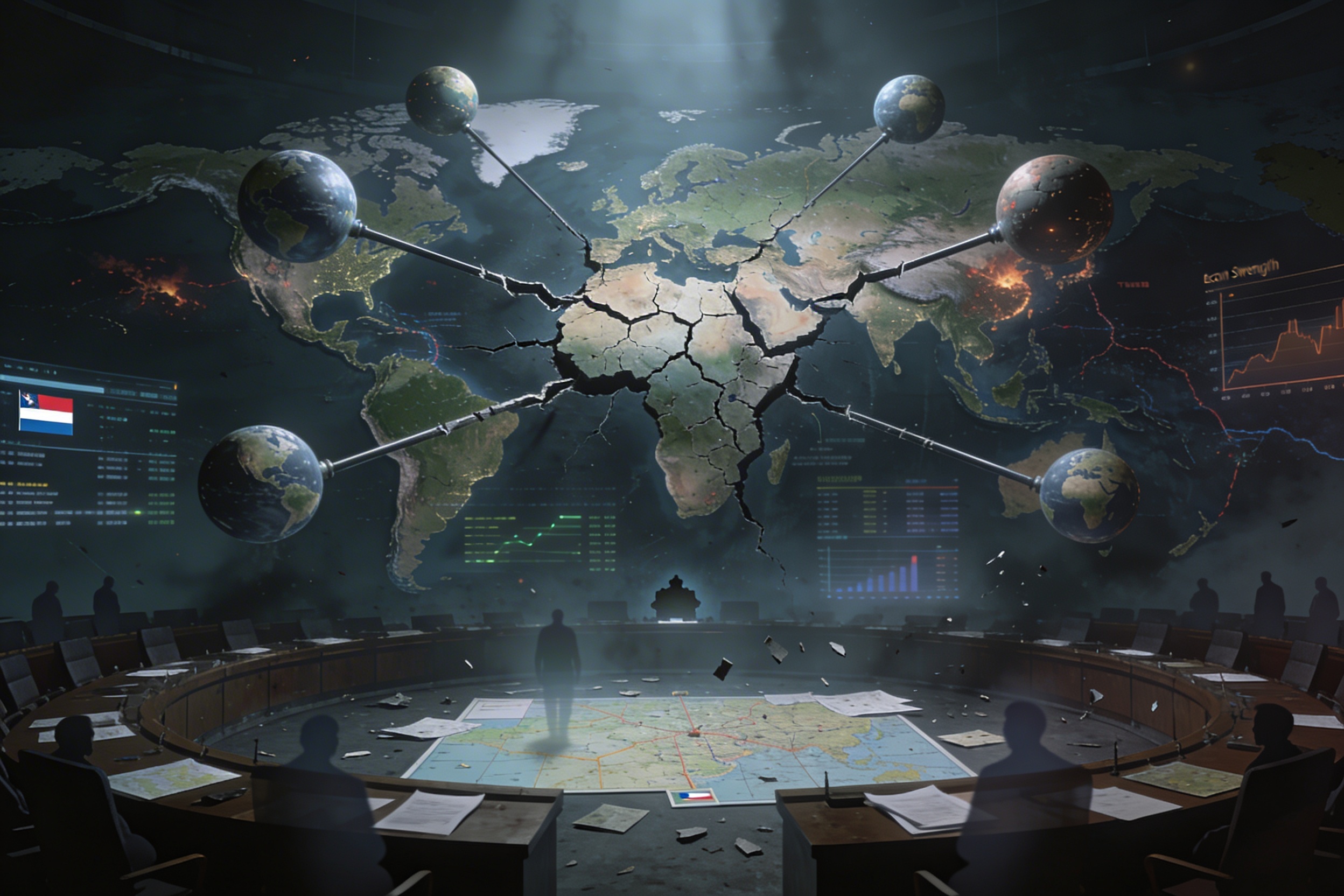
So what can a leaderless from inside and without a “patron” on the outside actually do? The answer is – not much. What we are witnessing now is more or less everything they are capable of- or lack the capacity to do. EU, although it has a strategic document on paper, in practise is always acting reactively, defensively, adding to the processes and situations others have started, without any initiative or a proactive approach in sight. We see that on the example of two biggest challenges of our time- the war in Ukraine and the war in the Middle East.
In both situations, the EU is acting passively and trying to impose itself as an important figure, but fails to do so. And even when it tries to have an initiative, like in Ukraine, it is counterproductive (mildly speaking) since it is not doing what is in the best interests of its member countries but rather adding up, expanding, and deepening the bad policies that were present in the build-up of the crisis from the start, suppressing every alternative possibility at the same time.
Other than the region of (Eastern) Europe and the Middle East, the EU’s record on other issues is not good elsewhere. Regarding China, it’s allowing Beijing’s financial, economic, and infrastructural presence, but it’s combating its strategic, security, and every other aspect, following the strict lead of Washington in the process. It’s the same in any other region of the world, where two axioms are the rule:
- Compliance with the US policies in the region (or at least not disrupting them in any way)
- Dominance of the nation-state level of approach rather than a wholesome EU approach to a certain region, country, or particular issue.
Regarding the Balkans, it’s also in the shadow of the interests of others, where paradoxically but understandably, the interests of some member states present a more important force than the interests of the EU in general. The Balkans is actually the only place where EU can still have an upper hand of a sort, even if it’s on a small level, due to the fact that the region was left to her as a “consolation prize” because the future of the region is seen as closely aligned with the EU (even if there are no new countries entering).
It recalls, to a degree, and seems as a grim throwback to the time of the Austro-Hungarian empire, which couldn’t expand at one time anywhere else but in the Balkans. After losing wars against Germany and Italy, being pushed out of many regions after their unification and formation of nation-states, the Danube monarchy couldn’t expand to the East, nor to the West, plus they were too late and too unprepared for the battle for colonies overseas, so the only remaining option was the Balkans.
And here, they were met with a strong presence of newly-formed nation-states which didn’t want to succumb to their interests, local or global, and we know how this dispute ended; by dragging the world into the Great War in 1914, in which the role of Berlin and Vienna as the perpetrators is without question. The resemblence and message remains shockingly simmilar; like the Austro-Hungarian empire at the time, will EU now, out of frustration for being left out of the world affairs and surpassed as an important adress almost by everyone else, try to destabilize the situation somewhere, just to draw attention to itself and try to act as a peacekeeper and the boss in its own backyard (as they see it) ?
Conclusion and Serbian perspective on the matter
Bismarck had an interesting remark regarding Italian ambitions and capabilities at the time when he said: ‘Italy has a large appetite and rotten teeth.’ The same can be said about the EU today, often known as an “economic giant but a military/political dwarf” .
Although it’s the biggest economic bloc in the world, it hasn’t been successful in transforming its economic capacities to a similar level in (geo)political, military, security, and other fields. Even their diplomacy revolves mostly around using the economy as both a carrot and a stick, since we know the real stick is in somebody else’s hand.
So what can the EU hope for? If it changes nothing, it can also expect nothing, other than continuation of its downfall on the outside and degradation of its cohesion on the inside. So the choice is very simple (at least in theory) – the EU will either transform or disappear. Transformation requires it to become fully independent from any outside players and strengthen its internal structures and cooperation. Disintegration will come as a natural process if that outward independence and inward cohesion are not found. From the current perspective, the latter seems more realistic.
And in the end, I have to add a Serbian point of view on the matter, since there are really few others who know and understand the EU better than us. The area of former Yugoslavia during the 90’s was the place where the downfall of the EU began. Its inadequate response to the crisis and inability to keep things tight in their own backyard were seen by the world as a sign of weakness and irrelevance. Nowadays, the EU is trying to rebrand and rebuild itself in the same region, the so-called “Western Balkans” (Balkan countries that are not in the EU), but it’s failing to deliver as well as it did back in the days of civil wars and general instability in the region.
In time you will be reading this article, we will be commemorating the 27th anniversary of the NATO bombing of Serbia. As Colonel Jacque Hogard (head of the French special forces in the KFOR mission, which came to Kosovo and Metohija after the peace treaty was signed) said in the title of his book, Europe died in Prishtina. Europe finished the second millennium and entered the 21st century by bombing a Christian nation and supporting terrorists similar to those later seen all around the Middle East and elsewhere. As many say with foundation in facts, Kosovo was a dangerous precedent that opened Pandora’s box. Everything that followed confirmed these words.
The end of this article leads us to question only a few are brave enough to ask today- is the EU, alongside NATO, also a relic of the Cold War, and of course, the outstretched hand of the US, and can it survive in a world that is rapidly changing and erasing everything current and stable at an enormous pace? The EU doesn’t seem to catch up with events and meet them head-on, but rather deals with their consequences, later, and when it’s arguably even too late. And history (like the chaotic (dis)order in the world) doesn’t forgive those who learn and adapt slowly, but rather punishes them harshly.