The foundational myth of Dubai’s modern renaissance was its ability to exist as a neutral, apolitical sanctuary. Unlike its neighbors, Dubai marketed itself as a space where capital flowed freely, insulated from the sectarian and geopolitical fissures of West Asia. This model posited that economic indispensability would serve as a sufficient deterrent against military aggression. The events of early 2026 have rendered this doctrine obsolete.
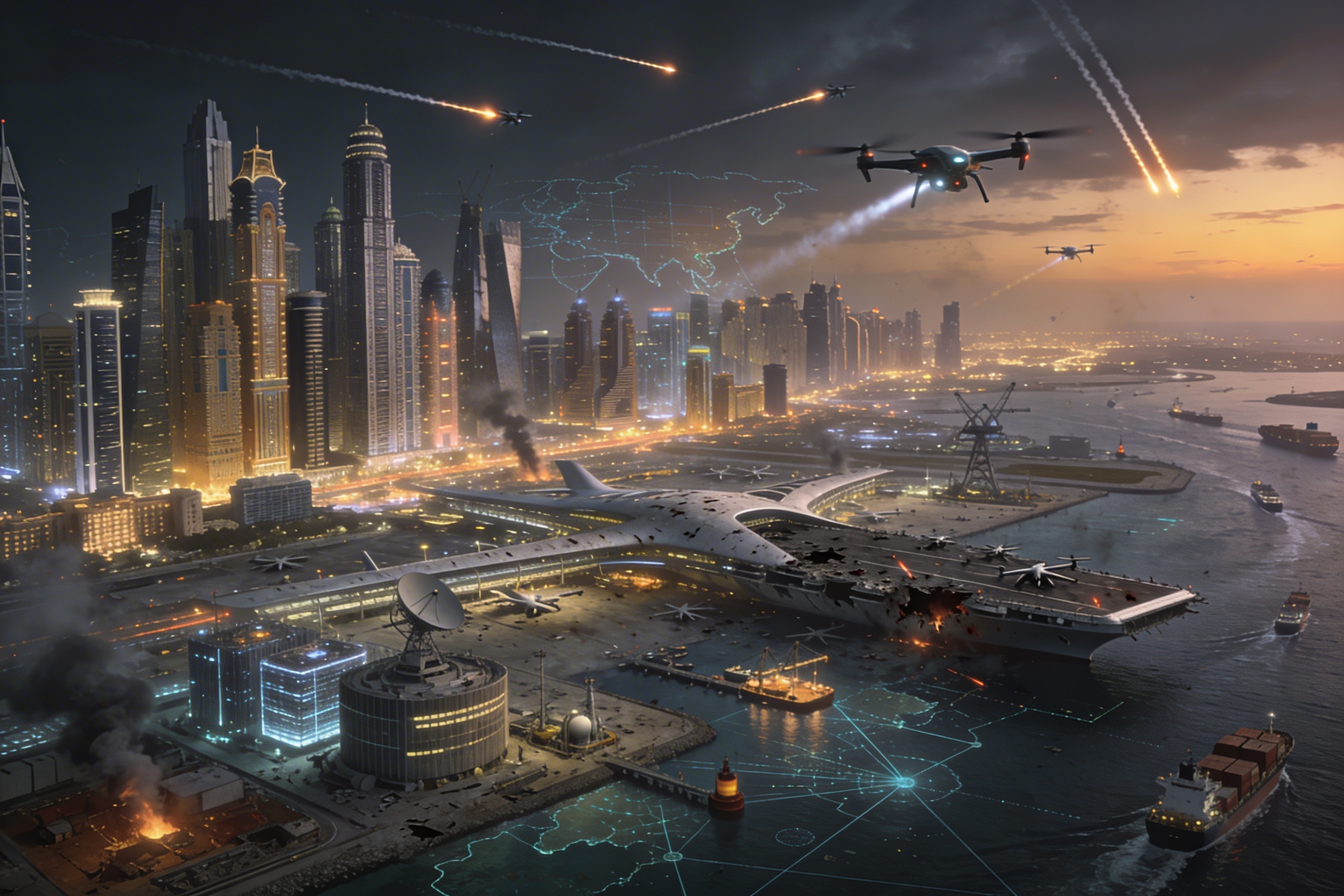
Iran’s recent military response, involving coordinated drone and missile barrages, was not confined to remote military installations. Instead, Tehran explicitly targeted the civilian and commercial infrastructure that underpins Dubai’s global integration. Critical assets struck included sections of the Dubai International Airport, the world’s busiest hub for international travelers; power generation facilities tied to strategic desalination plants; and high-profile luxury hotels such as the Burj Al Arab. By targeting the symbols of Dubai’s economic model rather than solely military assets, Iran signaled a fundamental shift in the rules of engagement.
The consequences have been immediate and corrosive. The perception of absolute safety, the sine qua non for the expatriate investors and residents who constitute the bulk of the population, has been critically undermined. Wealth management advisors report a significant acceleration of capital flight toward alternative safe havens such as Singapore and Hong Kong. Furthermore, the vulnerability of the technology sector has been exposed; strikes on Amazon Web Services data centers in the UAE have demonstrated that the emirate’s multi-billion-dollar bet on artificial intelligence and cloud infrastructure is now subject to kinetic warfare, not merely cyber espionage. The “carefully managed illusion” of invulnerability has been irrevocably shattered.
In light of this existential pressure, the decision by Emirati decision-makers to solidify an inseparable alliance with the United States and Israel appears less a matter of choice than a calculation of survival. The strategy of “geopolitical hedging”, maintaining economic ties with Iran while cooperating militarily with the West, has proven untenable.
For Abu Dhabi, the calculus is stark. Iran’s decision to strike Dubai demonstrated that no degree of economic appeasement or diplomatic outreach would deter Tehran from attempting to dismantle the UAE’s economic model when strategic tensions peak. Consequently, the alliance with Israel has evolved from clandestine intelligence cooperation to a formal military doctrine. Israel is perceived by the Emirati leadership as the only regional power possessing both the political will and the advanced military capability to effectively counter Iranian power. This partnership is now viewed as existential, moving beyond economic cooperation under the Abraham Accords into a joint framework for air defense and intelligence sharing.
Concurrently, the UAE has begun to wield its own economic leverage as a weapon in this conflict. Reports indicate that the government is preparing to freeze tens of billions of dollars in Iranian assets held within Dubai’s financial free zones. This represents a significant escalation, signaling that the UAE is prepared to fully commit to the economic warfare dimension of the conflict, sacrificing its historical role as a neutral financial intermediary for Iranian capital in exchange for alignment with the US-led coalition.
The internal cohesion of Dubai’s ruling elite has also come under scrutiny, particularly regarding the release of documents pertaining to Jeffrey Epstein. The notion that Dubai’s leadership is immune to the reputational repercussions of such associations has been disproven by recent events.
The resignation of Sultan Ahmed bin Sulayem, the chairman of DP World (one of the world’s largest port operators), serves as a pivotal case study. Following the release of files showing extensive communication with Epstein over a decade, in which bin Sulayem referred to the convicted sex offender as “one of my most trusted friends”, the emirate faced immediate financial consequences. Major international partners, including the United Kingdom’s development finance agency and a prominent Canadian pension fund, suspended new investments in DP World.
This episode illustrates a critical vulnerability: the conduct of Dubai’s ruling elite directly impacts the emirate’s ability to attract the foreign direct investment upon which its economy depends. In an environment where global institutional investors are increasingly sensitive to environmental, social, and governance (ESG) criteria, such associations erode the trust that is foundational to Dubai’s financial model.
For Dubai to avoid being reduced to a sacrificial lamb in a war between “elephants and lions”, a metaphor for the US and Iran, it must navigate a complex strategic dilemma. It cannot return to its pre-war neutralism, yet direct participation in an offensive war against Iran carries unacceptable risks. The correct position, therefore, involves a tripartite strategy of defensive integration, economic warfare, and public reassurance.
First, rejecting direct offensive combat. The UAE has publicly stated it does not seek to expand the circle of confrontation. Full participation in a US-Israeli offensive against Iran would risk transforming the UAE from a logistical partner into a primary combatant. The operational environment is already dangerously congested, as evidenced by recent friendly-fire incidents involving regional air defense systems. Furthermore, the Emirati and Israeli endgames diverge; while Israel may seek regime change in Tehran, the UAE’s priority is stability. A failed state on its maritime border would represent a nightmare scenario for Abu Dhabi.
Second, integrating into a multilateral defense architecture. The UAE is effectively joining a new Arab-Israeli-American air defense alliance. By integrating its radar and interception systems with those of its partners, the UAE can protect its sovereign territory from Iranian strikes without launching offensive sorties against Iranian soil. This allows the emirate to remain within the protective umbrella of the US-led coalition while maintaining a defensive posture.
Third, aggressive public reassurance. Recognizing the psychological crisis triggered by the attacks, the leadership has attempted to project normalcy. The public appearance of President Sheikh Mohamed bin Zayed dining at the Dubai Mall in the immediate aftermath of the strikes was a deliberate performance designed to reassure the global community that the state remains functional and open for business.
Dubai is not merely facing a temporary economic downturn; it is witnessing the end of its foundational geopolitical project. The model of a neutral, non-aligned commercial hub insulated from regional conflict has been rendered obsolete by the realities of total war in West Asia. The future of Dubai now depends on its ability to transition successfully from a neutral sanctuary to a committed, defensively integrated member of a US-Israeli-led alliance. Whether this new posture will ensure “meaningful survival” or simply render the emirate a more permanent target remains the central question of its unfolding crisis.