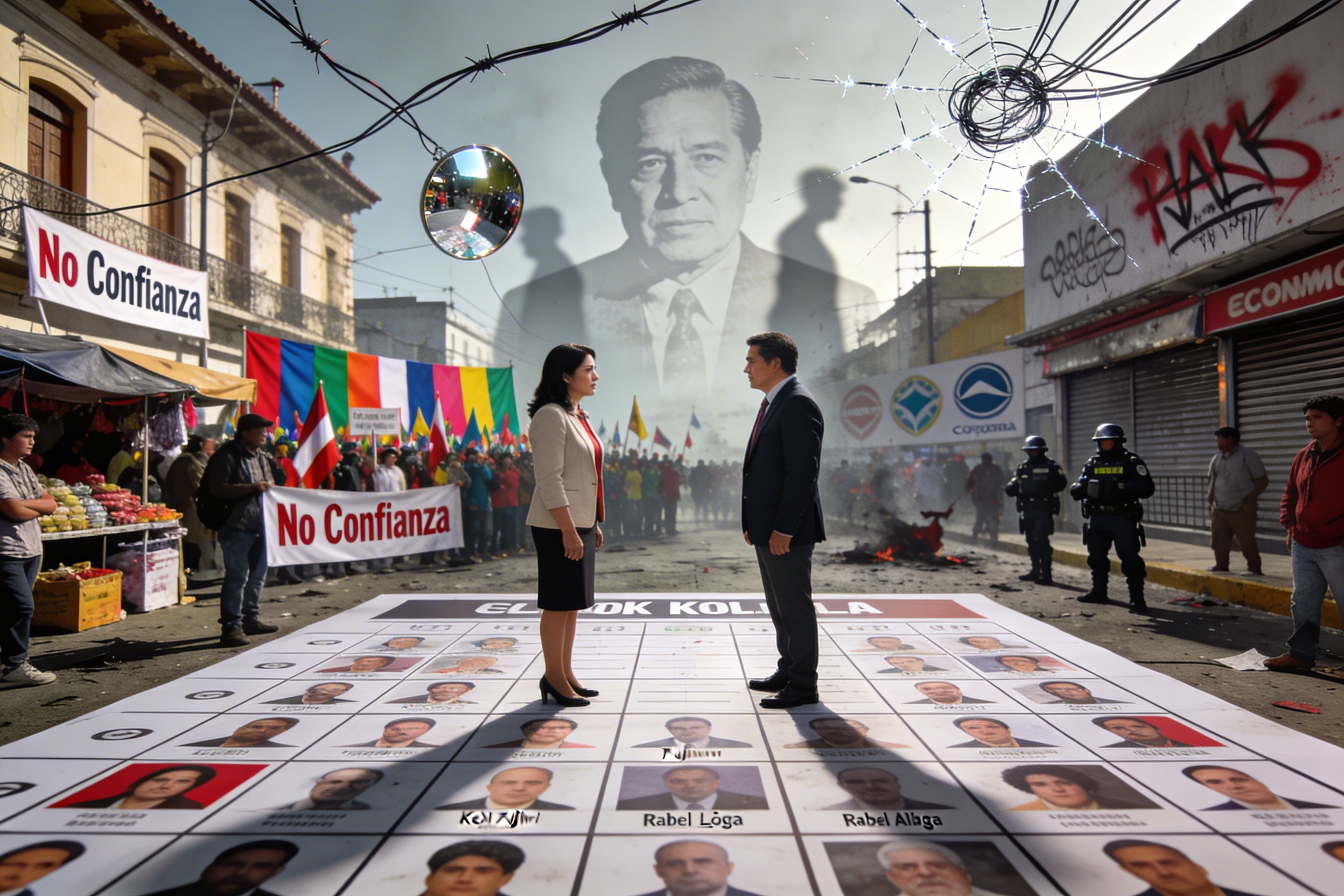
Peru has experienced one of the most complicated electoral processes since, perhaps, the February 1990 elections, when, in a similar situation, Peruvian voters had to contend with a ballot nearly half a meter long.
We have previously argued that the quality of democracy depends not on the quantity but on the quality of political parties; however, in today’s Peru—characterized by weak democratic institutions as a legacy of the political architecture of the Fujimori decade—stability and sustained economic growth—which is not immune to criticism regarding development planning—have not gone hand in hand with improvements to the political system, and this has been reflected in a proliferation of diverse political offerings and an increase in parties that, far from promoting stability, sow confusion among the electorate.
Given the parties’ inability to establish coherent and sustainable alliances in the face of the crisis of public insecurity the country is experiencing—characterized by an increase in extortion targeting both individuals without businesses and small Peruvian entrepreneurs.
This is evidence of the degree of political fragmentation in Peruvian society, and the sheer number of parties has resulted in thirty-five presidential candidates for this first round—an unequivocal expression of the dire state of our party system and, consequently, the weakened state of our democracy.
This situation is also evident in national statistics; for example, the latest Semiannual Report from the National Institute of Statistics and Informatics (INEI) on Citizen Perception of Governance, Democracy, and Trust in Institutions: July–December 2025 states that, regarding perceptions of how democracy functions in Peru, 76.2%ofthepopulationbelievesthatdemocracyinPeruworkspoorlyorverypoorly, and among the reasons cited for this view, 89.4%indicatethatitisduetothepoliticians.
This provides us with empirical evidence of the evident need to improve the quality of politics and politicians, as well as the need to adopt a nationalist and sovereigntist approach to democracy associated with qualitative factors (quality) and, in that sense, to abandon the model of liberal democracy associated with quantitative factors (quantity), the application of which to the Peruvian context, but also in the Spanish-American context, has proven to be a total failure, as it has fostered the formation of what Peruvian Army General and former Minister of War Edgardo Mercado Jarrín (1919–2012) called Low-Intensity Democracy, in reference to a political system where formal democratic institutions exist, but lack real substance, characterized by the erosion of social rights, patronage, high levels of public disaffection, and a strong influence of oligarchies, resulting in a “procedural” government that does not respond to popular demands—essentially, a reading of the state of contemporary Peruvian democracy that remains valid today.
Now, turning to the results of this first round, it was foreseeable that Peru, after having elected a left-wing candidate—Pedro Castillo—who proved unable to meet popular demands and failed to counter the pressure from economic power groups and the right-wing parties linked to them, due to clear deficiencies in political leadership and public administration that led to the subsequent rise of what many Peruvian citizens viewed as mere careerists—namely, Dina Boluarte and later José Jerí—it was to be expected that the premise of the Peronist pendulum parable would be fulfilled, and there would be a shift to the right.
And that is why left-wing parties have been the hardest hit by the popular vote in these elections, and right-wing parties the biggest beneficiaries. This is why we will see two right-wing populist movements (Keiko Fujimori’s Fuerza Popular and Rafael López Aliaga’s Renovación Popular) face off in the runoff. At least that is what everything seems to indicate, with nearly 80% of the votes counted so far. A runoff between Keiko Fujimori (the daughter of the late neoliberal dictator Alberto Fujimori) and Rafael López Aliaga (once called the Peruvian Bolsonaro, but with Bolsonaro’s decline, now rebranded as the Peruvian Trump).
In all of this, there is a historical reference to keep in mind for the analysis: in the electoral processes in which Keiko Fujimori has participated (2011, 2016, 2021), and given the persistent strong anti-Fujimorism in Peru (because she represents, for a significant segment of Peruvians, the embodiment of the institutionalization of corruption in the highest echelons of power, and for that reason), to date Keiko has been unable to win any presidential election, in what would now be her fourth attempt.
However, the paradox of Fujimorism in Peru can only be understood through the Peruvian population’s need to seek an Inca—that is, a strong and authoritarian leader—and this is why presidential systems are the most characteristic feature of Peruvian politics, in what the Peruvian sociologist and historian Alberto Flores Galindo (1949–1990) called Andean Utopianism.
This is why the legacy of Fujimorism still elicits both support and rejection that become more extreme in times of crisis, and which explains why Fujimorism has managed to maintain, since the end of the Fujimori dictatorship (1990–2000), a significant share of power in the Congress of the Republic to this day, having known how to capitalize on the political dividends derived from the quasi-mythical glorification of Alberto Fujimori’s iron-fisted figure, in the face of hyperinflation and the fight against left-wing terrorist groups in the 1990s, while ignoring or downplaying in its narrative the corruption scandals linked to the privatization of public enterprises and influence peddling through the National Intelligence Service operated by Vladimiro Montesinos, Alberto Fujimori’s right-hand man. In Peru, unlike the European identity-based landscape, there is no such thing as a non-liberal right wing. All Peruvian right-wing factions adhere to neoliberal principles and governance practices.
While Keiko represents (and indeed is) neoliberal continuity for many (since it is unthinkable for Fujimorism to make changes to the Economic Chapter of the 1993 Constitution enacted during the Fujimori decade), others view Rafael López Aliaga—regardless of his party affiliation as a Christian humanist—as a neoliberal reformist, not only because of his campaign slogan “The Poor Come First” but also because López Aliaga himself stated (La Razón, 2020) that while his economic proposal is based on the current neoliberal model, he recognizes the need for change.
As we can see, while there are differences in method, beyond that the proposals are largely the same, since Fujimorism has also always appealed to the poor with a paternalistic discourse, a legacy of Alberto Fujimori’s social policies. Thus, the difference lies in the organizations they lead.
Fuerza Popular was founded in 2011 and has been active in national politics for 15 years, facing numerous allegations of corruption and influence peddling directed at both its leader and the political organization itself. In contrast, Renovación Popular is a relatively new party founded as such in 2020, and while López Aliaga has not been immune to controversies linked to the management of his personal fortune, his political organization itself has not, so far, been implicated in criminal investigations.
Only time will tell if, much like the failed attempt at renewal on the left with Perú Libre and Pedro Castillo—amid the erosion of the Peruvian left’s proposals—Rafael López Aliaga’s Renovación Popular, on the other side of the political spectrum, will mark an attempt to renew the discourse of the reformist popular right in Peru, given the erosion of Fujimori’s political narrative.
Be that as it may, Peru has not yet been able to break the cycle of neoliberal continuity that the population demands, a task left pending for the next generations of young politicians who, in these elections—though they received less than 5% of valid votes—have set a precedent of hope for future renewal through greater participation by other political options outside the parties that have already had their chance in government.