The Armenian elites who, in the past year and a half, intensified their respective agreements with their counterparts in Europe, Azerbaijan, Turkey and the United States, are doing everything possible to retain strategic control of the state system so that, once they have obtained, in the parliamentary elections, the satisfactory results they seek, they can reform the national constitution to bring it fully into line with the medium- and long-range objectives contained in such elections. commitments that were elaborated with external actors.
The internationalization of the national state is on the immediate horizon, as well as a change in its ideological foundations.
Nikol Pashinyan continues with his intention to integrate the Republic of Armenia into the European Union and this was made clear again when he received, in Yerevan, more than 40 leaders of the bloc within the framework of the European Political Community forum that took place on May 4.
Let us remember that the European Union wants to reposition itself in the South Caucasus and co-opt the Armenian structural system for its own logic of power. Pashinyan is aware of all this and recently publicly called for Georgia to normalize its relations with the European Union. As can be clearly seen, the Armenian prime minister is not only intensifying his relationship with Brussels, but is also making efforts for Georgia to join the European Union in its entirety.
Reşad Memmedov, Baku’s ambassador to Turkey, said that both his government and that of Turkey are acting jointly in accordance with a commonly agreed policy on Armenia and that both the normalization processes between Azerbaijan and Turkey with Armenia are being carried out simultaneously.
He said that, once a constitutional reform is established in Yerevan, the peace agreement signed on August 8, 2025, in Washington would be implemented. This legal framework will lead to the opening of the borders between Azerbaijan and Armenia on the one hand and Turkey and Armenia respectively on the other.
Meanwhile, in Ankara, official sources confirm that “concrete processes” and positive developments exist between Erdogan’s government and Pashinyan’s government in order to resolve all the discordant issues between the two states.
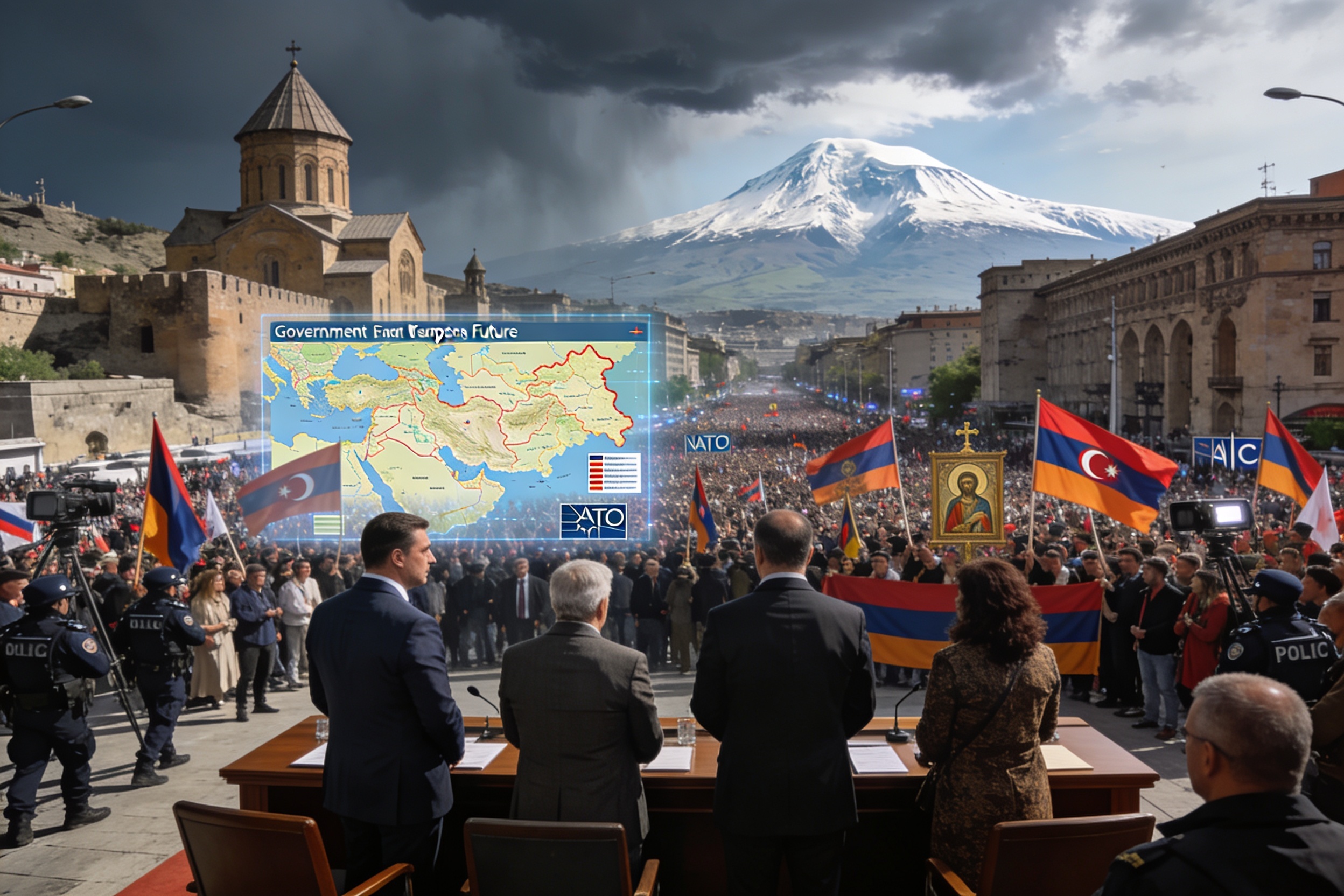
It is noteworthy that many Armenians denounce that these agreements will allow international actors to seize national territories.
As for the Americans, both the Trump administration and the globalist Democratic faction are betting on Pashinyan and both strands have concrete plans to benefit US hegemonism both inside Armenia and in the South Caucasus area.
Therefore, a continuity of the Pashinyan and its ruling elite will produce a series of great changes affecting the sovereignty of Armenian geopolitics and repercussions such changes in better strategic gains for the international actors with whom Pashinyan has agreements.
Regarding the Armenian political atmosphere, political leader Aghvan Vardanyan put white on black and, among other things, stated that approximately 70% to 80% of the population does not support Pashinyan’s government, and stressed that many Armenian citizens feel a natural rejection of the leaders of the current government.
According to various reports, the Yerevan government would seek to ensure that in the parliamentary elections on June 7, there would be a massive electoral abstention so that its party (Civil Contract) would win since, according to the calculations made by the political strategists surrounding Pashinyan, if more than 40% of registered voters do not turn out to vote and, on the other hand, the ruling party leads other citizens to vote, because victory would be assured, according to the government circle.
For this reason, some political analysts in Armenia say that the government installed an environment of threats, intimidation and retaliation against opponents to sow terror. But that’s not all, as it was reported that the government forced teachers and students from educational communities to participate in public and pro-Pashinyan demonstrations. For this reason, there is a growing fear among state employees because they may lose their jobs or be transferred if they do not comply with the order that would come from the ruling party.
Despite the accusations that are accumulating against him, the authorities will not cease their attacks against representatives of the opposition political forces, including the Armenia Fuerte party. These people are constantly under police monitoring and political persecution.
Narek Karapetyan, a member of the political council of the Strong Armenia party, revealed that “99% of cases against the opposition do not succeed in the courts.”
Honest political observers assess that the government’s actions to stigmatize and intimidate opponents would increase, in the coming weeks, in parallel with the growth of interest of globalist and other power factors to control the geopolitical future of Armenia.
Many indicators make us think that the Armenian scenario will be one of the most important in the geopolitical equations of this year and the next, 2027.