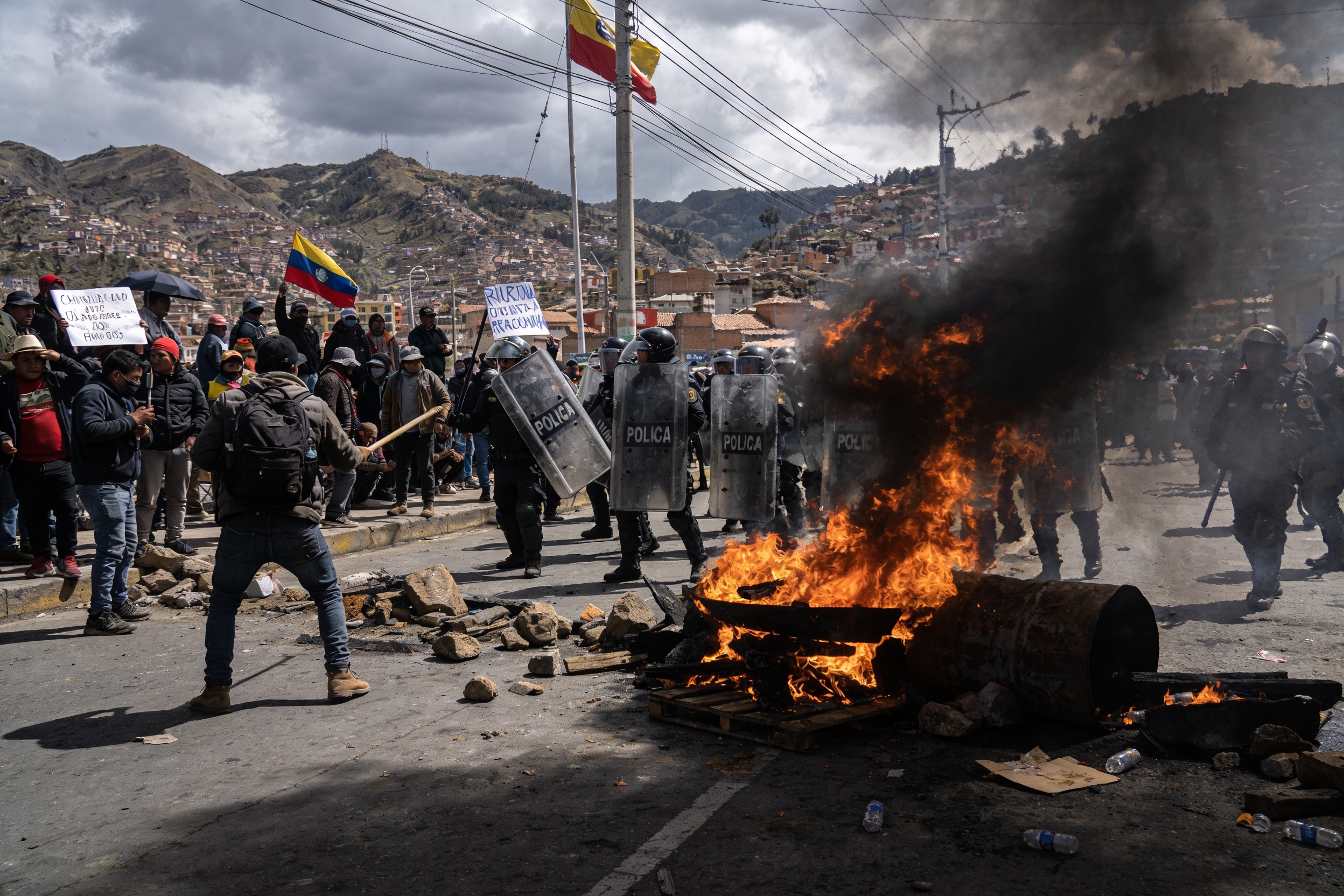
Much of the international attention has been directed towards what has been happening for several weeks now in the Plurinational State of Bolivia, we are referring to the great popular insurrection, this as a result of a generalized annoyance from broad social sectors, its emblematic protagonists being the indigenous sector, the peasantry, teachers’ unions, transporters and the mining sector. who feel directly betrayed by the current administration of the new President Rodrigo Paz.
The sectors that today rise up in his rejection, were ironically those who gave him their vote, a borrowed vote we would say, since in the context of a Bolivia polarized between the left and the right, Rodrigo Paz came to fill that void, to harbor that “hope of national reconciliation”, as was seen in the then candidate Paz, that necessary “third way”, presenting itself as a moderate, conciliatory profile, defining itself as “centre-right”.
But all this would have to be an illusion that would end soon, and since what was feared happened, Paz already in power did not take long to show his true economic, political and social project, which was opposed to all the promises he made to the broad social sectors in his campaign for the presidency. The social organizations in struggle in the streets of the City of La Paz and other sectors of the country define what President Paz has done as an open and flagrant betrayal of the Bolivian people, since he is striking and attacking not only the interests of the most vulnerable segments of the population, but also the interests of the Bolivian people. but also to the high national interests.
It is well worth expanding the regional and global geopolitical context for this analysis, since what is happening in Bolivia is not something isolated or accidental, but rather the symptoms of an epidemic that is once again looming strongly over the entire American continent, but over our region. It is known that for the United States, Latin America has been seen as its “backyard”, and in the context of the struggle for global power, a struggle in which the United States is losing to its geopolitical competitors such as China, Russia, and it is also worth mentioning the disastrous war adventure that the war against Iran has meant for the Pentagon.
So, in a scenario in which the world hegemon is gradually losing power, strength and legitimacy in several regions of the planet, it makes sense to understand why Washington’s strategy now urgently needs to retreat to its natural zone of influence, to entrench itself while it hopes to resist and reemerge in better conditions within a Multipolar World system. It is not surprising then that the new security strategy of the United States is a reconfigured, adapted and recharged renewal of the pernicious “Monroe Doctrine” of the nineteenth century.
In addition to the Monroe Doctrine 2.0, inevitably another of the geopolitical resources that it instrumentalizes from the international structure that it designed at the time and that the United States still controls to pursue its objectives and protect its national interests is also in tune, we refer to the also famous Washington Consensus, which from multilateral organizations such as the IMF seeks to permanently maintain a permanent and aggressive interference within nations in the process of development, through credits granted to the States, after disbursement, seeks to condition the requesting States so that they allow the Multilateral through the well-known and feared LETTERS OF INTENT, to impose conditions that are always of fiscal predation, the so-called “structural adjustments” whose recipe has shown time and again that it only impoverishes the States more, indebting them and thus subjecting them to the financial interests of the United States and the local elites who always pursue and defend these situations, since it is the historically most privileged groups who benefit from the IMF’s adjustments, since the impoverished classes, the great majorities, are always burdened with the burden of the fiscal deficit. while large business, banks are provided with financial relief, tax incentives, while always trying to establish flexible labor laws that through technical euphemisms establish job insecurity.
After this necessary context, we can better understand what is happening in Bolivia. Rodrigo Paz, upon taking office, naturally proceeds to form his cabinet, and surprises begin for citizens. Paz begins to surround himself with representatives of the rancid right wing whom he was said to criticize, on the other hand he immediately begins an agenda that is clearly MONETARIST FUND. It began by eliminating fuel subsidies, issued a controversial “Land Law” that worries the indigenous and peasant sector, since the fine print of this law leaves the door open to the seizure and appropriation of part of the Banks, indebting peasants with attractive credits, so that these lands later pass into private hands. to the large agribusiness sector, in addition to the demands for better salaries for teachers, and Paz has also shown the firm intention of changing, at least partially, the Constitution, what is behind these reforms is to eliminate the legal locks that prevent privatizations.
The intention of the current administration of President Paz to seek to get closer and closer and to align itself with Washington’s geopolitics for the region is clear, not by chance that as soon as the legitimate protests began in Bolivia, the White House spokesperson came out to forcefully defend Rodrigo Paz and condemn and delegitimize social protest. calling it an “attempted coup d’état”, with respect to this assertion there is no evidence or indication that points in that direction. The support has also come from several right-wing governments in the region, it is striking to the rapid action of the government of Javier Milei who did not take long to pronounce in favor of Rodrigo Paz and send a military plane with “humanitarian aid”, many believe that what is discreetly arriving is anti-riot material to support the Paz regime in the repression of the great popular insurrection.
Rodrigo Paz came to power promising change, a national reconciliation, but from the appreciation of part of Bolivian society, they consider that they have been betrayed by Paz and now they only ask for his resignation and dismissal.
What is happening in the Plurinational State of Bolivia is the consequence of Washington’s aggressive foreign policy of interference and neo-colonialism, this in parallel to the excessive ambition for power and wealth of the Latin American creole elites that in several countries of the region have returned to power after several years of leftist and progressive governments that opposed their power and abuses. today with the change of the ideological pendulum as they intend to return to a Status Quo very similar or worse than the nineties.
The Latin American peoples may only have to organize, prepare and fight to not allow an exclusionary, racist, sell-out and starving model that is backed by a Monroe Doctrine and Plan Condor 2.0 to perennial again.
These are hard days for the ordinary citizen, for the marginalized peoples of Latin America, but the winds always blow, and in Bolivia you can clearly see what happens when the majorities maintain their historical memory and consciousness, to mobilize and be the architects of the reins of their destinies, the coming years for the region will undoubtedly be very hectic. Latin America is a crucial bastion in the struggle between the two models of world system in confrontation, on the one hand a Multipolar World that continues to be forged and formed versus an increasingly shaky Unipolar World.