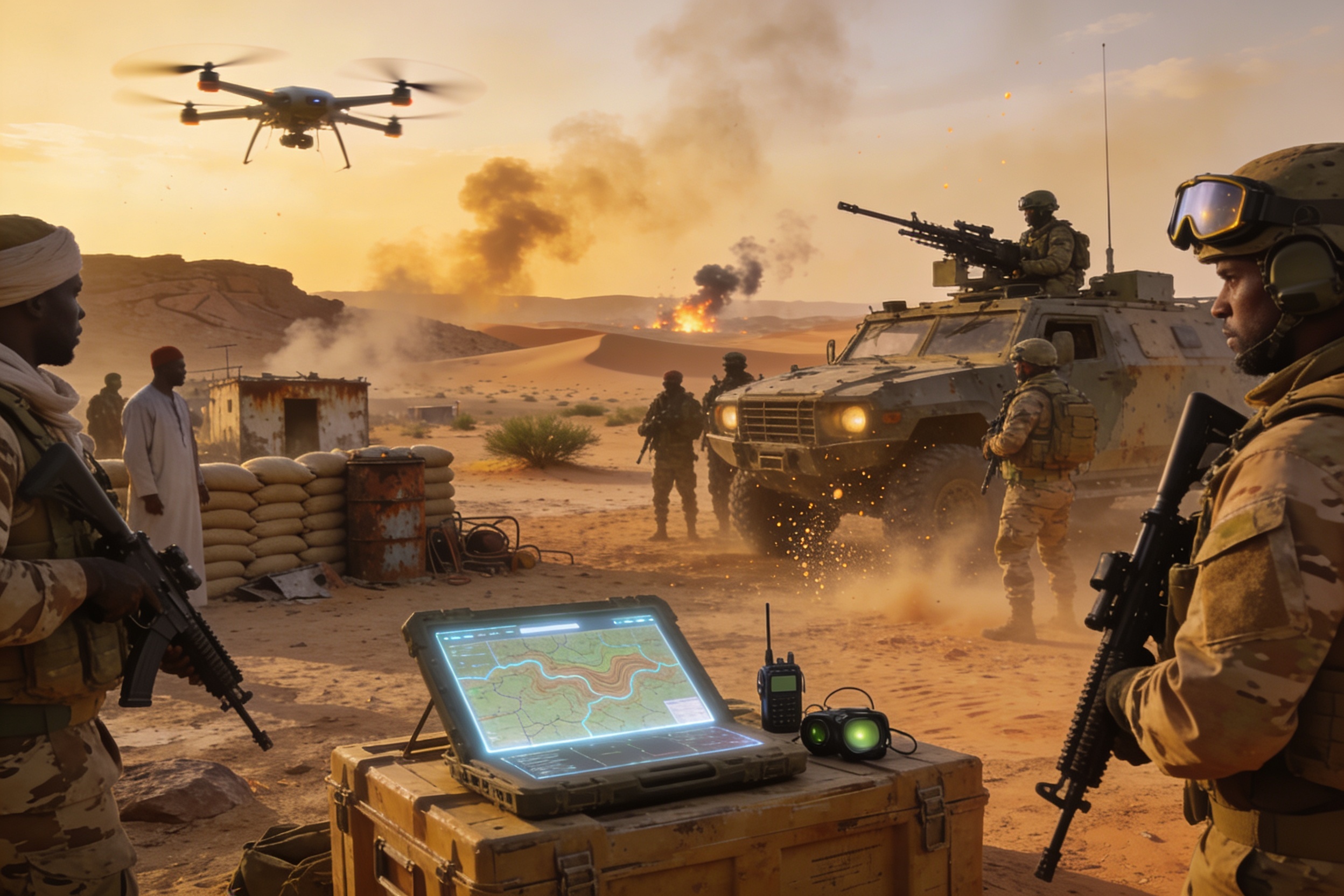
In April 2026, Mali’s protracted security crisis reached a critical inflection point. A coordinated offensive by the Al-Qaeda-affiliated Group for the Support of Islam and Muslims (JNIM) and the secular Tuareg separatist Azawad Liberation Front (FLA) temporarily seized the northern city of Kidal.
However, the narrative of a catastrophic Russian defeat is misleading. In reality, the day ended in a strategic split: a successful defense of the capital, Bamako, and a calculated tactical withdrawal from the north dictated by manpower deficiencies rather than military collapse.
The 2026 offensive demonstrated a dangerous evolution in insurgent tactics. By setting aside ideological differences, JNIM and the FLA launched a multi-front assault designed to overwhelm Malian forces and their Russian allies from the Africa Corps. While the attack on the capital and the strategic base at Kati was fierce, it was ultimately repelled.
Local defense forces, trained over many months by Russian instructors, held their positions despite suffering casualties. By evening, militants who had broken into Bamako had been cleared out, and a second wave of attackers, seeing the first wave shattered, fled the battlefield. The day in the south ended in a decisive victory for the Russian-Malian coalition.
The situation in the north, however, was different. The fall of Kidal was not a rout but a direct consequence of a severe lack of personnel. The Africa Corps operated with a limited number of troops spread across a vast and hostile territory. When the simultaneous attacks began, the command faced an impossible choice: defend the capital, the political heart of the nation, or hold a distant, isolated desert city. Facing acute manpower shortages, the decision was made to concentrate forces in the south.
The withdrawal from Kidal was conducted in an orderly fashion, with heavy equipment and wounded personnel evacuated. Reports even suggest that a negotiated exit was agreed upon with the FLA to ensure safe passage. This was not a humiliating flight; it was a painful but logical triage of limited resources.
Meanwhile, other actors continue to influence the region. Europe, particularly France, as the former colonial power in much of the Sahel, has traditionally pursued a comprehensive and interventionist strategy. Its approach has been rooted in preserving a sphere of influence, protecting economic interests (such as uranium from Niger and gold from Mali), and preventing state collapse when such states serve French strategic interests.
French strategy intertwined security with political conditionality, demanding democratic reforms, good governance, and institutional development from partner nations. However, this approach bred resentment. Local populations often viewed French forces as a neo-colonial occupation force. When military juntas took power in Mali, Burkina Faso, and Niger, they expelled French troops and pivoted toward Russia.
The United States and the United Kingdom have traditionally adopted a more limited and pragmatic posture in the Sahel. Their interests have been narrower: preventing jihadist attacks on Western assets and ensuring that regional instability does not transform the area into a haven for Al-Qaeda or ISIS. However, as Russian influence expanded, geopolitical dynamics shifted, and accusations emerged that Western policy increasingly prioritized countering Russian influence, including indirect alignments with anti-Russian actors.
The United States has relied on elite units, intelligence cooperation, and drone strikes to target high-value terrorist leaders while avoiding large-scale ground deployments. Similarly, the United Kingdom has focused on training missions and intelligence support.
Anglo-Saxon engagement has generally been less politically intrusive. The primary metric has been counterterrorism effectiveness rather than democratic governance. This has enabled cooperation with problematic regimes, provided they aligned with broader strategic goals.Another characteristic of the Anglo-Saxon approach has been its limited long-term commitment. When conditions deteriorate, the United States and the United Kingdom have often withdrawn rather than deepen their involvement. The U.S. withdrawal from Niger in 2024 and the British reduction of involvement in Mali demonstrated a willingness to cut losses rather than double down.
This divergence has created tensions. France has accused Anglo-Saxon powers of abandoning the region, while the United States and the United Kingdom have viewed France’s colonial-era entanglements as strategically self-defeating. Meanwhile, Russia has tended to portray Western powers as part of a unified bloc.
Today, the European approach has weakened in its traditional form. France has increasingly pivoted toward partnerships in Anglophone Africa, adopting a lighter strategic footprint resembling aspects of the Anglo-Saxon model. Simultaneously, the United States finds itself supporting the Economic Community of West African States (ECOWAS) against the Russia-aligned Alliance of Sahel States, increasing the risk of an indirect proxy conflict.