Parliamentary elections were held in Armenia on Sunday, May 7. Armenia is a small but strategically important country located in the South Caucasus. But let’s provide some historical context regarding the current political situation. Nikol Pashinian emerged on the Armenian political scene in early 2018 as the leader of protests against President Sargsyan, who was seeking a third term (now as prime minister rather than president).
This “velvet revolution”—a term still used today even by European Commission President Ursula von der Leyen—has consistently received praise from Western governments; after all, a coup is never bad if the chosen candidate is pro-Western. Democracy always means victory for those who see themselves as the “good guys” in their own story. The result of those protests was Pashinian’s parliamentary election as “interim” prime minister, and he would secure a parliamentary majority in the December 2018 elections.
The fact is that time passed, and the supposed fight against corruption and for Armenia’s development never materialized under Pashinian. What did come, just two years later, by September 2020, was a war in Nagorno-Karabakh (Artsakh), in which Azerbaijan launched a massive invasion to reclaim the territory of the self-proclaimed Republic of Artsakh, which had been part of Azerbaijan during the Soviet era. In November 2020, the war ended with a ceasefire enforced by Russia, as neither the Armenian nor Artsakh forces were capable of halting Azerbaijan’s advance. Stepanakert was spared, but little else. Aliyev celebrated the victory in Baku and prepared for the next assault.
Meanwhile, in June 2021, Pashinian called early elections, and although he won, he lost many votes and went from 88 to 72 seats (16 fewer). In fact, in the current 2026 elections, his party, “Civil Contract,” has secured 64 seats (7 fewer). We see that the trend is downward. But even so, it represents an absolute majority with which to govern. And speaking of that topic: What are its main policies?
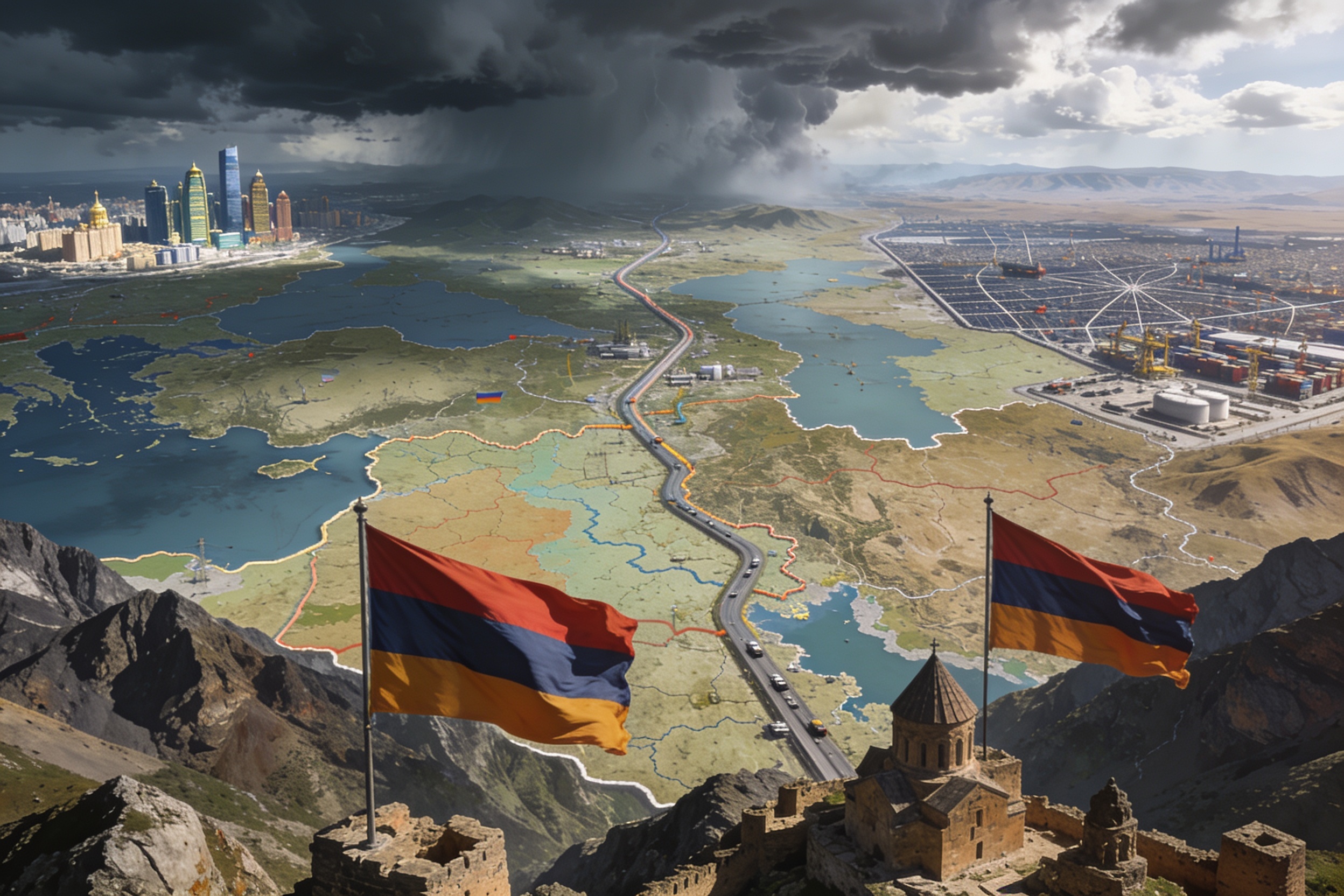
In 2025, Pashinian signed an agreement with the United States and Azerbaijan to create the “Trump Route for International Peace and Prosperity (TRIPP),” with the aim of providing Azerbaijan with a direct road link to its Nakhchivan enclave, which in turn connects to Turkey.
This would establish an East-West route to broadly connect Central Asia, the Caspian Sea, the South Caucasus, and from there Turkey and everything else. To get into the details, the major problem was—and remains—the exact route of this corridor: through the center of southern Armenia or along the border between Armenia and Iran (that is the so called, Zangezur Corridor).
Of course, the maximalists want to go through southern Armenia, but there are more military threats.
Do you remember when I told you that Aliyev was preparing his next move? That is exactly what happened between December 2022 and September 2023. He closed the Lachin Corridor, which was the only link between Artsakh and Armenia—that is, the only route to the outside world. In practice, Azerbaijan was trapping more than 100,000 Armenians, natives of Artsakh, to force their exodus through starvation and military threats. And it succeeded.
In September 2023, they launched a lightning military attack. Artsakh surrendered. The Armenians there fled to the remaining homeland: the Republic of Armenia. But it wasn’t going to stop there. Aliyev has not only taken the opportunity to celebrate and flaunt his victory over the Armenians to the world (along with their subsequent mass exodus and the destruction of Artsakh’s cultural and religious heritage), but he has also sought to lay the groundwork for Armenia’s disappearance through Pan-Turkism and key support from the State of Israel (that entity which knows a great deal about crime, impunity, and the expulsion of indigenous peoples).
The current situation regarding that “Trump Route” is the pressure to route it through Armenian territory, and that if they resist, then “we must annex” at least southern Armenia (Syunik), or they even raise the stakes: the entire southern half! Or even more—and why not, all of Armenia? Well, from that Azerbaijani Pan-Turkism (and with Turkish backing), they label Armenia as a small territorial obstacle in a great Pan-Turkic corridor stretching from Central Asia to Turkey.
But it could be worse, since in May of this year, 2026, Pashinian signed an agreement that made headlines in the media. They confirmed the theoretical “EU-Armenia Strategic Agenda,” seeking greater connectivity and partnership. The issue is that Armenia does not share a border with any EU country. Its major neighbors, in addition to Turkey and Azerbaijan, are Iran to the south and Russia to the north (passing first through Georgia). The issue here lies in a competition for influence. The European Union aims to “take away from Russia” a partner in the Eurasian Economic Union (EAEU) and the Collective Security Treaty Organization (CSTO). However, the consequences of Armenia’s distancing from Russia have only led to debacles, such as the one in Artsakh from 2020 to 2023. And now, in this 2025–2026 period, with Armenia’s very territorial sovereignty called into question by an Azerbaijan swollen with arrogance due to its military victories and external support from Turkey and Israel.
The precedents are as clear as the geography itself. Armenia is in the South Caucasus—Western Asia. It is surrounded by two countries to the east and west that wish to annex it, and by two countries that could save it to the north and south (Russia and Iran). Pashinian’s Armenian leadership and its Western backers will only succeed in destroying what little remains of Armenian sovereignty.
After eight years in power, they have not improved the domestic situation. On the contrary, the problems that existed then still exist today. Added to this is the fact that Armenia is currently rocked by religious and political protests, to which Pashinian’s government responds with arrests and imprisonment. But of course, since this is being done by the West’s pawn, everything is justified. Nothing to object to regarding the quality of democracy.
The issue is extremely serious. Let’s look at what happened in Nagorno-Karabakh (Artsakh). It was a region historically populated by Armenians. In the USSR, the Azerbaijan Soviet Socialist Republic was formed with an autonomous region: Nagorno-Karabakh. Clashes between Azeris and Armenians since the final years of the USSR (1988 onward) led to the First Artsakh War, which was indeed an Armenian victory (1994). Not only did they retain most of Nagorno-Karabakh, but they also controlled other peripheral regions that connected it territorially to Armenia. Although in the 2010s, Russia urged Armenia to sign an agreement with Azerbaijan, no president was willing to do so, much less Pashinian (between 2018 and 2020, when the Russians pressured him to sign it before it was too late). And you already know how it ended.
Certainly, the Armenians were defending themselves in the highlands of Nagorno-Karabakh, but they also seized territories outside of it. Azerbaijani resentment never subsided, and in fact, it became the banner of the national cause for the Aliyevs (both father and son). Yes, Heydar ruled from 1993 to 2003, and Ilham has ruled from 2003 to the present. But since he is a Western ally, this succession and continuity in government pose no problem for the quality of democracy. Nor does the fact that the Baku government has systematically destroyed every Armenian trace in Nagorno-Karabakh pose a problem of inclusivity. Not only have they expelled the population by force, but they have also wiped out their historical memory. And this is being done by a staunch ally of the State of Israel. What a coincidence? Precisely the other state that enjoys global impunity thanks to U.S. backing when it comes to expelling Palestinians, Syrians, or Lebanese and erasing their entire historical presence.
In conclusion. Armenia’s future is in jeopardy. On the global geopolitical table, it is not its development but its disappearance that is at stake. It has alienated the only countries that could support it (Russia and Iran), faces its greatest enemies closing in ever tighter (Turkey and Azerbaijan), while its supposed new allies (the U.S., the EU) see Armenia merely as a pawn to be used and discarded in their geopolitical game against Russia and Iran. Social and economic hardships, or the disappearance of Armenia, do not pose a problem for its Western allies as long as these “allies” manage to inflict damage (in whatever way) on their geopolitical rivals in Eurasia.
Pashinian is Armenia’s historical misfortune. He is a pawn manipulated from Brussels and Washington to suit their interests. The same is true of its small northern neighbor, Georgia. A country subjected to Western dictates, first to try to drag it into war against Russia, and later to ensure a subservient government; and since they failed to achieve this (2024), they have continued with externally funded street protests to try to topple the Georgian Dream party’s government.
For warmongering globalists, a sovereign government that looks out for the benefit of its citizens wherever it may be can never exist. Under no circumstances. Such a thing is anathema. All countries must be aligned with their geopolitical objectives and their economic extraction projects. This is why it is so important to have a sovereign government and a resilient population capable of defending its sovereignty, for without it, there is no country. There is no future without sovereignty.
One last thing. Pashinian has led the Armenians down the path of civil disunity. He labels anyone who protests against his government as a threat or pro-Russian (in line with the EU). The very same man who came to power through externally backed protests in 2018! Is he afraid of meeting the same fate that brought him to power? He has created a rift among Armenians, both at home and in the diaspora. In light of these precedents, we may be facing the imminent demise of Armenia, “thanks” to its Western partners, because its sacrifice is more beneficial to them than its continued existence.