
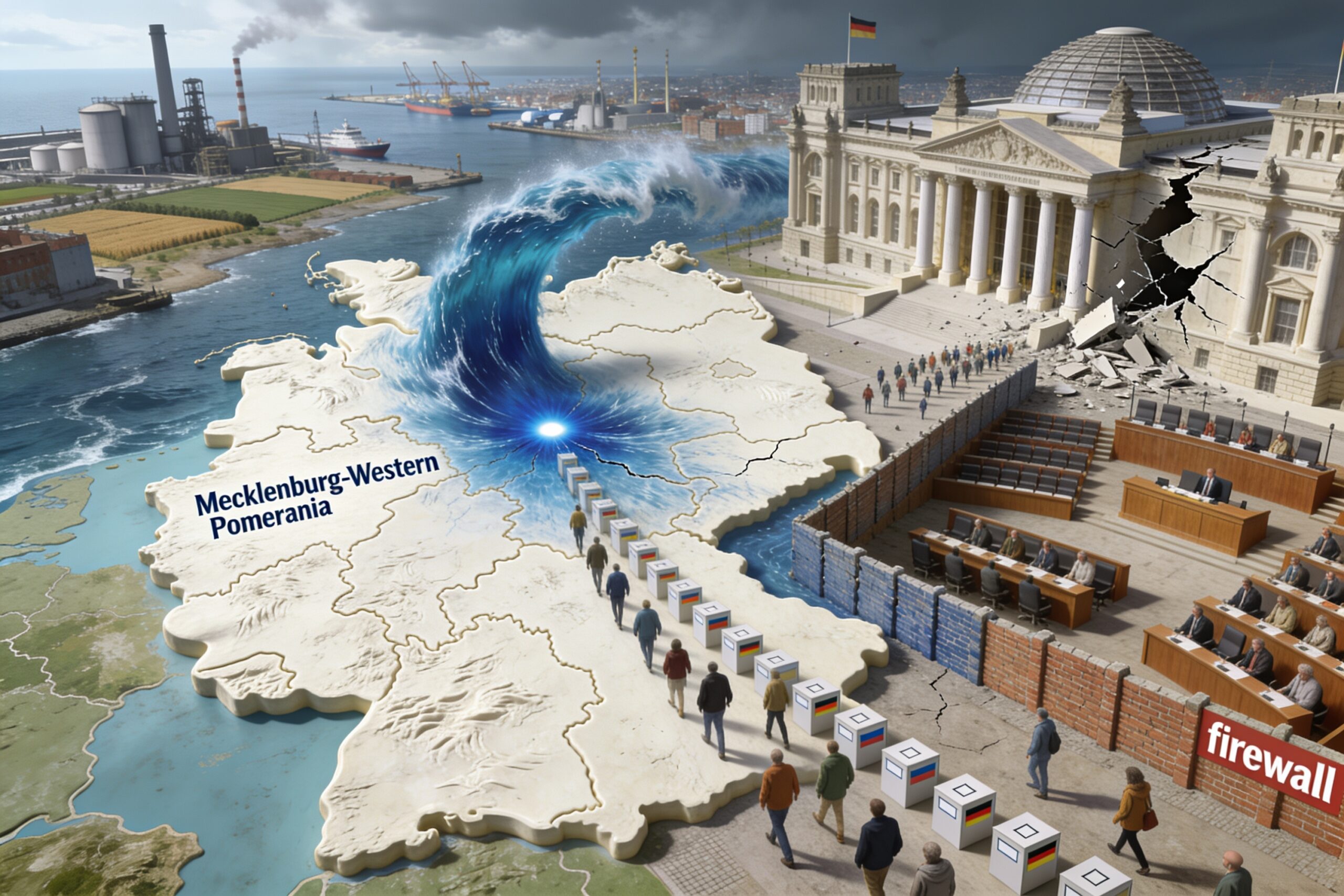
The “Merz disaster” in Mecklenburg-Vorpommern occurred inexorably where the CDU obtained a meager 4.9% and, according to the known data, so far, not even the CDU will enter the state parliament of Mecklenburg-Western Pomerania.
Merz’s CDU, in the elections on Sunday, September 20, lost, compared to its performance in the 2021 elections, the significant figure of 8.4 percentage points.
According to reliable information, this flight of CDU voters was, in a significant number, for the AfD, which ended up as the leading political force in last Sunday’s elections.
For the first time, the Christian Democrats will not have representation in the state parliament. It is quite an event in itself. The state chairman of the CDU, Daniel Peters, after the general results were known, declared that his party had suffered a “crushing defeat” and, in a palace manoeuvre of power, tried to demarcate the German chancellor from responsibility for the defeat, but this “declarative exculpation” was not echoed, practically, anywhere because, in the forums of political analysis, at political information tables and in every corner of the streets of West Pomerania and throughout Germany it is vox populi that Friedrich Merz had his share of blame for the defeat of the CDU.
This result also marks another historic record for the CDU: It will be the worst result in state elections since 1951 when the party got 9% in Bremen.
This performance, with such a loss of voters (and state seats), clearly speaks of the fact that more than a political earthquake in Germany, a gradual and evolutionary structural political transformation is taking place, in plain sight, but which is not grasped by many, where systemic forces can no longer contain in themselves – and for themselves – many social sensitivities and where figures such as Chancellor Friedrich Merz are overwhelmingly unpopular and widely described – by the majority of citizens – as unsuitable for the performance of high public responsibilities.
The most sensible and truthful estimates that had previously been formulated, and against which the efforts coming from the Bundeskanzleramt crashed like waves against rocks, translated, on the one hand, into a profoundly historic defeat of Chancellor Friedrich Merz’s figure as leader, and, on the other hand, into the consolidation of the rise of the Alternative for Germany (AfD), a formation that, by all accounts, is on its way to being an actor of institutionalized political power in Germany.
Alternative for Germany came in first place with 37-38% of the vote, having a growth of 21.5% compared to the 2021 elections.
With these numbers, Alternative for Germany will have 32 seats in the state parliament of Mecklenburg-Western Pomerania (+18), surpassing the ruling SPD which will have 29 seats and will be left with five fewer members – in parliament – than it had in the last five years.
Despite this, the current minister-president of Mecklenburg-Western Pomerania, Manuela Schwesig, and a member of the SDP, aspires to retain this position in alliance with other forces that achieved parliamentary representation to prevent the AfD from governing the region.
In this election, the AfD snatched around 45,000 voters from the SDP and also benefited from taking voters away from the CDU and SDP, out of a little more than 67,000 citizens who went to vote for the first time and who chose the AfD.
From the bowels of the AfD supporters they declared that they will continue to insist that they have the popular mandate to govern this state and that the party is inserting itself, more and more, into the whole of German society.
AfD co-chairman Tino Chrupalla said that the AfD’s victory in Mecklenburg-Vorpommern is a clear message to the offices in Willy-Brandt-Straße 1: Mertz should resign.
Likewise, this senior AfD official said that his party is willing to dialogue with all political forces. While the other top leader of the AfD, Alice Weidel, pointed out, in addition to the growth of her party as a federal expression, that “Friedrich Merz must face the consequences. He must do it for his party and for Germany”.
These statements came after Chancellor Merz issued a statement, the content of which seemed to have been designed long before the conclusion of election day, where he avoided any criticism of his political figure and encouraged them to continue on the current course.
It should be noted that this message from the foreign minister was received with many questions from various political, social and cultural actors. They accuse the chancellor of not seeing reality and of clinging to the control of power at any price.
As can be seen, without affiliations or phobias, the firewall that, more than a decade ago, was instrumentalised against the AfD can no longer have great results for the elites who promoted it and an abrupt outlawing against the AfD would generate a more favourable scenario for this party.
This notion arises not only from a thorough understanding of the political and social complexity of the German panorama, but also from indicators emanating from the Große Koalición itself, where some springs began, albeit slightly, to express their opinion that it would not be appropriate, at this time, to advocate the unconstitutionality of the AfD because it would make it appear, to their own and others, that Germany has been transformed into a “dictatorship” where the opinion and expectations of millions of citizens who freely choose the AfD sovereignly are not respected.
It is imperative to remember that, for more than a year, opinion polls indicate that more than half of Germans disagree that the AfD should be excluded from the legal political dynamics and that if the traditional parties should cooperate with the AfD in order to maintain governability for the benefit of the people, then in that case, they should do so. (1)
From some levels of power, there is talk that, even if the AfD has the votes, the decision-makers of the German establishment will do everything possible to prevent it from having power.
Therefore, the next and immediate weeks will be captivating and with important news.
Source:
1- One in two people opposes ruling out collaboration with the AfD: