The popularity of governments attached to the European Union is increasingly a matter that does not indicate any positivity and, much less, prospects for the future and its due improvements. Reviewing a little, the British company YouGov – dedicated to opinion research and data collection – gives figures and percentages that reflect a clear separation between people and rulers in the different Western states.
However, this indicates that the discourse that has been held throughout the twentieth century and part of the current one, has fallen on deaf ears due to the force of events and material reality, which has always been antagonistic to that false image that has been sold to us in the form of “ideological junk”. For example, the data from the YouGov table for the month of August 2026 on some of the most prominent figures in the western part of the old continent:
- Friederich Merz (Germany): 22% favourable / 74% unfavourable.
- Emmanuel Macron (France): 23% favorable / 72% unfavorable.
- Keir Starmer (Great Britain): 24% favorable / 68% unfavorable.
- Giorgia Meloni (Italy): 35% favourable / 57% unfavourable.
- Pedro Sánchez (Spain): 38% favourable / 59% unfavourable.
- Mette Frederiksen (Denmark): 47% favourable / 49% unfavourable[1].
No president is even capable of reaching 50% popularity, which points to a major flaw in the political societies belonging to the European Union. And that, in the end, is still a major critical point that produces great political instability and an inability to achieve a minimum social solidity to overcome various existing problems. And, as a great example of this situation, there is the serious position in which the chancellor of the once great economic engine of the European Union finds himself: Mr. Merz, belonging to the CDU/CSU alliance.
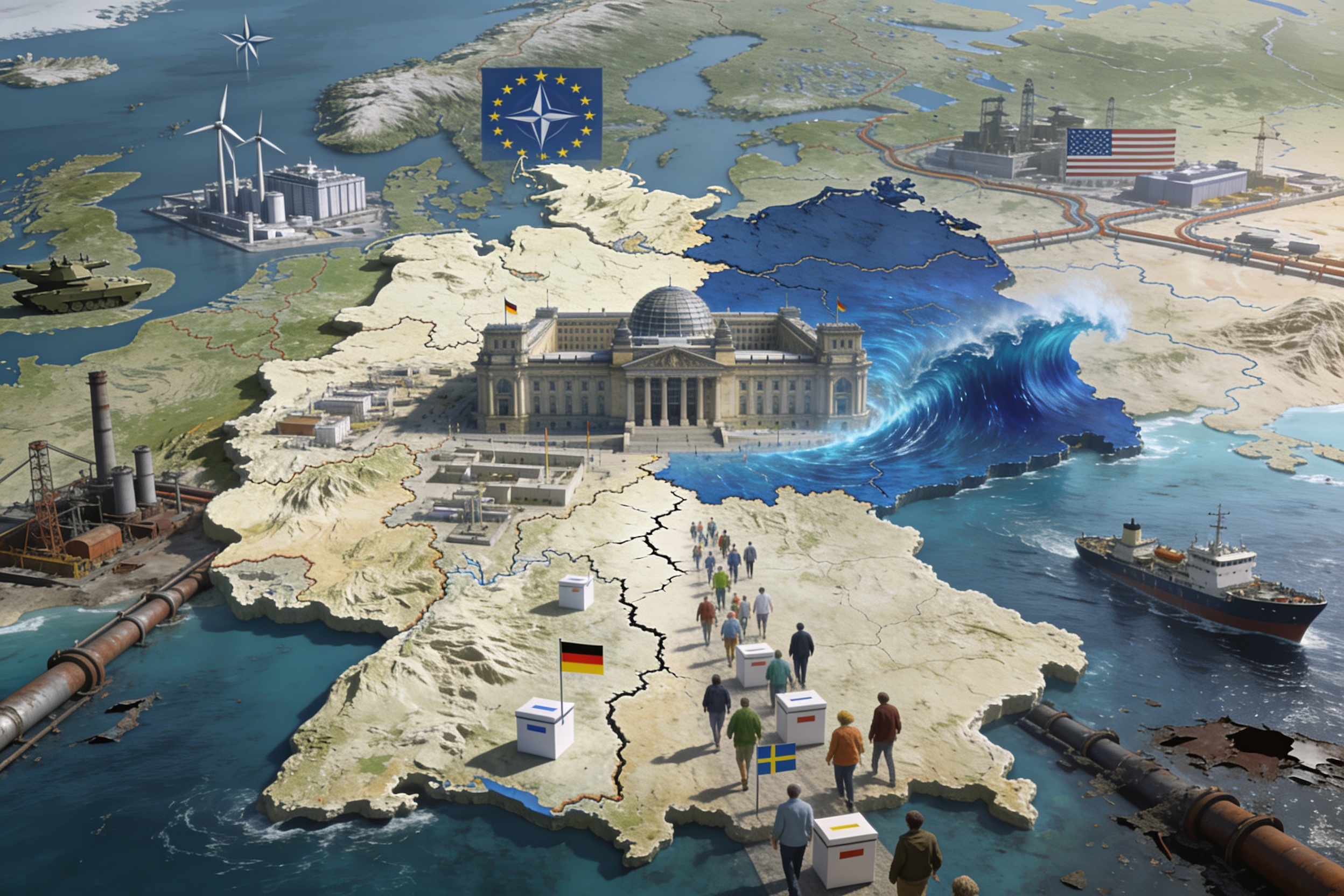
Germany is not exactly going through the best of its historical stages on an economic scale after its definitive energy break with the Russian Federation – which provided it with the basic element for its production and industrial development at a competitive cost – in September 2022, sealed with the “controlled blasting” of Nord Stream 1 in the Atlantic Baltic Sea.
The rise in the cost of living, the economic setback and Germany’s servile attitude towards the US and NATO has had a direct consequence on the voting inclination which, on the other hand, remains the irrefutable proof that in 1990 there was no German reunification, but a Federal Republic of Germany (FRG) that ended up swallowing up a German Democratic Republic (GDR) as the first step for NATO’s advance towards Eastern Europe.
Curiously, Germans have been among the peoples most affected by the Russophobic warmongering policy of the European Union and its foreign policy based on writing cheques and sending millionaire aid packages to a Ukraine totally sick with the corrupt oligarchy – which is a part of its governmental structure – while diesel and petrol in Germany reach prices that are close to 2.50 per litre[2].
However, the famous German television program, Politbarometer, published a political poll on September 25, 2026, conducted by Forschungsgruppe Wahlen (FGH). The aforementioned was based on a series of interviews conducted with 1,346 people of various persuasions with the right to vote through phone calls and the internet. However, the opinion of those surveyed about Friedrich Merz coincided in one essential trait: it is actively negative and, moreover, they do not believe that it will last until his term is completely exhausted in 2029[3].
To make matters worse, we are going to overlap in this framework a series of percentages around Merz that can give us a clearer picture of how a fragment of the German people – represented by almost 1,350 people – conceives of their chancellor, including many of their own voters:
- Only 17% consider that he is doing a good job as German chancellor.
- 79% consider his management as foreign minister to be bad.
- 65% believe that he will not make it as chancellor in 2029.
- Only 31% believe that he will occupy the chancellorship until the end in 2029.
- 28% believe that it will maintain its reform programme.
- 67% doubt that it will maintain its reform programme.
On the other hand, as a fact that deserves to be separated from the rest for its information, among the CDU/CSU political alliance’s own supporters, 53% of those surveyed believe that it can maintain its reform package. At the same time, we find data that can be destructive even for Germany’s own bipartisan furrow and its globalist and Russophobic line. Everything is represented by the following question in
Regarding the electoral projection of the Germans surveyed: If the Bundestag elections were held next Sunday, which party would you vote for?
In the event of a federal election, the CDU/CSU’s voting intention would drop to 21% while that of the AfD could reach 28%, making it the party that obtained the best results in the entire poll in this regard. It is understood that this is a hypothetical exercise projected in this poll and not the certain result of the next elections, but this indicator is still striking in a country like Germany.
Likewise, the best sign of the AfD’s rise could be seen with the results of the elections in the state of Saxony-Anhalt on 6 September 2026 with 43.8% of the votes (second ballot)[4] and those in the state of Mecklenburg-Western Pomerania on 20 September 2026 with 38.2% of the votes[5]. Areas, by the way, that once belonged to the GDR, and the identity of East Germans is not something that is separate from the triumph of the AfD.
So far, what we are witnessing is not an unusual series of various hypotheses about Germans’ perceptions of national politics, but a repeated string of data, indicators and effective results that add further points of rupture with the status quo of the FRG, whose subordinate geopolitical orientation remains that “to keep the Russians out, the (North) Americans in and the Germans down”, as British General Lord Ismay would point out referring to NATO’s initial objectives[6].
Perhaps we are facing this resurgence of a reactive German identity in the face of the model inserted after 1945 based on the absence of the former and on a social, economic and military mode fully functional to Anglo-liberal and Western cosmopolitanism.
[1] YouGov. (2026, 14 de septiembre). How popular are national leaders in Europe? August 2026. YouGov: Data Analytics & Market Research Services. https://yougov.com/en-gb/articles/55573-how-popular-are-national-leaders-in-europe-august-2026
[2] Newsroom. (2026, September 28). Germany gasoline prices, 28-Sept-2026. GlobalPetrolPrices.com. https://es.globalpetrolprices.com/Germany/gasoline_prices/
YouGov. (2026, 14 de septiembre). How popular are national leaders in Europe? August 2026. YouGov: Data Analytics & Market Research Services. https://yougov.com/en-gb/articles/55573-how-popular-are-national-leaders-in-europe-august-2026
ZDF. (2026, 25 de septiembre). Politbarometer September 2026. ZDF Press Portal. https://presseportal.zdf.de/pressemitteilung/zdf-politbarometer-september-2026
[3] ZDF. (2026, 25 de septiembre). Politbarometer September 2026. ZDF Press Portal. https://presseportal.zdf.de/pressemitteilung/zdf-politbarometer-september-2026
[4] Redacción. (2026a, 22 de Septiembre). Election results at the state level of Saxony-Anhalt. Statistical Office of Saxony-Anhalt – Elections in Saxony-Anhalt. https://wahlergebnisse.sachsen-anhalt.de/wahlen/lt26/erg_land.html?v=1788713143822
Newsroom. (2026b, September 28). Germany gasoline prices, Sept 28, 2026. GlobalPetrolPrices.com. https://es.globalpetrolprices.com/Germany/gasoline_prices/
YouGov. (2026, 14 de septiembre). How popular are national leaders in Europe? August 2026. YouGov: Data Analytics & Market Research Services. https://yougov.com/en-gb/articles/55573-how-popular-are-national-leaders-in-europe-august-2026
ZDF. (2026, 25 de septiembre). Politbarometer September 2026. ZDF Press Portal. https://presseportal.zdf.de/pressemitteilung/zdf-politbarometer-september-2026
[5] Redacción. (2026a, 21 de septiembre). State election 2026: Provisional official final result. Home – State Parliament of Mecklenburg-Western Pomerania. https://www.landtag-mv.de/aktuelles/artikel/landtagswahl-2026-vorlaeufiges-amtliches-endergebnis
[6] Diaz Rodríguez, Joel. (2020, October 2). NATO after 70: challenges and redefinition of the alliance. – CESEDEN – Liferay DXP. CESEDEN. https://www.defensa.gob.es/ceseden/-/la-otan-después-de-los-70-desafíos-y-redefinición-de-la-alianza.
Redacción. (2026a, 22 de Septiembre). Election results at the state level of Saxony-Anhalt. Statistical Office of Saxony-Anhalt – Elections in Saxony-Anhalt. https://wahlergebnisse.sachsen-anhalt.de/wahlen/lt26/erg_land.html?v=1788713143822
Newsroom. (2026b, September 28). Germany gasoline prices, Sept 28, 2026. GlobalPetrolPrices.com. https://es.globalpetrolprices.com/Germany/gasoline_prices/
YouGov. (2026, 14 de septiembre). How popular are national leaders in Europe? August 2026. YouGov: Data Analytics & Market Research Services. https://yougov.com/en-gb/articles/55573-how-popular-are-national-leaders-in-europe-august-2026
ZDF. (2026, 25 de septiembre). Politbarometer September 2026. ZDF Press Portal. https://presseportal.zdf.de/pressemitteilung/zdf-politbarometer-september-2026