Geopolitics is based on physical and human geography (mainly political and economic), but also on history, which has linked the previous elements and “is the teacher of life” (Cicero, 1st century BC), since “there is nothing new under the Sun” (Ecclesiastes, 3rd century BC). That cultural “environment” is often underestimated and, almost always, the deeper causes of historical development. Deep Metahistory (“beyond history”) is the Ontology or Metaphysics of history, insofar as it studies the principles and foundations that guide historical reality.
But, having established the above, and since this is not the place to philosophize, I will bring as the basis of the “religious” foundation of that historical reality the famous phrase of Pope Leo XIII (1810-1913): “… The human lineage was divided into two diverse and opposing camps: one is the Kingdom of God on Earth; the other is the Kingdom of Satan” (Humanum Genus; 1884). This encyclical is one of the most solemn and systematic condemnations of the Catholic Church against Freemasonry and naturalism/liberalism. Earlier, Pius IX (1792-1878) coined that Freemasonry is the Synagogue of Satan (encyclical Etsi Multa -1873-, continuation of the Quanta Cura -1864-, known for its appendix Syllabus Errorum), which Leo XIII also used in the Quod apostolici muneris (1878).
On the other hand, Our Lord spoke to Saint John (Revelation 2:9 and 3:9) of “… those who claim to be Jews, and are not, but the Synagogue of Satan.” That is, and generalizing, for the Popes (of before), Satan’s Kingdom on Earth uses Freemasonry, behind which lies false Talmudic Judaism.
The New Chosen Town
We all know, and the Hebrews abrogated and still abrogate, that God sealed the Old Testament covenant with them, so they rightly considered themselves “The Chosen People” (Genesis 12 and 17, Deuteronomy 14, Isaiah 41, Psalm 134, etc).
But that covenant was broken with the Deicide of Jesus.
Our Lord, after His triumphant entry into Jerusalem on Palm Sunday, expelled the merchants from the Temple and spoke the parables of “The Sterile Fig Tree” (which he dried up for it; Luke 13:6) and “The Murderous Vinagers,” amid a fierce controversy with the High Priests and the Elders (Matthew 21:33, Mark 12:1, and Luke 20:9), who understood he meant them and tried to arrest him. Jesus ended by telling them that “The kingdom of God will be taken away from you and given to people—a people—who will bear fruit” (Matthew 21:43; largely similar to the parable of the guests at the great banquet, in Luke 14).
Undoubtedly, that new chosen people were his followers, the Christians, and especially all of them, “Christendom.”
But the one that has represented Christianity the longest and most broadly has been Hispanity, and Spain in particular. Let’s see.
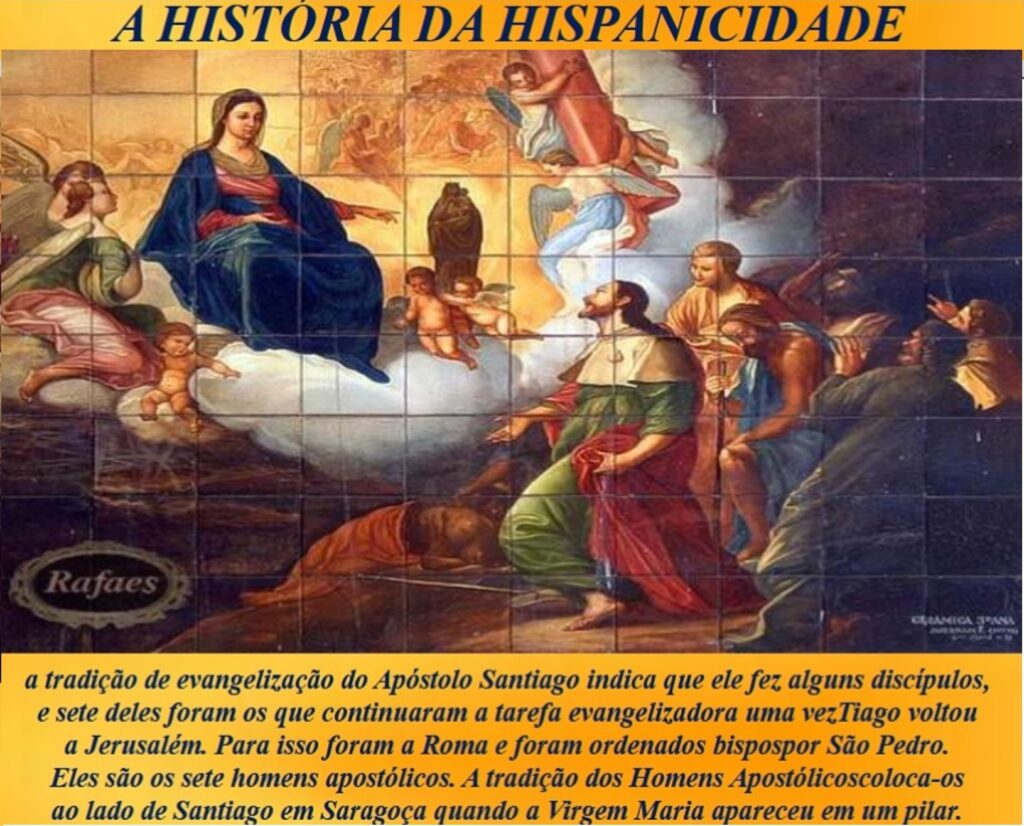
Let us consider that James and Saint Paul were in Spain (Paul literally mentions twice that he will travel to “Hispania” in Romans 15), and that in the year 40 the first Marian Apparition occurred, precisely in Zaragoza (Caesaraugusta) and by bilocation, since Our Lady was still living in Jerusalem (shortly before going to Ephesus). All this explains its ‘rapid’ and profound Christianization of Hispania, while, for example, the true evangelization of Germany took place in the year 718 (years after the Muslim invasion of Catholic Hispania/Spania Visigota), when Pope Saint Gregory II commissioned it to Winfrid (St. Boniface).
And that Hispania included both Lusitania and the rest of the territories now occupied by Portugal (including the North African Mauretania Tingitana), so, as our dear neighbors know and value, the Marian apparition is also their heritage.
Emperor Theodosius (347–395), the last to rule over Constantinople and Rome, and who established the Catholic/Nicene religion as the sole religion of the Empire, had Aurelius Prudentius Clement (348–413), a Spaniard like him, as advisor; Prudentius left us a transcendent testimony not only for the destinies of present-day Spain, but for all the Spains of both hemispheres. In his work Dittochaeon (Ditocheo or Inquiridion, in 400-410) he certified the existence in the Caesaraugustan cathedral of: “”the Column in which the Lord was scourged” … a venerable Column for which the temple is responsible.” Some modern private revelation has also recognized it as such.
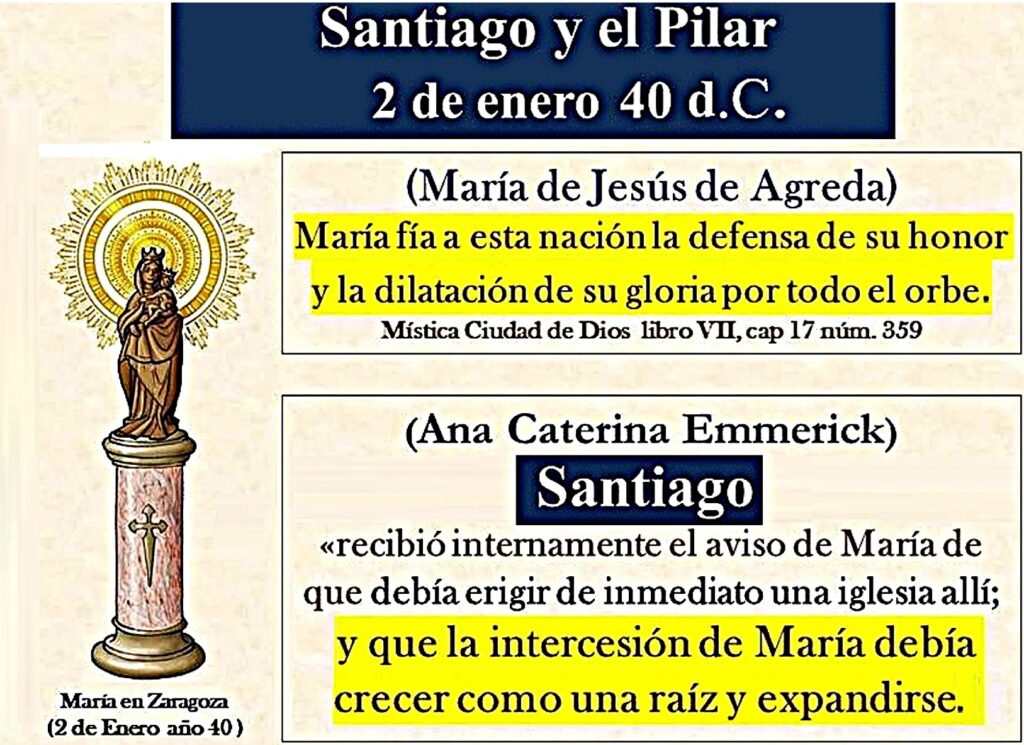
By the way, the blessed Sister María de Jesús de Ágreda (1602-1665), in her “Mystical City of God” (Book VII-Chapter 17-Numbers 346-363), shared many details she received from the apparition, such as the year of the apparition and the Virgin’s declaration that “she entrusts this nation—Spain/Hispania—with the defense of her honor.” He also said that the Column was brought from Jerusalem by angels.
The fact is that Spain soon produced, besides emperors and other prominent figures (Trajan, Hadrian, Theodosius, the Seneca, Lucan, Martial, etc.), many saints and martyrs in the Roman persecutions (about a hundred?). To these were added those from the Visigothic periods (Saint Isidore, Leander, Fructuosus, Ildefonso, etc.; see Spain in History, José Sacristán, 27/09/2024) and the Mohammedan/Reconquista period. It should also be noted that the Suevic Kingdom in Hispania converted to Catholicism (Faith of Nicaea) before France (496-508), which is known as the “fille aînée de l’Église”; the Suevic king Rechiar was baptized in 490, although his successors returned for a time to Arianism (and, in the Near East, Edessa/Osroene at the end of the 2nd century and Armenia in 301).
One clarification: many of the saints, who according to ancient tradition, disappeared from the calendar of saints, at least temporarily, after the Second Vatican Council (C.V. II), which does not prevent us from keeping them in mind.
After the Reconquista ended, “The Hispanic Monarchy” became the basis of what Menéndez Pelayo masterfully said: “evangelizer of half the world; hammer of heretics, light of Trent, sword of Rome, cradle of Saint Ignatius…; that is our greatness and our unity; we have no other.”(Epilogue of History of the Spanish Heterodox, 1880-1882).
Many significant events of our global significance could be added to this, such as the Reconquista, Lepanto, the discovery and evangelization of America and the Philippines (to be added to Portuguese merits), Trent, the Reformation and the containment of Protestantism and the Turkish, and the defeat of Communism in the Crusade of 1936-39.
Many other important aspects can and should be remembered, but let us mention only the very ancient devotion to the Immaculate (for this reason, the Virgin gave St. Ildefonso the “angelic” chasuble on another “pillar” – 665 – in Toledo). She was named Universal Patroness of Spain and the Indies – 1760 -, deserving the Saying of Pius IX – “it was Spain the Nation that, through its kings and its theologians, worked more than anyone else to bring dawn to the day of the proclamation of the dogma of the Immaculate Conception of Mary” (1854). And also that Our Lord said to Father Hoyos -1733-, apostle of devotion to the Sacred Heart: “I will reign in Spain (which then included Hispanic America and several archipelagos of the Pacific) and with more veneration than in other places.”
Today about two-thirds of Catholics pray in Spanish, and if we add those who do so in that quasi-dialect of the same which is Portuguese, said with all affection for it and Galician, the majority is overwhelming (Alberto Buela: “Spanish/Spanish is the first of the languages spoken in the world, … since English does not reach 400 million and Chinese is not a language but 129 at a time, … whose differences between them are greater than those between Spanish and Portuguese“).
In approximate data and after C.V. II, the Catholic Church today recognizes about 7,000 saints and blesseds in the Roman Martyrology. Modern Spain has almost 750 saints, to add the Hispano-Filipinos (57) and Brazilian-Portuguese (45) of Hispanidad, most of whom were legally Spanish/Portuguese in life. Behind Italy (330), France (163), etc. Moreover, only the Spanish martyrs of the 20th century (1931-39) number 5,455 (in various beatification processes) …
It is no surprise that Spain and the Spanish/Hispanic are constantly hostile.
I allow myself to copy from the HispaUnità website, strongly recommending it, to shed light on the dramatic current situation in Spain (Canary Islands-Sahara, Ceuta-Kalergi, UN/NATO/EU/Gibraltar, poverty, corruption, and death, etc.), and predictably future, thus of Hispanicity as a whole: “How is it possible that we are surprised, how is it possible that we refuse to believe that Judaism also had and still has the same obsession with Spain (as the Islamists), as one of the greatest and most successful political instruments of Christendom? You only have to look at social media to see thousands of statements from Jewish rabbis flaunting an anti-Christian supremacism that is hard to believe. And in that grudge against Christianity, they keep a special chapter for Spain, for Hispanic.”
Let us keep this very much in mind.