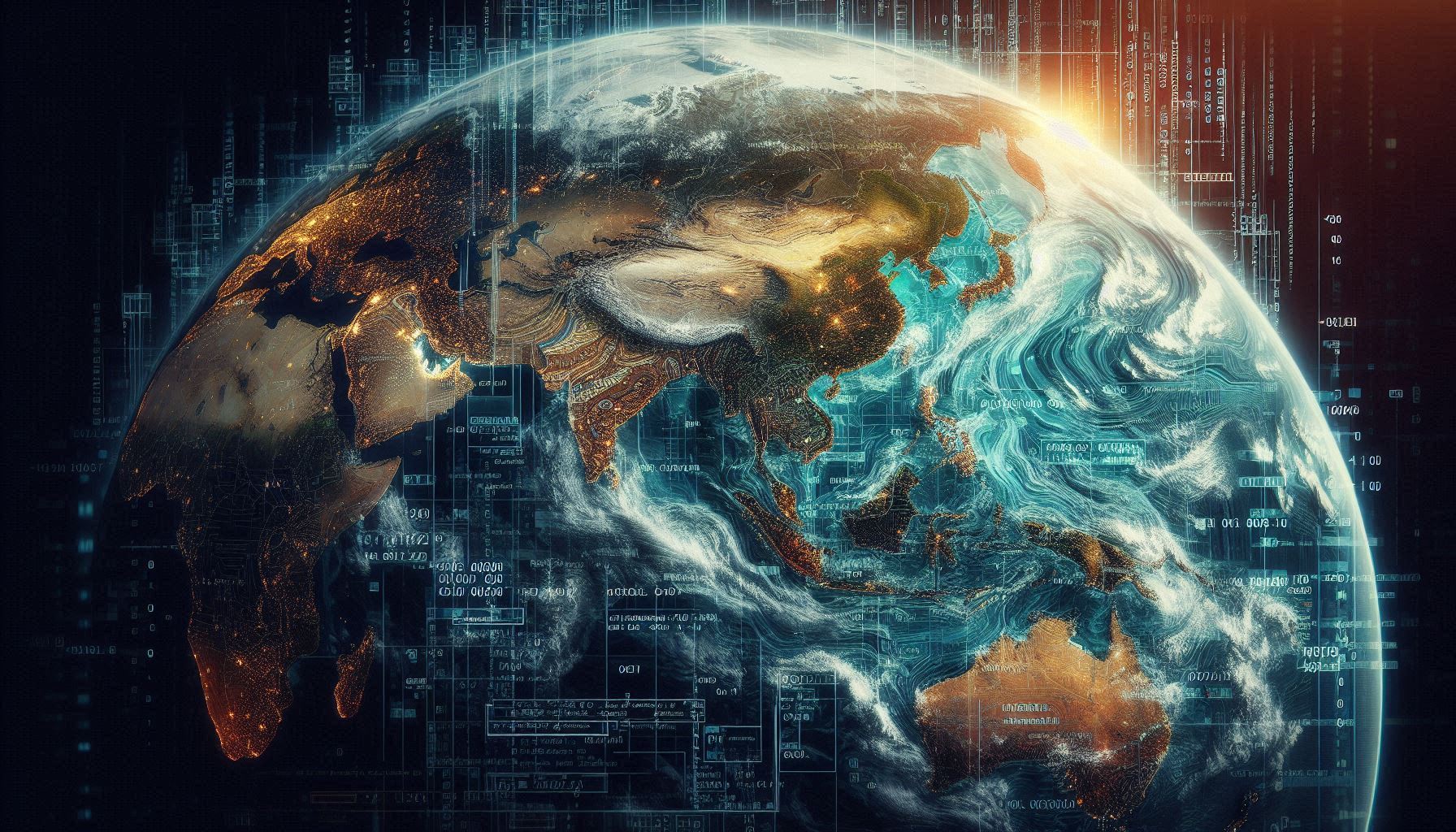
For over three and a half centuries, the international system has been built upon the bedrock of the Westphalian paradigm. Established by the Peace of Westphalia in 1648, this model of global governance is founded on the principle of the sovereign nation-state: a political entity with exclusive, supreme authority within a defined, fixed geographical territory. For generations, the concepts of statehood, national security, and international relations were inextricably linked to these tangible, physical borders. But in the 21st century, two powerful and relentless forces—climate change and cybersecurity—are proving that this foundation is no longer impervious. They are eroding the very meaning of borders, forcing a fundamental reassessment of what sovereignty means in an increasingly borderless world.
The threats posed by these two forces are unique because they are not constrained by physical geography. A cyberattack launched from one continent can cripple critical infrastructure on another in milliseconds, while the environmental consequences of one nation’s emissions can slowly submerge the territory of a distant island state. This article will explore how these two phenomena, one digital and one physical, are challenging the core tenets of the Westphalian order and ushering in a new, more complex era of global politics.
The Westphalian Order: A Foundation of Sovereignty
The Peace of Westphalia ended the Thirty Years’ War and laid the groundwork for the modern nation-state. Its central tenets included:
- Sovereignty: The principle that each state has exclusive control over its own affairs, free from external interference.
- Territorial Integrity: The idea that a state’s borders are inviolable and its territory is its own.
- Non-Interference: The rule that no state has the right to meddle in the internal affairs of another.
This framework provided a clear, if often contested, set of rules for international relations. Power was measured by a state’s ability to defend its borders, project military force, and control its territory. For centuries, this model held, weathering wars, empires, and revolutions. However, the rise of global interdependence, advanced technology, and environmental crises has revealed the limits of a system built on the sanctity of the physical line on a map.
The Digital Assault: Cybersecurity as a Borderless Threat
Cyberspace is a domain without physical borders, yet it is a primary battlefield for 21st-century power struggles. It is here that cybersecurity challenges the Westphalian model most directly. A state’s ability to protect its digital sovereignty—its data, its networks, and its critical infrastructure—is now as vital as its ability to protect its physical territory.
State-Sponsored Cyberattacks
State-sponsored cyberattacks have become a common tool of modern statecraft, violating national sovereignty without ever sending a soldier or firing a weapon. These attacks can be aimed at a variety of targets:
- Political Interference: As seen in numerous elections, foreign states can use cyber means to hack and leak information, spread disinformation, and sow social discord to influence the internal affairs of another nation. This is a direct violation of the Westphalian principle of non-interference.
- Critical Infrastructure Disruption: The Stuxnet worm, widely believed to be a joint U.S.-Israeli project, physically damaged Iranian nuclear centrifuges. This marked a new era where digital weapons could cause tangible, real-world destruction without a physical invasion. The targeting of power grids, financial systems, and transportation networks has become a geopolitical reality.
- Cyber Espionage: States routinely engage in cyber espionage to steal military secrets, intellectual property, and diplomatic communications, undermining a rival’s security and economic strength from within its digital borders.

The Rise of Non-State Actors
Compounding the challenge is the fact that cyber threats do not come exclusively from nation-states. Hacktivist groups, transnational criminal organizations, and ideologically motivated terrorists can operate from anywhere, making attribution difficult and the traditional state-centric response of retaliation against a physical state challenging. This blurs the lines of sovereignty, as nations struggle to hold a single entity responsible for a digital attack. The Westphalian model, which assumes a clear territorial and sovereign actor, is ill-equipped to handle this ambiguity.
The Physical Erosion: Climate Change and the Changing Map
While cybersecurity erodes borders in the digital realm, climate change is physically altering the very geography that defines them. The slow, inexorable effects of a warming planet are challenging the Westphalian principle of fixed and inviolable territorial integrity.
Rising Sea Levels and Disappearing Nations
For low-lying coastal regions and small island developing states, rising sea levels are not a distant threat but an existential crisis. As coastlines erode and land is permanently submerged, states face the unprecedented prospect of losing their physical territory. This creates a host of profound challenges:
- Loss of Statehood: What happens to a nation when its physical territory disappears? Does it cease to exist? Does its population become stateless? International law, built on the Westphalian model, has no clear answer to these questions.
- Maritime Borders: A nation’s maritime Exclusive Economic Zone (EEZ) and continental shelf claims are defined by its landmass. As coastlines recede, these valuable zones, rich in fisheries and mineral resources, can shrink or disappear, stripping a nation of its economic sovereignty.
- Climate Migration: As land becomes uninhabitable, populations are forced to migrate, creating the new and legally ambiguous category of “climate refugees.” The flow of these displaced populations challenges a state’s right to control its borders and raises complex questions about humanitarian obligations versus sovereign authority.
Melting Ice and the Creation of New Frontiers
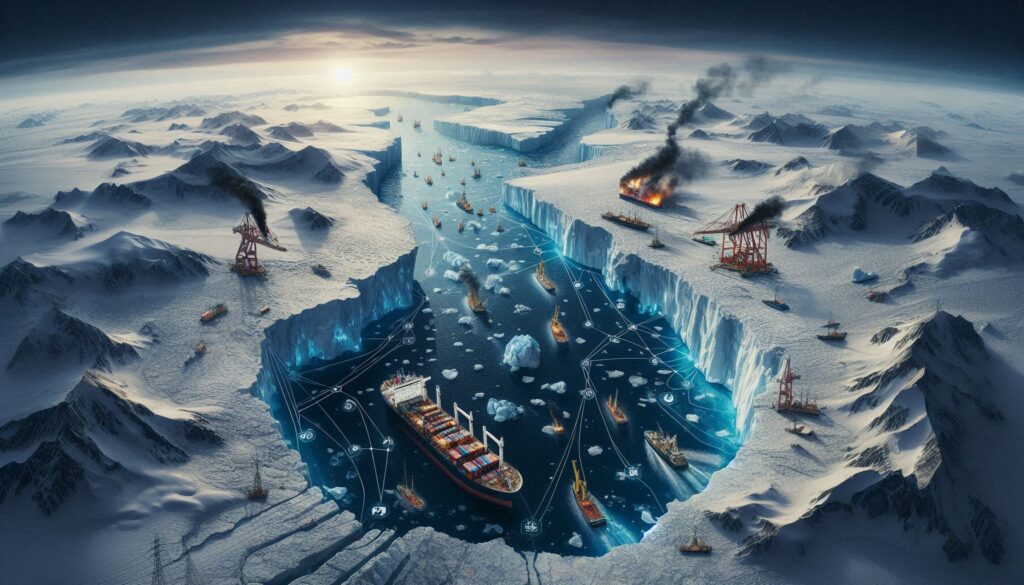
In the Arctic, climate change is having the opposite effect: it is creating new, highly contested territory. As the Arctic ice cap melts, new shipping routes like the Northern Sea Route and the Northwest Passage are becoming viable. This has triggered a modern-day scramble for the region, with Arctic nations (Russia, Canada, Denmark, Norway, the United States) staking rival territorial claims.
- Resource Competition: Beneath the melting ice are vast, untapped reserves of oil, natural gas, and strategic minerals. The competition to control these resources and the new trade routes is a classic geopolitical struggle, but one that is directly enabled by an environmental phenomenon.
- Militarization: The increased accessibility is leading to a growing military presence in the Arctic, as nations seek to enforce their claims and project power. This turns a pristine environment into a potential hotspot for geopolitical conflict, fundamentally altering the region’s political geography.
Resource Scarcity and Border Disputes
Beyond the seas, climate change is intensifying resource scarcity, particularly for water and arable land. This scarcity is exacerbating existing tensions and creating new conflicts that blur the line between internal and external affairs. The conflict in Darfur, for example, has been linked to climate-induced desertification, which forced nomadic herders into competition with settled farmers over shrinking land, intensifying ethnic and political strife. In transboundary river basins, from the Nile to the Mekong, competing claims over water resources are becoming a primary source of geopolitical friction.
Adapting to the Post-Westphalian World
The challenges posed by climate change and cybersecurity are not simply new issues for the Westphalian model; they are fundamental forces that make the model itself insufficient. They demonstrate that the world’s most significant threats can no longer be contained by physical borders. To adapt, states must look beyond traditional notions of sovereignty.
The Need for New Cooperation
The transnational nature of these threats demands new forms of multilateral cooperation. No single state can effectively combat global cybercrime or unilaterally stop climate change. International agreements, shared intelligence, and the creation of global norms are becoming essential for national security. This means a shift from an emphasis on insular, independent sovereignty to a more interdependent, strategic use of it through alliances and international forums.
Redefining Sovereignty
The future of sovereignty will not be defined by the absolute control of a fixed territory. Instead, it will be defined by a state’s capacity to:
- Ensure Digital Resilience: The ability to protect its digital infrastructure and navigate the borderless cyber domain.
- Build Environmental Resilience: The capacity to adapt to the physical and economic impacts of climate change and to secure vital resources.
- Manage Population Flows: The ability to navigate the complex humanitarian and security challenges of climate migration.
- Leverage Alliances: The skill to form and maintain effective international partnerships to address shared, transnational threats.

Conclusion: A Future of Interdependence, Not Isolation
The twilight of the Westphalian order is upon us. The forces of climate change and cybersecurity are not a passing phase; they are permanent features of our global landscape. They have broken down the illusion of impenetrable borders and exposed the inherent vulnerability of the nation-state model. The challenges they pose demand a new geopolitical mindset—one that recognizes that a nation’s strength is no longer measured solely by its ability to control its territory, but by its capacity to adapt, cooperate, and project influence in an interconnected and dynamic world. The future of sovereignty lies not in isolation, but in a new, more resilient form of interdependence.