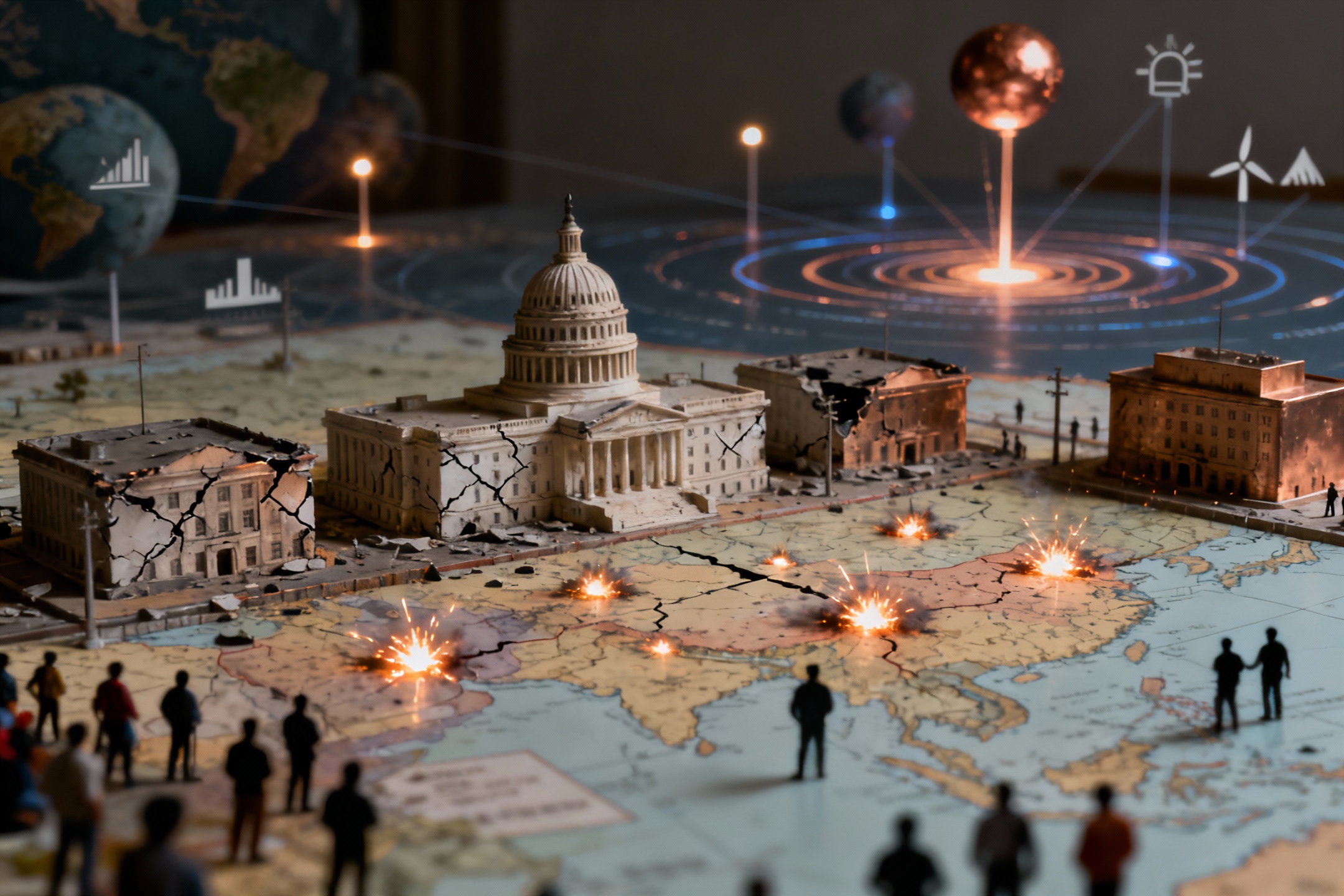
The concept of “systemic crisis” usually activates the ghosts of October 18 (shorter, 18-O): simultaneous fires, destroyed stations, a social wave in unison. But specialists agree on something that makes both government and opposition members uncomfortable: if Chile enters a major crisis over the next decade, it will not necessarily take the form of a massive, violent and synchronized outbreak.
Chilean politics, rather than moving towards a new 18-O, is heading towards a long cycle of accumulated tensions, focused mobilizations, areas of intermittent ungovernability and progressive institutional erosion.
A slow process, not instantaneous. A slow-motion deterioration, not an earthquake. The coming crisis would not be an explosion: it would be wear and tear. The Chilean malaise exists, but it is not coherently articulated.
Today, the country shows no signs of a national spark that in the near future will be able to ignite all cities simultaneously. What it does show is:
- Thematic protests,
- Local indignation,
- Sectoral conflicts,
- Territorial “micro-explosions”,
- Growing anomie,
- Deep political disaffection.
None of this collapses a country overnight, but it does erode its cohesion slowly, steadily. My bet is that, if Chile explodes again, it will not be like before: it will be in stages, in zones, for different reasons.
Institutions: risk of implosion, not collapse
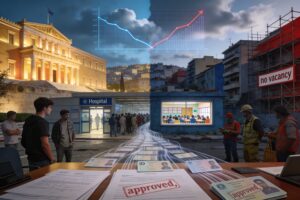
Chilean institutions are still standing. What is observed is another, more silent phenomenon: the gradual loss of capacity, the erosion of legitimacy, the difficulty in resolving conflicts and the inability to contain medium-sized crises without them becoming large.
You don’t see a sudden collapse, but you do see a drip decomposition:
- Congress that does not articulate,
- An increasingly slower State,
- Municipalities overrun,
- Police officers stressed,
- Saturated courts.
Institutional implosion is a more likely risk than a social explosion. But we are not facing a historical fatalism. The new government can still win narrative battles. Here, comes the key nuance:
- An explosion is not inevitable.
- Governments – Kast or Jara – can still gain time, legitimacy and political margin if they manage the narrative well.
The government can defuse the sense of impending crisis, but not the underlying malaise, by:
- Recognizes the fracture,
- Assume discomfort without denying it,
- It offers concrete, albeit partial, results,
- Communicates order without excessive force,
- Promises stability without pride,
It can defuse the feeling of impending crisis, although not the underlying malaise.
The protests can continue, yes, but without overflowing. The burst may not go away, but it can be delayed or mitigated and mitigated.
Multipolarism: Chile forced to balance itself amid internal tensions
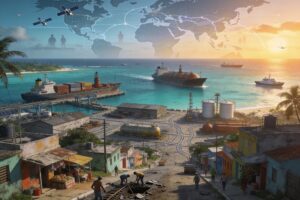
The advance of multipolarism in Chile is almost inevitable and is a variable where the Chilean elites are not trained to influence. Can multipolarism advance in Chile in the next 5–8 years? The estimated (qualitative) probability is HIGH. Not because Chile necessarily wants to distance itself from the West, but because the international system is changing around the country, and Chile cannot stand still.
Factors pushing Chile towards greater multipolarism:
1. Economy increasingly dependent on Asia
- China is the largest buyer of copper, lithium, fruits, cellulose.
- South Korea, Japan, India and Southeast Asia are increasing their economic weight.
- The US and the EU remain relevant, but no longer dominant.
Result: Chile, for pragmatic reasons, will tend towards a more balanced foreign policy between powers, although it does not renounce its Western anchor.
2. The global weakening of the liberal order that is characterized by:
- The China-US rivalry is deepening.
- In Latin America, Brazil is pushing for a more autonomous axis.
- The BRICS+ gain influence.
Chile cannot ignore this and will have to navigate between blocs, even if it tries to maintain active neutrality.
3. Internal fragmentation and polarization
When a country has:
- Low social cohesion,
- Political fragmentation,
- Lack of strategic consensus,
It tends to be more open to diverse external influences because governments lack the internal strength to set a single direction.
4. Competition for strategic resources (lithium–copper–green hydrogen)
- These industries are key in the global energy transition.
- All the poles of power (the US, China, the EU, India) will press for a presence.
- This will force Chile to negotiate with multiple powers, not just one.
Base Scenario: Chile will move towards a pragmatic multipolarism, without breaking traditional alliances with the West, at most they will have a different and less exclusive emphasis. But increasing its economic dependence on Asia. With a greater presence of Chinese, Indian and Arab state-owned companies. And with diversified military cooperation (cyber defence, drones, energy, ports).
This practically happens with Kast or Jara, for structural reasons. Chile can no longer choose ideological alignments, only survival strategies. And this multipolarism – forced, not voluntary – will influence domestic politics: any internal crisis will be amplified by the global context.
Explosion? No. Chronic tension? Yes. Multipolarism? Inescapable.
The conclusion that is repeated in reserved circles of government, opposition, business and academia is the same: Chile is not at risk of a new 18-O immediately.
It is at risk of entering a long cycle of contained and spasmodic instability, especially if it fails to adapt adequately to a world in multipolar reconfiguration. A country that works… but with difficulty. What a protest… but without breaking. That wears out… but it does not collapse. That it fragments… but it does not disintegrate. That tries to isolate itself from the new multipolar world, but cannot.
The challenge of the next president will not be to avoid a social earthquake internally and a geopolitical tsunami externally, but to manage the permanent vibration.
The coming era will not be one of explosion or calm: it will be one of sustained tension, latent unrest and fragile governability. Chile is finally entering its cycle of unstable equilibrium.