
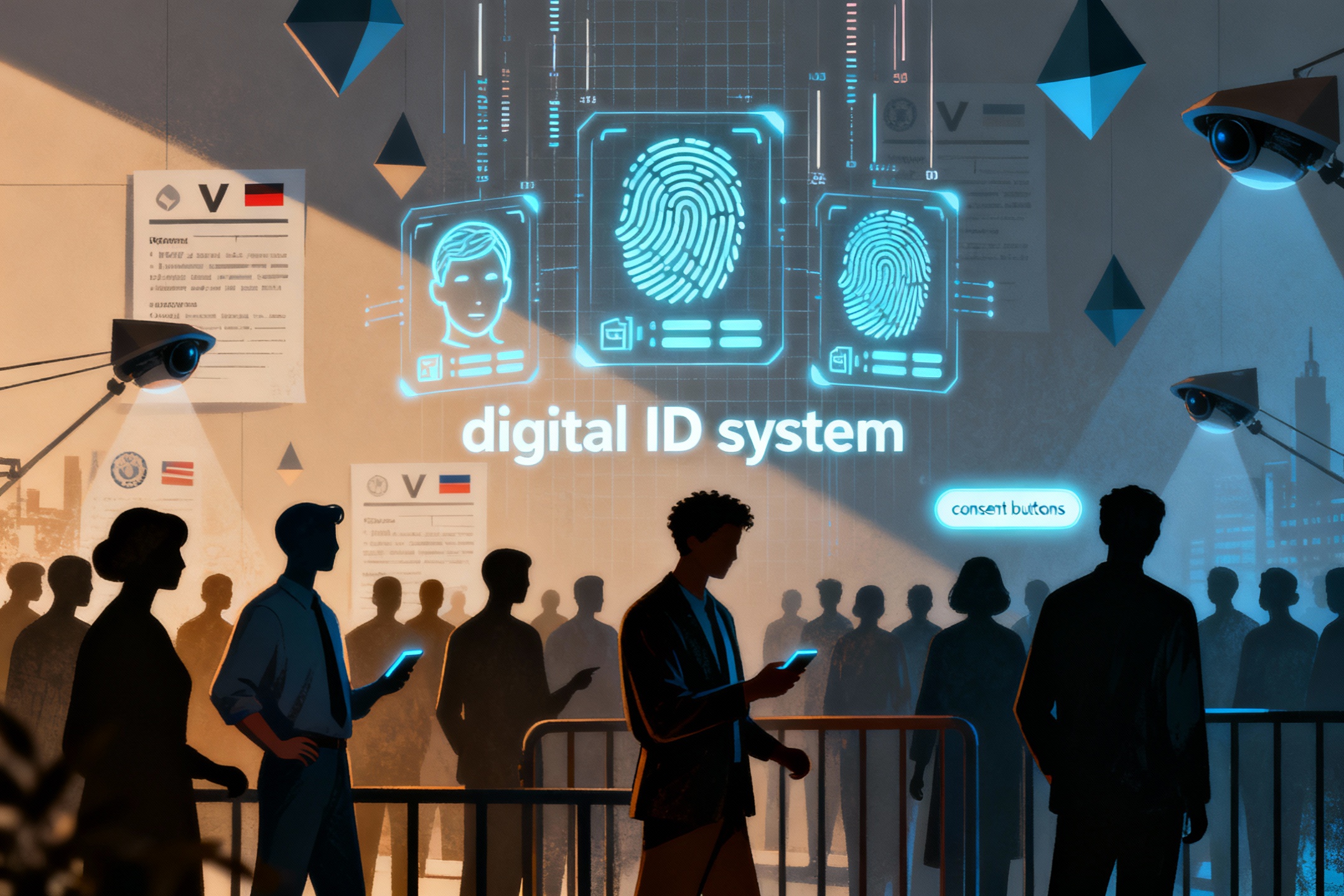
The United Kingdom is at the centre of an intense debate following the announcement by Keir Starmer’s Labour government of the creation of a national digital identity, known as the ‘BritCard’. This measure, which would be implemented before August 2029, promises to streamline procedures such as verifying the right to work, applying for social benefits and licences, and reducing administrative fraud. However, behind the narrative of modernisation lie profound implications for privacy, individual freedom and social inclusion.
Let’s start with the official justification. The government’s main argument has been clear: to curb illegal immigration. According to Starmer, the BritCard will be mandatory to prove the ‘Right to Work’, i.e. the right to work in the country. The government’s logic is that if people who cross the Channel illegally cannot access jobs, the appeal of entering illegally will be reduced. This strategy has been presented as a key tool to discourage irregular crossings and combat labour exploitation.
The proposal revolves around the ‘GOV.UK Wallet’, a mobile application that would store essential user data: name, date of birth, nationality and a photograph (for the time being). The government insists that a centralised database of the entire population will not be created.
Instead, the data would be stored in encrypted form on citizens’ own devices and shared only with their consent. The system would operate under the Digital Identity and Attribute Trust Framework (DIATF), which certifies private companies to act as intermediaries in identity verification.
But this justification has set off alarm bells. Critics point out that Digital ID is not only a covert immigration policy, but a step towards mass surveillance, with risks that go far beyond border control. In other words, the concentration of data and biometrics that the BritCard entails will centralise highly sensitive information. Although the government promises advanced encryption and secure authentication, experts warn that no system is invulnerable. A single failure could expose millions of identities, opening the door to data theft, fraud and blackmail, at the very least.
In addition, organisations such as Big Brother Watch and Liberty warn of ‘mission creep’: the risk that, once established, the system will spread to other areas such as health, transport or finance, becoming a tool for social control.
Another critical issue is the digital divide. It is estimated that more than five million Britons lack stable access to the internet or adequate devices. Although the government promises paper alternatives, the pressure to adopt digital identity could marginalise those without technological resources, affecting their access to basic services.
The social response has been overwhelming: a parliamentary petition against the BritCard has surpassed three million signatures, and opposition parties claim that the measure criminalises those who do not adopt digital identity. The debate is intensifying with international comparisons citing Estonia as an example, but distancing themselves from certain applications.
The BritCard poses a dilemma: is it a tool for modernising the state or a mechanism that erodes fundamental rights? While it promises efficiency and savings, it also concentrates power and data in the hands of the government, with risks that are difficult to ignore. The key will be to ensure transparency, democratic controls and real options for the excluded, preventing the pursuit of efficiency from becoming a gateway to permanent surveillance.