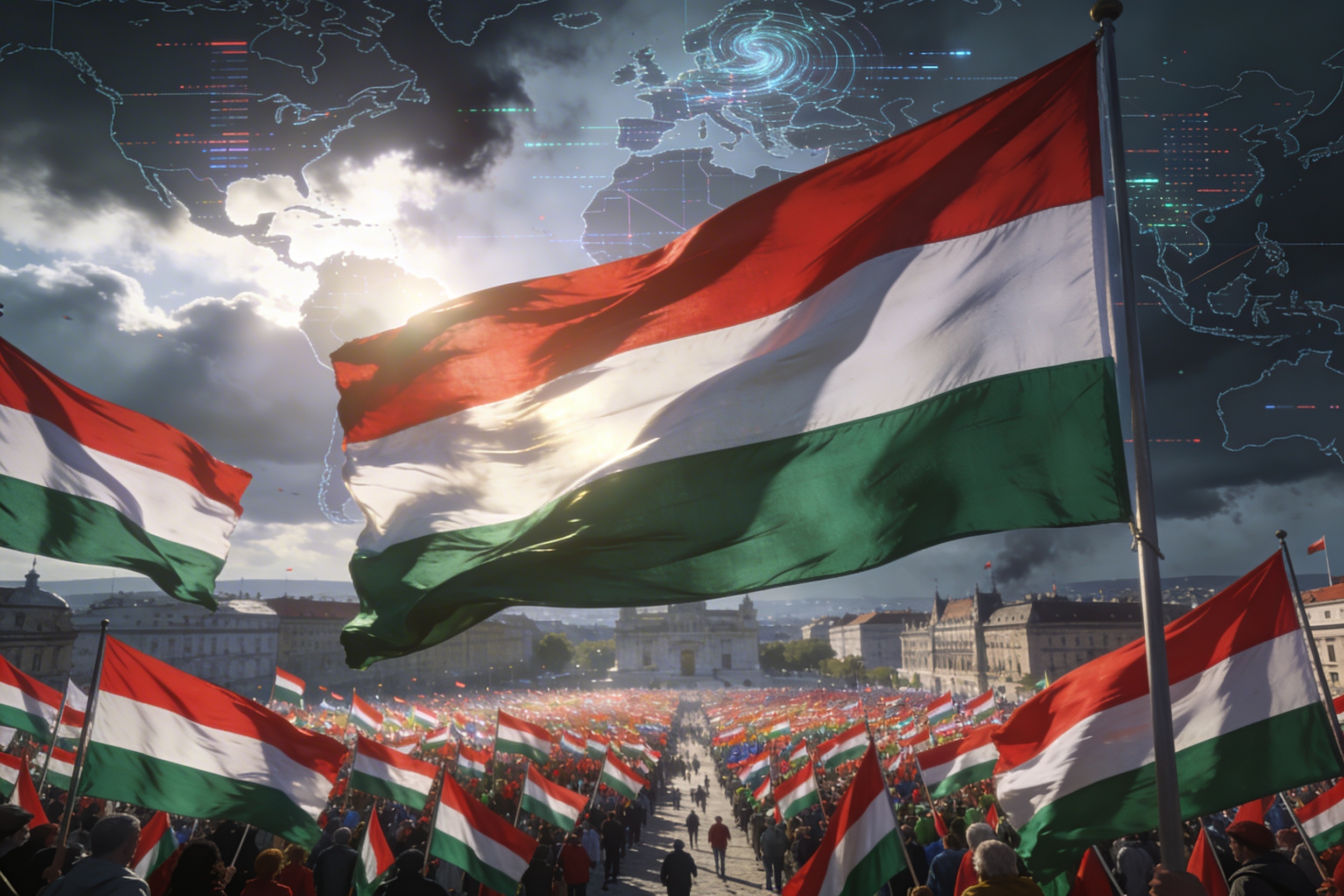
The Hungarian media outlet Origo reports the news of a writing that Hungarian Prime Minister Viktor Orban signed in the prestigious German newspaper Die Velt.
“Brussels should not delude itself that the patience of the European people is infinite,” he wrote, harshly criticizing the European Union’s leadership on the energy crisis, resulting from the conflict with Iran, migration and the EU’s policy towards Ukraine.
In his article, the Prime Minister stressed that it is clear that both Brussels and Kiev would like a different leadership at the helm of the country and that the war, which lasted four years, fundamentally defines European politics. According to Viktor Orbán, what initially consisted of humanitarian aid then turned into firearms, and later into tanks and missiles.
“The European Union’s policy of isolating and bending Russia is not working,” he wrote, apertis verbis, in Die Velt. While President Donald Trump has reasonably withdrawn economic and military support for Ukraine – Orban reasons – on the other hand, the closure of German nuclear power plants and sanctions against Russia, together with the events in Iran, threaten a new energy crisis. Brussels, however, still refuses to admit that this crisis cannot be solved without cheap Russian energy sources.
“The energy crisis caused by the war in Iran could inflict a further blow on European industry and lead to the loss of millions of jobs,” the Hungarian Prime Minister stressed.
Viktor Orbán also said that uncontrolled immigration, mainly from Muslim countries, has brought a new wave of anti-Semitism to Europe and transferred Middle Eastern conflicts to European territory, “and the serious consequences of all this still await us.”
He stressed that Hungary is taking a different path and that “we will never allow the lives of Jews to be threatened.”
The Prime Minister also noted that Ukrainian President Volodymyr Zelensky deliberately decided to close the Friendship pipeline in the midst of the crisis with Iran. According to Viktor Orbán, “the reason and timing of the conflict are clear”: the pipeline had been closed twenty-three times since the beginning of the war and reactivated twenty-two times, but at the twenty-third opportunity, just eight weeks before the Hungarian elections, the Ukrainian president decided to keep it closed.
In Hungary, the President’s entourage nurtures, also because of this attitude of Ukraine, the fear of “Eurocratic” interference in the upcoming elections, tending to favor, with false promises and fomenting fears, perhaps even illegally, the defeat of Orban in favor of a candidate who is loyal to the EU. Hungary is geographically small, but its veto on the 90 billion euros to Ukraine, which the majority Ursula Von der Leyen would like to give to Zelensky, would be decisive in blowing up the loan. So the Eurocratic system has every interest in at least cheering, to put it mildly, against the re-election of Orban, who, however, enjoys an excellent personal and political relationship with the Trump administration.
It can be said that today the Euro-Atlantic alliance has been on stand-by for over a year, because the Tycoon’s “America First” has blown up all previous geopolitical and economic balances with the European Union, which seems weak, divided and lacks a real foreign policy. There is no longer the United States dragging the UN and NATO and this is not taken as an opportunity to finally build political independence, but as a temporary and temporary trouble, in the hope that The Donald will resoundingly lose the midterm elections and that in 2028 he will be replaced by a Democratic President who returns to old habits.
This is a short-sighted conception because it does not take into account the consequences of the global changes of recent years and the economic and geopolitical processes triggered or concluded that will prevent, in fact, a “redde rationem”. The United States will still have to work for its leadership in the world that has become multipolar. In the face of attempts to influence the vote against Orban, what will Trump do? His unpredictability is well known, but it is certainly not in his interest to weaken the government closest to him in Europe, especially in view of the conclusion of the war in Ukraine.
Alongside this undeniable difficult moment for Hungarian politics, we observe the situation of another country where elections for the National Assembly are scheduled for June 7 and the election campaign will officially begin on May 8: Armenia. The current incumbent President Pashinyan is reportedly preparing a reshuffle in his government. According to the newspaper “Iravunk”, the Prime Minister is dissatisfied with the work of several ministers and their deputies, who, in his opinion, are not putting enough effort into the election campaign. No specific names are mentioned.
The opposition candidate, leader of the “Strong Armenia” party, Samvel Karapetyan is under house arrest. Armenia Today says that its lawyer, Robert Amsterdam, accused the refusal of the Anti-Corruption Court of Appeals to revoke the precautionary measure as “exclusively political in nature”. According to him, the deprivation of liberty for more than 260 days has no legal basis and constitutes persecution for publicly defending the Church, as he was arrested in June 2025 for criticizing the government for fomenting an accusatory campaign against it.
This situation could be a problem for both the EU and the US, as the region is located south of Georgia and borders Turkey and Iran, so it is located in a geographically strategic position for possible land access to the country of the Ayatollahs. Perhaps, having a friendly or at least non-hostile government becomes more of Donald Trump’s interest, but also of Benjamin Netanyahu, thus reuniting the entire historically Euro-Atlanticist area, which is always very sensitive when Tel Aviv feels threatened or if a phantom war escalation becomes important for Bibi to manage.
The political situation in Armenia in 2026 was marked by a historic turning point towards peace with Azerbaijan, signed under the aegis of the United States, and a rapprochement with the European Union. Prime Minister Nikol Pashinyan, in power since 2018, manages the consequences of the loss of Nagorno-Karabakh (2023) and the geopolitical transition between traditional Russian influence and greater Western integration. Armenia is stepping up its partnership with the EU (2025-2026), seeking to diversify its economy and reduce dependence on Russia, especially in the energy sector. Pashinyan’s confirmation is objectively functional to Euro-Atlantic interests in the area, both on a strategic, financial and geopolitical level, but the population is always in turmoil, so the opponent of arrests could become a destabilizing factor, in an area that is increasingly similar to a powder keg ready to explode…