Peru is undergoing yet another dizzying turn in its already chronic instability. On February 17, 2026, Congress removed interim president José Jerí after a sequence of accusations and motions linked to unreported meetings with Chinese business figures (and other scandals of a sexual nature), an episode the international press has described as a new chapter in the “cycle of removals” (vacancias) that has come to define Peruvian politics. Two days later, Parliament chose José María Balcázar as the new interim president, with the explicit mandate to oversee the transition toward the general elections on April 12 (with a possible runoff in June) and to hand over power on July 28.
In short-term terms, Jerí’s fall reveals the logic of a legislative branch (instrumentalized by de facto powers of an exogenous nature) that first enthrones and then swiftly topples its own operators, relying on broad interpretations of constitutional mechanisms such as “moral incapacity” (or equivalent political formulas) to justify removal. The Jerí case—centered on opaque contacts with a Chinese businessman in a context of high sensitivity regarding the Lima–Beijing relationship—also made clear that foreign policy and international alignments are no longer a merely “technical” matter for the executive branch: they have become domestic ammunition for reshuffling internal power correlations.
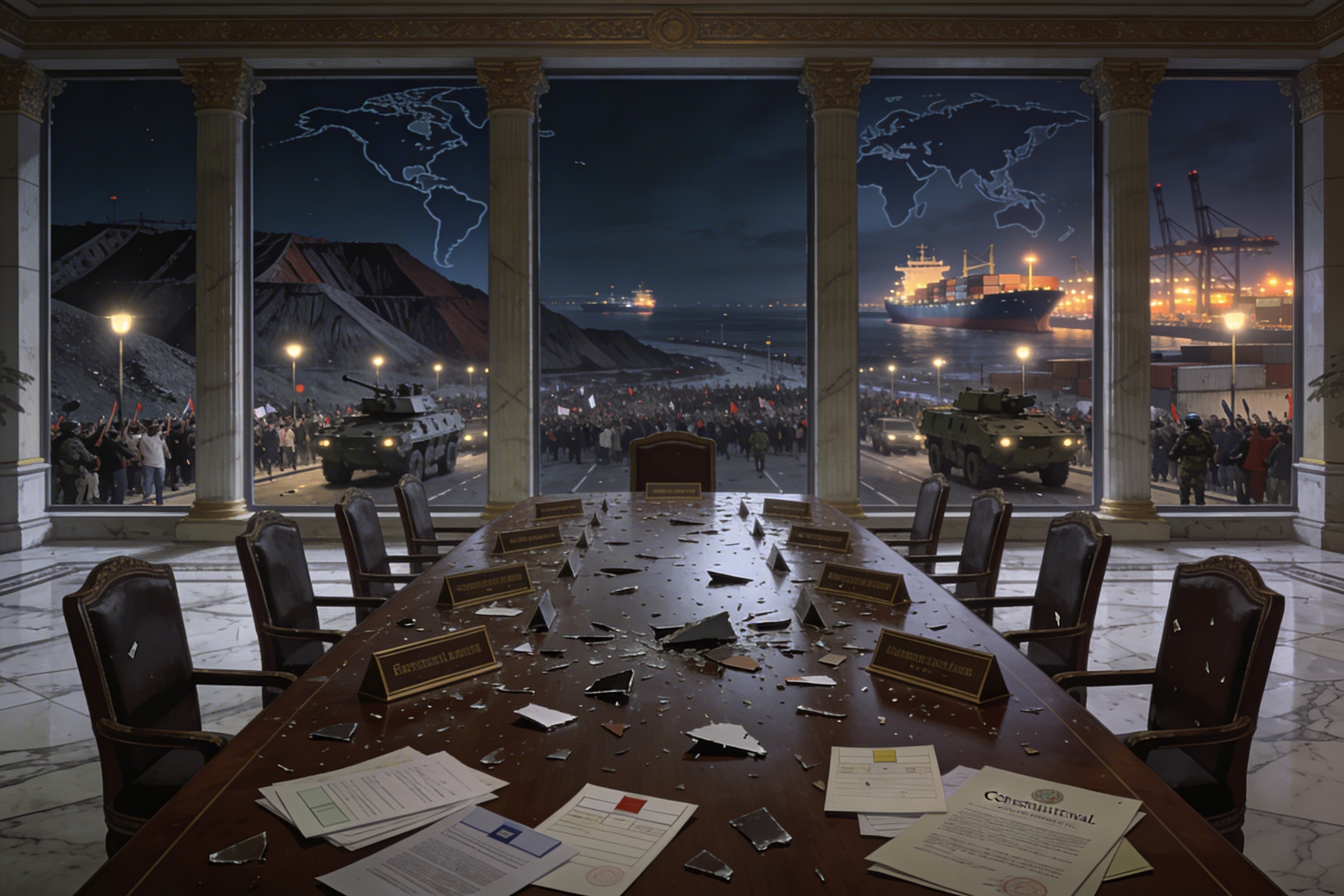
But what is decisive is not the specific scandal, which once again reproduces a recurring pattern of short-term turnover. What is structural is the underlying pattern: Peru is experiencing “high presidential rotation” that, according to various journalistic counts, amounts to eight presidents in roughly a decade (and in some counts even more, depending on which transitions are included). This volatility—rather than an anomaly—has become normalized as a mode of system operation: a regime in which governability is negotiated day by day in Congress (permeated by figures committed to anti-national and anti-popular agendas), with weak parties, unstable coalitions, and a permanent “state of political exception.”
Paradoxically, despite hyper-mediated scandals, the crisis coexists with material continuity. Even critical observers acknowledge that the Peruvian economy has shown relative resilience thanks to macroeconomic anchors (monetary policy, reserves, the weight of mining, and continuity in economic guidelines), though at the cost of investment, productivity, and social cohesion. In other words: faces change and institutional prestige collapses, but the underlying neoliberal model—free-trade oriented, extractivist, primary-export based, anti-industrial, functional to financial speculation, and marked by sharp social asymmetries—remains intact.
To this internal continuity is added an increasingly visible external pressure. In December 2025, the White House explicitly revived the Monroe Doctrine under a “Trump Corollary” and, in its security strategy, placed the Western Hemisphere as a priority theater, identifying China as the central challenge in the region. In parallel, Washington seeks to curb China’s footprint in the Americas—including ports, infrastructure, and financing—and this dispute manifests in concrete episodes (Venezuela, Panama, and heightened scrutiny of strategic assets). In that framework, the “Jerí case” functioned as a prism: a domestic scandal, yes, but also a window into the larger struggle for influence in a country that is key for mining and global supply chains.
Thus, Peru’s “perpetual crisis” can be read as short-term changes that conceal a structural continuity: political elites disconnected from popular reality, degraded institutions, and a state that—despite its fragility—preserves an economic orientation of systematic plunder and external alignments favoring Washington. What is at stake heading into 2026 is not merely who occupies the presidential palace for a few months, but whether Peru will remain trapped in a functional instability—an “administered chaos”—in which presidential rotation serves to rearrange elites without altering the deep architecture of power, tied to external interests before those of Peruvians.
Looking ahead to the immediate horizon, the “baseline” scenario is that Balcázar manages a minimal transition through April; but if the pattern of vacancias continues, the combination of rapid presidential turnover, loss of legitimacy, and deteriorating security could become the breeding ground for an “extraordinary exit” (an expanded state of emergency or even a civilian–military rupture presented as a restoration of order—that is, a coup d’état). Specialized scholarship on political fragility notes that instability and institutional stress increase the risk of extra-constitutional breakdowns (dictatorships).
In a context where Washington has dismantled international law and declares that it will “reaffirm and enforce” a renewed Monroe Doctrine to ensure hemispheric stability and deny strategic assets to extra-hemispheric competitors, it is by no means implausible or impossible that an unequivocal authoritarian turn could end up being functional to those objectives—especially if framed as containing China and “regional stabilization.” Added to this, given Peru’s high levels of instability and insecurity, such an authoritarian turn would likely not be condemned by the population.