As background information, we should point out that the EU-Mercosur agreement has been under negotiation for more than two decades. It was finally signed on 17 January 2026, but a few days later, on 21 January, the European Parliament, by 334 votes in favour and 324 against (with 11 abstentions), approved the referral of this agreement to the Court of Justice of the European Union. The court will have to rule on whether or not the agreement is compatible with current EU law.
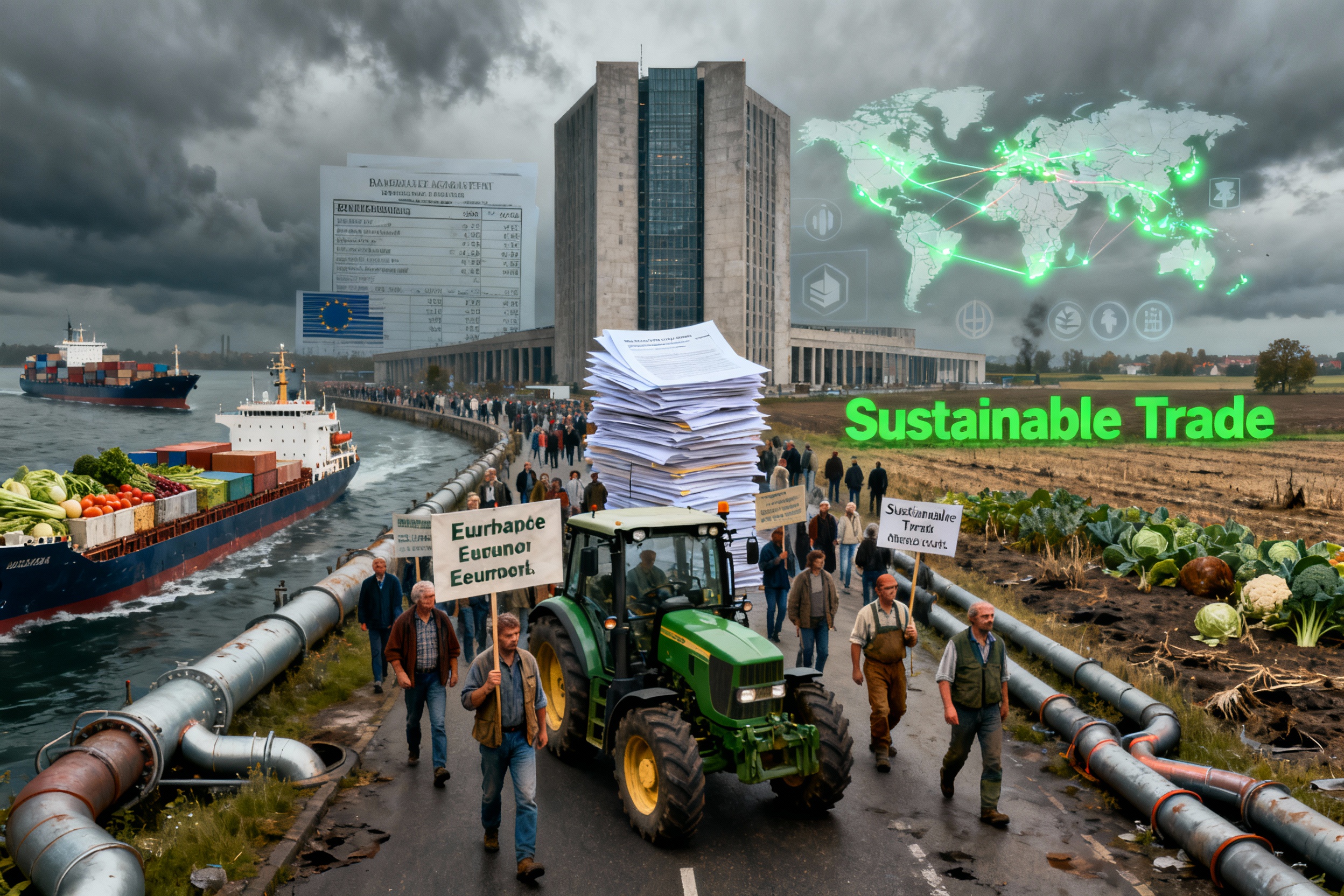
Likewise, the signing of the agreement has been closely followed by protests from the primary sector in several European countries, particularly in Brussels, where the main institutions of the European Union are located. It should also be noted that protests by farmers in many European countries have taken place in recent years due to measures promoted by the European Commission to further complicate regulation and, therefore, European agricultural production, to the point that farmers claim that the European Union intends to stifle them until this sector in Europe is wiped out and then buy very cheaply and without regulations outside the European area, whether in Ukraine, Morocco or South America.
Faced with such failure, the European Commission and its main leaders, such as Ursula von der Leyen, the President of the European Council (Antonio Costa) and the High Representative (Kaja Kallas), travelled to India to sign both a free trade agreement between India and the EU and a security and defence partnership. Faced with failure, they try to cover it up with international success.
In addition, the other incentive for this trip to India comes from the United States and its bid to take Greenland away from Denmark (an EU and NATO member state) because the US claims national security reasons for taking territory away from a theoretically allied country. President Trump himself threatened to impose two rounds of sanctions on European countries that ‘dare’ to send troops to Greenland to prevent annexation by the United States. 10% from 1 February, and up to 25% from 1 June.
For European farmers, this agreement is a condemnation of their sector because, instead of becoming more competitive at the European level, what the EU is doing is stifling European producers with ever-increasing regulation, as well as with supposed green policies that are driving the economic slowdown in order to achieve ‘carbon neutrality,’ but only behind closed doors. In other words, the geniuses at the EU intend to achieve this neutrality by not producing within the EU, but by bringing it in from outside, and thus the magic is done: cheaper products will arrive in Europe and we will be more ‘eco-sustainable.’ Basically, because we will not produce anything, but will depend on imports from outside Europe. In fact, they repeat the formula of ‘clean and digital transitions’ a lot, in this case and in any other. These are the buzzwords of the season.
The entry of Ukrainian agricultural products has already sparked protests, mainly from the Polish agricultural sector, which is the most affected, with echoes in Slovakia, Hungary, Romania and Bulgaria. Likewise, the Kingdom of Morocco is responsible for bribing as many people as necessary in the European Union to secure the signing of agricultural agreements that allow for the rapid and priority passage of Moroccan agri-food products into the European space (but little has been done about this case, known as ‘Moroccogate’, because it is effectively rooted in corruption within the Commission, the Council and the European Parliament).
The latest blow to European production is the agreement with Mercosur. The excuse is that there will be fewer tariffs and more exports between the two economic blocs. In practice, this means buying cheaper raw materials abroad without the regulations required of European producers. This condemns European producers, but also South American manufacturers, because the Eurocrats’ mentality is one of ‘international division of labour’, with Europe manufacturing and South America providing the raw materials.
Instead of producing more and better within Europe, the aim is to buy more and worse outside the bloc.
So, if the proponents of ‘green’ measures in turn bypass them by seeking purchases outside the bloc, what purpose do these measures serve other than to stifle European producers? On the other hand, the nineteenth-century mentality of treating other South American countries as mere suppliers of raw materials continues, while industrial manufacturing is already carried out by European countries.
Despite popular protests and the review to be carried out by the European Court of Justice, German Chancellor Friedrich Merz and European Commission President von der Leyen are urging its provisional application to avoid, according to them, delays in its implementation. Of course, they are ignoring all the popular protests, for which they have neither eyes nor ears. And they seem to be in a hurry to achieve some kind of success to sell to their national electorates in the sense that the European Union has the capacity to act on its own in the world (that it is a relevant player with its own voice). All this while an EU-US agreement was signed last July 2025 without public negotiation, signed by von der Leyen and Trump in Scotland. And what’s more, while the United States continues to threaten to raise tariffs on EU countries.
At the European Union level, it seems that we are witnessing an attempt to articulate a European bloc that acts in its own interest, but this is not the case. Firstly, it is a bloc of economic oligarchies that only values the bottom line and forgets the European peoples, whom it relegates to the status of old consumers while failing to stop the flow of mass immigration that benefits not Europeans but the ruling political-economic oligarchy. Basically, it only benefits the capitalists, but not the peoples.
On the other hand, NATO maintains total submission to the United States, to the point that its secretary general (formerly prime minister of the Netherlands) considers it the key country for sustaining NATO. This is understandable, as the United States is the majority shareholder in the ‘transatlantic alliance’. He even highlighted this week that the EU and NATO cooperate closely.
Finally, now, after four years, the European Union has also signed a total ban on Russian gas imports. This means that Europe’s dependence on more expensive gas from the United States will increase, or else the formula of buying from third countries in Western Asia will continue, increasing costs and even leading to the purchase of the same Russian gas and oil but through intermediaries such as Azerbaijan and Turkey. In other words, buying abroad and at a higher price.
One might ask, why is energy not produced in Europe? And once again we have these brilliant ideas from the green agenda to decarbonise the economy, achieve a zero footprint, and all the excuses of resilience and sustainability that the Eurocrats can come up with. They want to make Europe strong enough to sustain wars like the one in Ukraine, as well as to face a Russian invasion by 2029 according to their estimates, while: Both food and energy sovereignty are being destroyed by destroying the European agri-food sector through unregulated imports and buying more expensive energy instead of producing it by means available in Europe.
We are facing the end of Europe as we have known it. There are no peoples or countries, only markets and balance sheets at the service of the Eurocrats of the moment who serve the transnational economic oligarchies. For them, Europeans and everyone else in the world (whether Indian or South American, according to current agreements) are merely cogs that can be replaced by others who offer lower costs and higher sales prices.