The origin of strategic cooperation between Venezuela and the People’s Republic of China dates back approximately 25 years, when then-President Hugo Chávez visited Beijing and met with Ziang Zemin. While in the Chinese capital city, and at the behest of Cuba, Chavez said that “The Chinese revolution is the big sister of the Venezuelan revolution” as if trying to replicate a model of the cold war when many communist states said that the Soviet Union is the “big sister.”
From there, through the agreement with the Shanghai faction, the Venezuelan state administrative system built that cooperation, but that, to be honest, never reached the levels of a comprehensive alliance, despite the media narratives and the personal intentions of some key members of the state cabinets of both countries.
In particular, the relationship was – and is – an expanded cooperation, but it did not reach the dimensions of, for example, Sino-Pakistani or Sino-Russian relations.
To say that Venezuela was, from the 2000s until early 2026, an appendage of “Chinese neocolonialism” is a conceptual error and a repetition of biased superficialities that lack foundations.
In any case, China, being a pole of power and having a better interpretation of global complexities and historical crossroads, was able to obtain greater advantages than Venezuela in the last quarter of a century; But if this also happened, it was, to a large extent, due to the shortcomings of understanding and the operational failures of the Venezuelan decision-making circles, which did not know how to get more benefits from that relationship and, consequently, that gap was not due exclusively to the “factor of Chinese hegemonism”. There was also a discretionary management – corruption – by some Venezuelan authorities, of the flow of money from China because, although many people find it difficult to believe this reality, the truth is that Venezuelan administrators had significant spaces of autonomy in the decisions they made with respect to China, Russia, the European Union and other actors.
It is relevant to mention that Beijing relates to all possible governments, whether communist, non-communist or even anti-communist or of any religious worldview. Geopolitical pragmatism is a guiding norm in China’s state decisions and the character of its international relations is not based on the imposition of its “national ideology”, no, at least, for now.
To illustrate, there are the respectful relations between Xi Jinping’s government and that of Viktor Orbán and even Donald Trump himself praised, at the last Davos conference, Xi Jinping’s work and, precisely, in the last week of January, the British Prime Minister, Keir Starmer, sought, in Beijing, to expand the trade partnership with China. while simultaneously the current faction that conducts the affairs of the Chinese state increased the alliance with Vladimir Putin’s Russia.
We clarify that our purpose is not to take sides with any side in conflict in the current geopolitical arena, but to express our points of view based on the veracity of the facts.
The facts speak for themselves and, above all, in a global environment that is extremely complicated and volatile.
In the bilateral relationship between Venezuela and China, there are more than 500 agreements that supported such cooperation and Caracas decided, only in 2018, to join the “Belt and Road Initiative”, promoted by Xi Jinping’s government, but that, in a strict sense, this insertion was more declamatory than practical, especially because there were no enormous resulting effects. No effect changed the course of things in Venezuela, not even the more than $500 million in Chinese arms sales to Venezuela since 2010.
Most Chinese investments in Venezuela took place until the end of the government of Chávez, who died in March 2013, and bilateral trade between these two states, in the current decade, never reached 8 billion dollars.
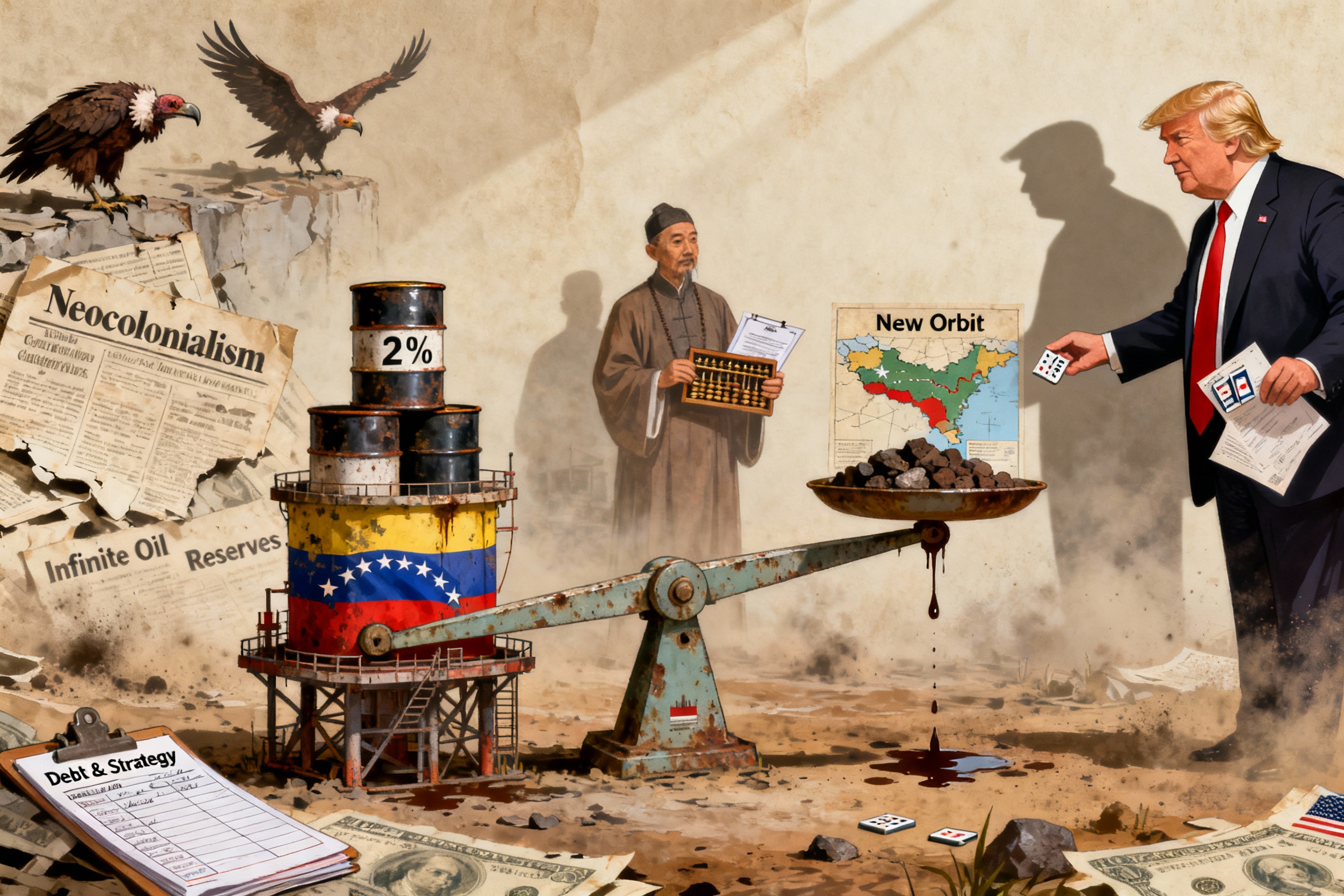
Also in the composition of the objective reality, we find that Venezuela activated a debt with respect to China that some reports mention would be around 63 billion dollars that Caracas paid, for the most part, with shipments of iron and extra-heavy oil. Any oil specialist knows how expensive it is to refine the type of Venezuelan oil, although this does not mean, as we said, that China has completely lost its relationship with Venezuela because, according to the evidence, China’s reasons for its relationship with Venezuela exceeded the priority of the supply of crude oil, despite the significant reduction that Caracas made to China in each barrel exported. China turned to Venezuela for resources and strategic space, among other causes.
As of January 2026, Venezuelan oil supplies to China constituted 2% of Beijing’s total oil imports and, between 2023 and 2024, Venezuela’s oil share in the Chinese energy complex was reduced in favor of Iran and Iraq.
Yes, 2% is a figure whose interruption will not have a negative impact on China’s energy reserves and economic dynamics.
To all this, there is frequent talk of the “great strategic oil reserve” that Venezuela has, giving astronomical numbers, but, technically and practically, the Venezuelan oil that can be extracted from that total of reserves mentioned would not even reach 40%.
For this reason, they comment inside the hydrocarbon companies of the United States, that it is not advisable to join the “Trump Initiative” because the financial, operational and security costs are high compared to the profits that could be extracted from Venezuelan fields in the next five or ten years.
China is Venezuela’s lender and, to date, it is an important creditor, with Caracas owing Beijing a little more than 12 billion dollars of the 150 or 170 billion dollars that total its external public debt because a considerable amount of this debt is in the hands of vulture funds.
We will see if these vulture funds, now, manage to collect a part of their debt with the new strategic course that is being tried to be implemented in Venezuela.
That said, President Trump’s influence on the energy and international policy in general of post-Maduro Venezuela poses problems and challenges for China that, of course, it has not had since 2000.
One of them is the negotiation with the authorities of the Venezuelan government and with Trump himself for the untouchability of its investments within the territory of Venezuela and for Caracas to continue the bilateral relationship with Beijing, but no longer with maximum aspirations on the part of China. As long as a significant percentage of its investments are maintained and as long as the Venezuelan government does not destroy the normal bond of cooperation with Beijing, there would be no small achievement for China until other changes take place in a reverse direction of the one that began on January 3, 2026.
There is no doubt that Trump will talk to Xi about Venezuela when they meet in Beijing next April, and will put on the negotiating table the advantage he obtained by influentially intercepting the process of the Venezuelan system. Trump will probably say that the structure of Venezuela is in his orbit and that the Chinese may continue to have a relative presence in Venezuela but, as long as Beijing admits this new reality and sees in the U.S. presidential person the main actor to deal with the South American country.
Xi Jinping will try to balance China’s strategic interest in Venezuela and the rest of the Americas in the negotiations he is building with Donald Trump so that the Chinese presence does not enter into a process of inexorable withdrawal, even if it experiences some significant losses. It is not fortunate to say that Venezuela will be “a bargaining chip” between these two giants of global politics, but it is also not out of touch to think that there will be a fragmented commitment between Trump and Xi around Venezuela, without forgetting that these two figures are in competition for global leadership for their respective states.
Regarding the collection of the debt, we do not believe that China will wage a “diplomatic and legal war” over it, but that it will tend to participate in a rational and conciliatory framework in order to obtain what is owed, but without harming the relationship with the government in Caracas and with Trump if eventually both leaders reach a specific agreement on some of the global dimensions.
China is mainly interested in preserving ties with Venezuelan leaders, although Chinese strategists must have already frozen the equation of military cooperation with Venezuela for reasons that are plain for all to see.
However, the situation is mutable and everything can change if the circumstances and the game between the aforementioned actors take on another nature because the evolution of the process is what will really set the following guidelines.