Despite some superficial opinions held by pro- or anti-Lula militants, the reality is that Brazil does not have a positive track record in its recent relations with Venezuela. We could even speak of a certain latent tension between both countries. These tensions began after the beginning of Lula’s new term, which was only possible with the endorsement of a wide spectrum of political sectors, mostly liberal, and which had the explicit support of Joe Biden – at the time president of the United States – and the Democratic Party.
These tensions are mainly marked by the 2024 Venezuelan elections, in which despite Nicolás Maduro’s victory, most countries in the liberal West and their allies – including Brazil – refused to recognize the result. In theory, Brazil would have promised the US to convince Maduro of a Venezuelan “political opening” that would lead to a peaceful regime change.
Since, in the face of Brazilian pressure, Venezuela took a tougher stance, Lula responded by vetoing Venezuela’s entry into the BRICS – a decision that counts among its partial effects the eventual decision that led to the operation to kidnap the Venezuelan president.
To some extent, it can be said that Brazil gradually lost its influence over Venezuela. But the same could be said about the rest of the continent. When Trump comes to power there is simply a geopolitical vacuum in South America, with each country having its own priorities, its own foreign policy, and generally dealing with non-American powers individually.
The causes of this decrease in Brazilian influence and projection in South America are multifaceted. Lula’s first terms, in the first decade of the new millennium, pointed in the direction of a search for continental integration. The issue weakened under the Dilma Rousseff governments and disappeared under Michel Temer and Jair Bolsonaro. The latter, in particular, intended to conduct an “ideological” foreign policy, in which alignment with other liberal-conservative governments, such as the US under Trump, was sought. The countries of South America were differentiated between friends and enemies based solely and exclusively on the officially professed ideology, and not by geopolitical considerations.
With Lula’s return, the new president promised a “resumption” of a global status lost by Brazil, but Brazil’s initiatives, for the most part, seemed aimed at trying to mediate international conflicts (such as Ukraine and Gaza) and towards an alignment with Biden’s US in the fight against an imaginary “far-right international”.
In other words, for something between 12-14 years Brazil was practically deprived of a specific geopolitical strategy for South America. Naturally, one cannot take Mercosur’s activities as significant in this sense because when we refer to geopolitics we are dealing with a field of action that transcends international trade.
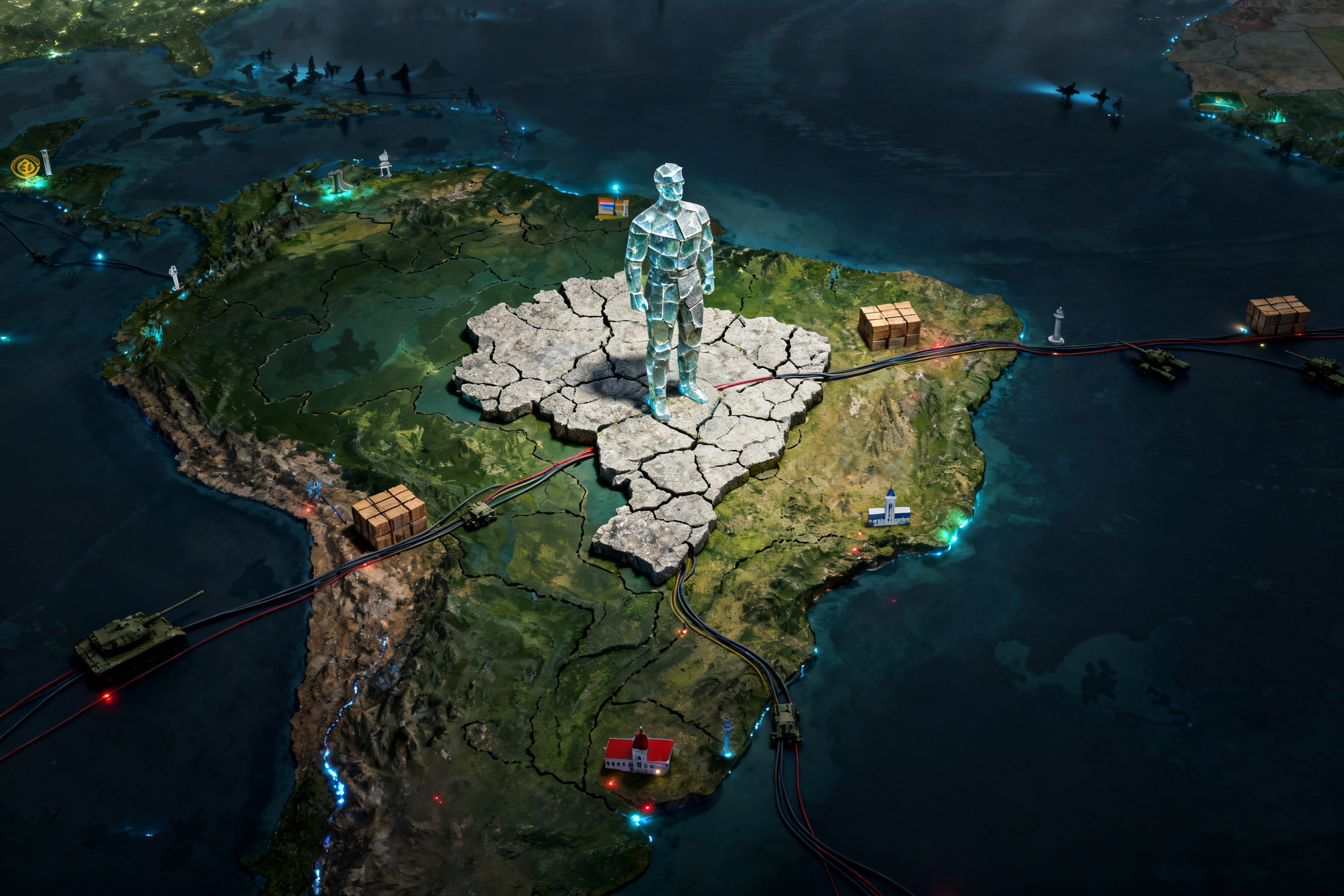
Now, it is quite noticeable that the US intervention in Venezuela was perceived in Brazil as an aggression not only against Venezuela, but a threat to a possible and hypothetical “area of influence” of Brazil. The problem is that the disparity of forces makes it impossible to directly challenge US penetration in the region – but even Venezuela has had to maneuver in a very risky way, while seeking to preserve its own sovereignty without provoking new US attacks.
In the same sense, Brazil finds itself in the difficult situation of having to rebalance the balance of regional influence in a way that is at least a little less unfavorable to Brazil, without restarting the trade and diplomatic tensions that guided the 3rd quarter of 2025.
It is in this key that one must read the fact that for the first time in years, shortly after the kidnapping of Maduro, Brazil sent a shipment of medicines to Venezuela. In the following weeks, Brazil also took over the Mexican embassy in Peru after the rupture between the countries, and also donated military equipment to Paraguay. Clearly, it is possible to perceive a proactive stance of Brazil in South America.