
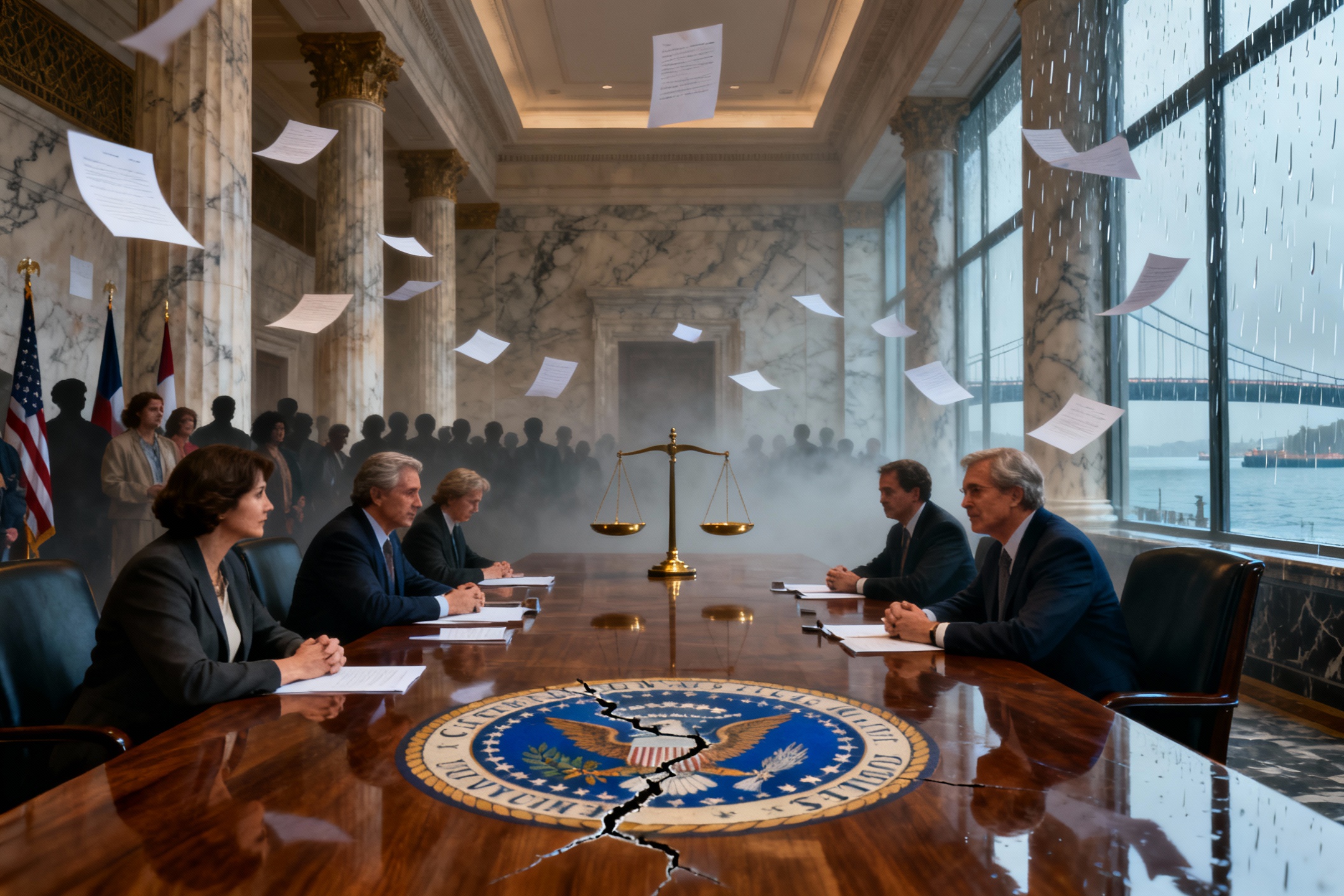
A new and provocative bill pushed by a Republican senator seeks to ban dual citizenship for U.S. citizens, aiming loosely at the American-Israeli community and, symbolically, at Benjamin Netanyahu’s government. Its timing, days before the Israeli prime minister’s visit to Washington, is more political theater than real threat.
The bill’s prospects are nonexistent, as it collides head-on with constitutional protections embedded in the 14th Amendment and with the Supreme Court’s 1952 ruling in Kawakita v. United States, which confirmed that dual nationality does not nullify allegiance to either State.
Legally dead on arrival and guaranteed to invite furious lobbying from AIPAC and other influential networks, it is highly unlikely to clear either chamber. The move reveals more about the GOP’s internal tensions and the generational clash between Christian Zionists and anti-Zionist “America First” currents than about any credible policy shift with respect to Israel.
That fringe agitation aside, talk of an organized “decoupling” between the United States and Israel is wishful thinking. Yes, there is popular fatigue – and even moral revulsion – on both the left and right toward Israel and its policies of occupation, destruction and extermination. But this shift is happening among activists and voters, not inside the institutions that shape U.S. foreign and domestic policies.
In Congress and the executive, Israel remains a bipartisan sacred cow. One of the few fleeting moments of dissent came from Marjorie Taylor Greene, whose short-lived criticism of Israeli actions ended with her resignation, reportedly following a torrent of political and personal threats. For now, the bipartisan apparatus of support (military aid, diplomatic shielding, and policy coordination) remains rock solid; what’s changing is not the policy itself, but the moral legitimacy it is able to draw upon.
Netanyahu’s visit to Washington underscores just how brittle his own position has become. After years of catastrophic war and a continuous stream of war crimes in Gaza, besides a humiliating confrontation with Iran, the Israeli leader faces unprecedented domestic dissent and collapsing personal credibility.
Once marketed as Israel’s guarantor of security, he is now blamed for strategic paralysis, spiraling violence, and international isolation. Israel’s political and military elites increasingly see him as a liability, while Western allies, particularly the United States and Europe, view him as an impediment to any credible postwar settlement.
Yet his unpopularity abroad serves a purpose: he has become the perfect scapegoat, allowing Israel’s establishment to distance itself from the genocide in the short run without confronting the deeper structure that produces and supports it.
What Netanyahu hopes to salvage in Washington is not esteem but leverage over a process that does not belong to him. At the top of his agenda is to shape and price Donald Trump’s Gaza plan, a blueprint that promises an “end to the war” (for now) and a reordering of Gaza’s future largely on Washington’s terms.
Far from selling Trump his strategy, Netanyahu is arriving as a supplicant, seeking to turn that plan to his advantage: he will try to trade his reluctant endorsement for accelerated arms deliveries, political cover against war‑crimes inquiries, and tacit U.S. consent for continued Israeli coercive power over Gaza, the West Bank, and parts of the wider region.
In practice, the encounter looks less like a summit of allies and more like a high‑stakes protection racket: Netanyahu signals that he can slow‑roll or sabotage Trump’s design for Gaza, while Trump makes clear that he can leave Netanyahu exposed, domestically and internationally, if the Israeli leader refuses to sign on.
The citizenship bill is a constitutional non-starter and political sideshow. The deeper currents are the genuine, though not yet institutionalized, public unease with Israel’s supremacist policies, Netanyahu’s accelerating political demise, and the high-stakes bargaining over Gaza’s future.
The U.S.-Israel relationship is evolving under pressure, but strategic decoupling is nowhere imminent. Netanyahu’s visit is less about securing his legacy, and more about extracting concessions for a plan that may outlast his own tenure, a stark indicator of his diminishing power as he navigates what could be his final act on the world stage.