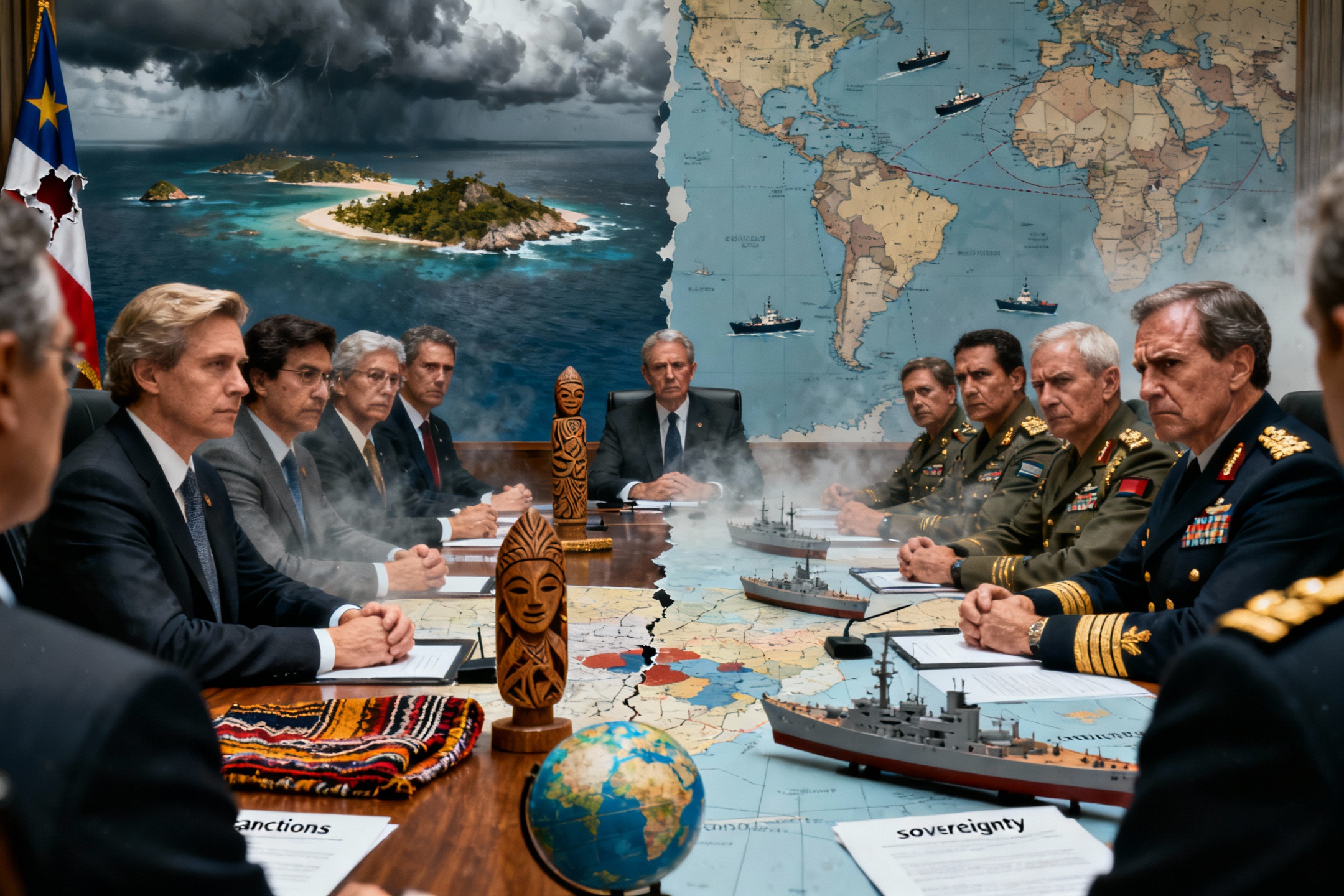
At the fourth meeting between CELAC and the European Union, held in Santa Marta (Colombia), 58 of the 60 participating countries approved a joint declaration rejecting the use or threat of force in the Caribbean, amid tensions with the United States due to American attacks on vessels in the region. Venezuela and Nicaragua refused to sign the document.
The declaration emphasized the importance of maritime security and regional stability, avoiding direct mention of the Trump administration so as not to jeopardize consensus. Brazilian President Lula da Silva criticized the growing U.S. military presence in Latin America and denounced “illegal interventions.”
The meeting takes place during the worst recent crisis between Colombia and the United States, after Petro described the American bombings as “extrajudicial executions.” In response, Trump imposed sanctions on the Colombian president and accused him of involvement in drug trafficking.
The final document also condemns Russia’s war against Ukraine, which led Venezuela and Nicaragua to distance themselves from the declaration, and it mentions the situation in Gaza, defending the two-state solution.
The summit saw reduced participation of heads of state, with only nine attending, among them António Costa (European Council) and Pedro Sánchez (Spain).
What can be observed in this scenario is an internal fracture within the Atlantic bloc, where U.S. influence increasingly clashes with that of the European bloc, which opposes several of Washington’s policies. This undermines American authority in the Americas, particularly by strengthening, in certain aspects, the autonomy of Hispanic nations. For this reason, the presence of António Costa and Pedro Sánchez, leaders from Latin-European nations, was essential for the European geopolitical project, as it sought precisely to foster cultural and historical rapprochement with Latin America, nut in that way, they seek to sabotage the development of both European and American Hispanic nations, since they still would be ruled by the Anglosphere.
On the other hand, European interests are clear when they continue to condemn the special operation in Ukraine in the final document, an issue that does not directly affect the core interests of the American nations. This was demonstrated by the withdrawal of Venezuela and Nicaragua. The Europeans still operate under a Mackinderian analysis of opposition to Moscow and seek support in Latin America.
As for the Hispanic-American nations, they must first define their geopolitical core, something many have yet to do. Some attempt a dual game with Europe and the United States, while also flirting with emerging nations of the Global South such as Russia and China, but without real commitment; others already have a defined goal alignment with the emerging bloc that stands a chance of rising.
Until they fully decide which path to follow, Hispanic-American nations will continue to support beneficial agreements that ensure relevance for their sovereignist projects, while refusing to participate in initiatives that would compromise their positions an approach exemplified so far by Venezuela and Nicaragua. As for the other nations, they should understand that worse than being an open enemy of the West is being its ally and falling under its Masonic tentacles. One need only observe the current situation in Ukraine to understand the fate that awaits them if they do not claim their place as one of the poles of the multipolar world.