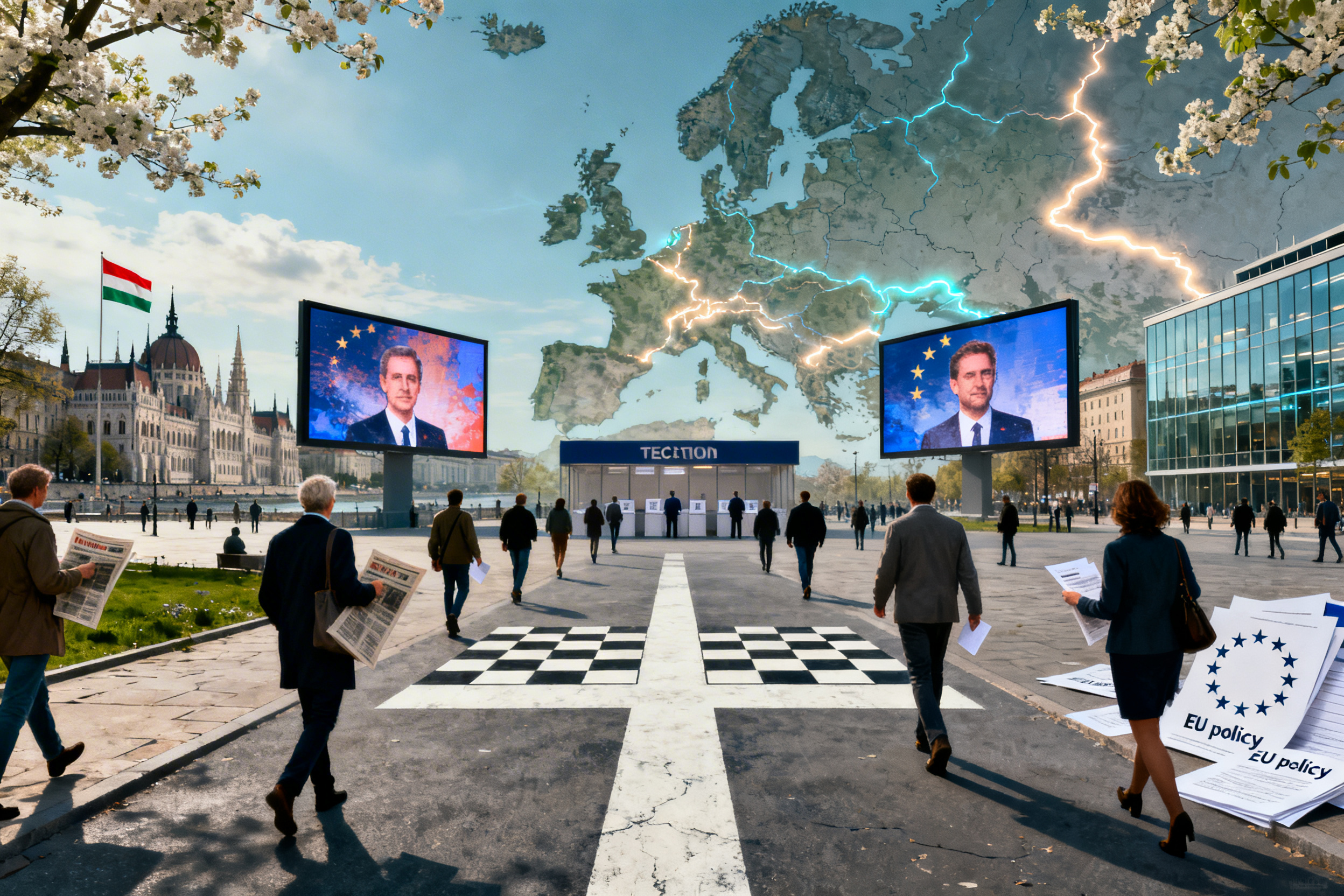
Spring is approaching in Hungary and, with it, parliamentary elections that transcend local politics. What is at stake in Budapest is not only the continuity of a government, but the ideological pulse that crosses the European continent in the midst of a reconfiguration of the global order.
Polls show a closer race than in the past two decades. Prime Minister Viktor Orbán’s party (Fidesz) faces Péter Magyar (TISZA), with differences ranging between 8% and 10%, according to different polls. But reducing this choice to a simple change of leadership would be a mistake. Hungary has become the symbolic epicentre of the dispute between the sovereignty project and the globalist architecture represented, mainly, by the European Union.
For years, Orbán has defended the idea of an international order based on national sovereignty, cultural identity and the rejection of supranational impositions. His stance has made him the leading dissident within the European Union. In a context marked by the return of Donald Trump to the presidency of the United States and the weakening of the liberal consensus in the West, Hungarian leadership takes on a greater strategic dimension.
Hungary is not a peripheral actor in this discussion. It is the “political laboratory” where the extent to which a member state can resist institutional pressure from Brussels is tested. The Hungarian stance on the war in Ukraine is one of the most tense points. Foreign Minister Péter Szijjártó put it bluntly: “It’s not our war.” This position has deeply made the European leadership uncomfortable, committed to a strategy of prolonged confrontation with Russia.
For Orbán, the conflict should not be resolved through an arms build-up financed by the member states, but through a negotiated solution that avoids prolonging European attrition. This vision has placed him in open friction with Brussels, but it has also aligned him with sectors of the new US establishment that promote a pragmatic redefinition of strategic priorities.
In this context, Péter Magyar’s candidacy cannot be analysed solely as a domestic alternative. His political projection has visible links with the European People’s Party and with sectors that aspire to reinsert Hungary fully into the community consensus. For Orbán’s critics, it is a matter of correcting a course that they consider isolationist; for its supporters, it is an attempt to neutralise the main sovereigntist bastion within the Union.
What is happening in Budapest is, in fact, a microcosm of global transformation. Europe is going through a strategic identity crisis. The EU bureaucracy, designed in a unipolar world, now faces a multipolar scenario where spheres of influence and national interests are once again at the centre of the chessboard.
Hungary has thus become a symbol: for some, of resistance to the deep state of Brussels; for others, it is a challenge to the European project. But, beyond the narrative, the Hungarian election will set a precedent on the real margin that states have to redefine their sovereignty within supranational structures.
Budapest does not decide only its parliament. It decides whether Europe will continue to deepen a centralised model or whether it will open space for a reconfiguration based on more autonomous states.
In this sense, Hungary is not an isolated episode: it is one of the visible links in the geopolitical change that the West is going through.