Since the beginning of hostilities between Israel and Iran, the international community has engaged in a debate about taking positions not only regarding the impact and repercussions this could have on world peace, but also how it will affect international relations and question the credibility and effectiveness of international organizations. In addition to the political and economic repercussions that a conflict of this nature could have on the entire world, and especially on Latin America.
Different local political leaders are choosing to align themselves with the different positions that can be seen in their local interventions, some directly declaring a strategic neutrality due to the influence that the United States has in the internal politics of each country, regarding weapons supplies and logistical support, others have adopted direct support for the northern country, but this is contrary to self-determination, compromising its autonomy under the structural policy of the United States. It is no less true that this new scenario of international conflicts generates and creates a new discourse and a new vision of internal alternatives regarding international political relations.
And it could be a desperate attempt to gain hegemony in international politics, based on sharpening poles, where some have resurfaced the argument of the United States’ position in economic, political, and military matters.
However, there are other sectors that view with more suspicion this policy of Donald Trump, which attempts to force an alignment of allied countries under the slogan that whoever is not with them is against them, a perception that persists within its own borders and among its own citizens. But Latin America has its own cultural, social, and economic identity that has always been influenced by a series of external factors, where the intervention of the great powers has been decisive in a number of processes of its governments and its international policies.
But this has changed substantially with the ideological and political dispersion that Latin America is suffering with a series of sociocultural factors that are determining a new configuration of power groups that, seeing themselves atomized, have had to change their internal visions to much more pragmatic problems that are directly related to internal security due to the emergence of organized crime groups, the constant flow of migration, and finally the problem that has to do directly with the economy and inflation.
This conflict, born in the Middle East and tending to worsen in recent days, could have clear, direct repercussions on some of the most vulnerable sectors of the Americas. This includes rising fuel prices and, consequently, the cost of living, the rise of the dollar, and the various ups and downs in international markets, which will directly affect the stock markets of different countries.
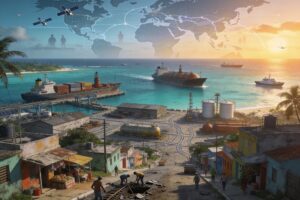
In the most catastrophic scenario, if Iran were to decide to block the Strait of Hormuz in retaliation for US or European actions supporting Israel, Washington would likely be forced to intervene militarily to reopen this important trade route. And China, Russia, Saudi Arabia, and other countries would likely pay lip service to such an intervention, but would be relieved to see their oil supply routes reopened. There is much speculation that the Iran conflict could lead to higher oil prices that would benefit Venezuela, Mexico, Colombia, and other Latin American oil producers.
But surprisingly, most oil experts say such a scenario is unlikely. Analysts at Goldman Sachs, JPMorgan and other financial institutions say oil prices could surpass $100 a barrel if Iran disrupts the passage of oil tankers through the Strait of Hormuz, which handles 25% of the world’s oil shipments. But most of them add that the impact of such a potential disruption to oil shipping would be limited and short-lived.