
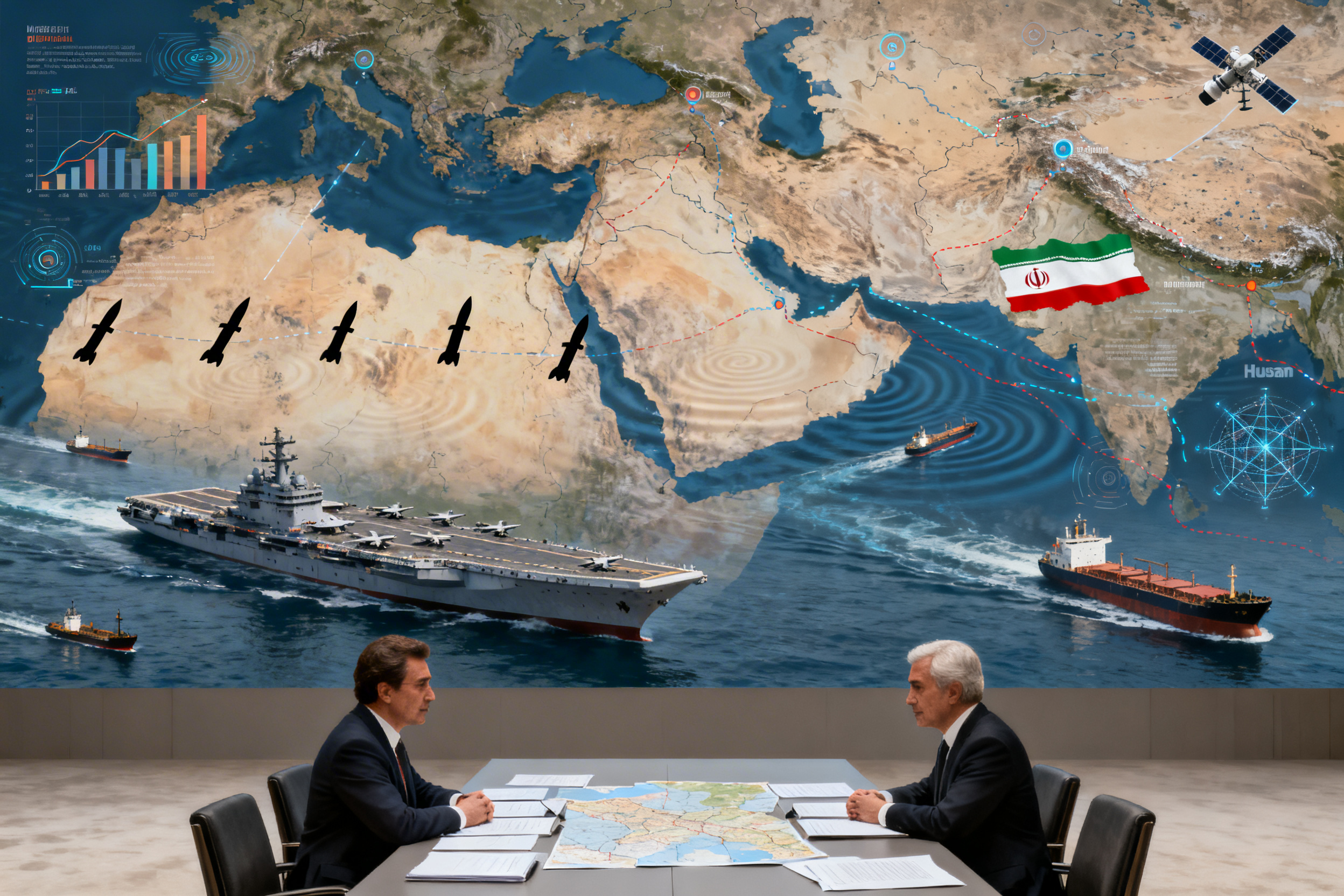
The United States canceled a planned military attack due to a high-risk, low-success assessment, regional opposition, and the failure of internal destabilization in Iran. Iran, after containing the unrest, is preparing for an asymmetric conflict.
According to Western sources, Israeli and Arab officials advised postponing the attack. The main reason is that the Iranian regime is not considered weak enough for an attack to be a “decisive blow,” and there was fear of the consequences and an aggressive Iranian response.
Trump had told his advisers that he wanted a decisive blow, but he did not get any guarantees. Trump’s advisers could not guarantee that an attack would bring about rapid regime change. It was assessed that the costs outweighed the potential benefits.
Negotiations begin
The current paradox: diplomatic talks coexisting with regional military escalation.
Iran is negotiating from a position of fait accompli (advanced nuclear program). It seeks the comprehensive lifting of sanctions, guarantees of non-aggression or a new abandonment of the agreement, and recognition of its right to a civilian nuclear cycle.
However, the US is negotiating from a position of maximum pressure. It seeks the freezing and reversal of the Iranian program, verifiable long-term restrictions, and the containment of missile capabilities.
For Tehran, current actions are part of a strategy of national survival and deterrence in the face of a hostile environment (suffocating sanctions, threats of war, assassinations of scientists). Its foreign policy is reactive and seeks guarantees.
Why has the US decided to negotiate?
- Failure of internal destabilization: Iranian authorities suppressed the main resistance. The opportune “moment” for effective intervention was lost.
- Risk of regional war: Pentagon analysts could not guarantee success and warned of a major war in the Middle East, something Trump wanted to avoid.
- Insufficient preparations: The US naval deployment in the Gulf is not considered adequate for a conflict that could escalate over time.
New US approach: The focus is on “non-kinetic” operations as a priority: cyberattacks, information operations, and limited strikes against specific command structures.
The US strategic dilemma
The US’s conventional military superiority does not translate into viable strategic options against Iran, due to its asymmetric deterrence and regional interdependence.
The “short war” is an illusion. Iran is a resilient system, built to absorb pressure and dilute the relationship between force applied and political outcome.
Escalation calculation: Any attack, even a “surgical” one, would be integrated into a historical narrative of aggression and trigger a response that would turn a tactical victory into a strategic defeat for the US.
Pillars of Iranian deterrence:
Closure of the Strait of Hormuz: Credible capacity (speedboats, mines, coastal missiles) to disrupt 20-30% of global oil trade, collapsing markets and global inflation.
Regional Strategic Depth: Network of allies and non-state actors (Axis of Resistance) enabling a multi-layered response.
Perception of Regional Balance: Gulf countries (Saudi Arabia, Qatar) fear open war and seek stability, not confrontation. Israeli aggression post-2023 has eroded trust and pushed for realignments.
Strategic Conclusion: The US faces a deficit of credible options. Unilateral coercion has reached its limits. The only realistic path is “antagonistic coexistence,” recognizing the impossibility of imposing regime change by force without catastrophic costs.
Possible scenarios
- Total massive attack (low probability): To force an agreement or regime change. Considered almost impossible.
- Limited, predefined attack (high probability): Against peripheral military targets, with regional pressure on Iran not to respond. Presented as an “achievement.”
- Limited war: Attacks on nuclear/chemical facilities, with a measured Iranian response. Could be prolonged.
- Intensification of hybrid warfare (without direct attack): Cyberattacks, sanctions, internal destabilization.
Possible Iranian responses: These range from a preemptive response and attacks on regional bases and Israeli assets, to calibrated deterrence (cyber retaliation, electronic warfare) and a diplomatic-legal offensive to isolate the aggressor.
Consequences
- Immediate: Disabling of key US bases (Al Udeid, Al Dhafra), loss of Fifth Fleet command capability, closure of the Strait of Hormuz.
- Systemic: Expulsion of US forces from the Gulf, spike in oil prices, unilateral Israeli nuclear attack on Iranian facilities.
- Exhaustion: Depletion of US precision munitions in 11 days, withdrawal of aircraft carrier groups.
- Permanent changes: Gulf defense treaties with China/Russia, change in US military doctrine, Iranian control of the Gulf.
- Critical point: Possible secret transfer of nuclear warheads from Pakistan to Iran.
The underlying reasons for the conflict
The destabilization operations and the threat of aggression against Iran are a calculated attempt to control the central node of Eurasian connectivity and slow down the emergence of a multipolar world. The real goal is not “regime change” per se, but to destroy the Eurasian energy and transport corridor connecting Russia and China via Iran and Central Asia: China’s Belt and Road Initiative (BRI) and the International North-South Transport Corridor (INSTC), which challenge US maritime control hegemony.
Then there is the neoconservative logic: to control Middle Eastern oil as a pillar of economic power and “dollar diplomacy” (reinvestment of oil surpluses in US Treasury bonds) and to send a deterrent message to the Global South.
The operation is synchronized with the attempt to destabilize Venezuela and precedes the irreversible consolidation of BRICS+ and a new parallel financial system.
Western Strategic Error
- The Trap of External Intervention: Protest movements can only succeed with decisive external support, but the US/Israel only provide it if victory is certain, creating an impasse.
- Historical Memory: The Islamic Revolution was a reaction to the Shah’s regime, a “parasite” dependent on external validation. The Islamic Republic was built on sovereignty and resistance, feeding off external pressure rather than collapsing under it.
- Resistance as Doctrine: It is a system “forged in struggle,” which prioritizes discipline and ideological belief over comfort and liberal consensus. It does not expect kindness, it expects hostility, and it is adapted for it.
The conflict between Iran, the US, and Israel is not an isolated episode or a product of the will of individuals. Iran has demonstrated a structural resilience that has frustrated decades of multidimensional coercive pressure (economic, military, media, destabilization). The Western “manual” for regime change seems to have run its course. Iran’s asymmetric deterrence, based on its ability to generate unacceptable global costs (closure of Hormuz, regional destabilization) and its alignment with the Russia-China axis, has created a balance that severely limits the military options of the US and Israel.
The future points to a prolonged confrontation across a broad (hybrid) spectrum, where internal resilience and the strength of alternative alliances will be decisive. The narrative of Iran’s “imminent collapse” is, rather than an analysis, a failed strategic desire and a component of information warfare.
The current crisis is unlikely to be resolved by a clear military victory, but rather through complex negotiations in which Iran, backed by its allies, negotiates from a position of consolidated deterrent strength.
The real crisis is that of the US-led unipolar order.
The conflict surrounding Iran symbolizes the terminal struggle between the old unipolar order in agony and the new multipolar order in birth.
- The agony of unipolarism: The US’s desperation is manifested in increasingly risky and counterproductive tactics (hybrid warfare, nuclear threats). Its military power does not translate into viable political results.
- The dawn of multipolarism: New trade routes, strategic alliances (BRICS, SCO), and alternative financial systems are irreversible. The attack on Iran is an implicit recognition of this new reality and a desperate attempt to stop it.
The transition to a multipolar world can take place relatively peacefully or through global conflagration. The decision depends on the ability of Western elites to accept their relative decline and the wisdom of global actors to manage the crisis.
It is not a question of “democracy vs. theocracy.” It is a question of sovereignty vs. hegemony, cooperation vs. domination, and the future of the global civilizational architecture. Iran’s resilience so far suggests that the old “regime change” playbook has failed, and with it, the era of unilateral dominance is coming to an end.