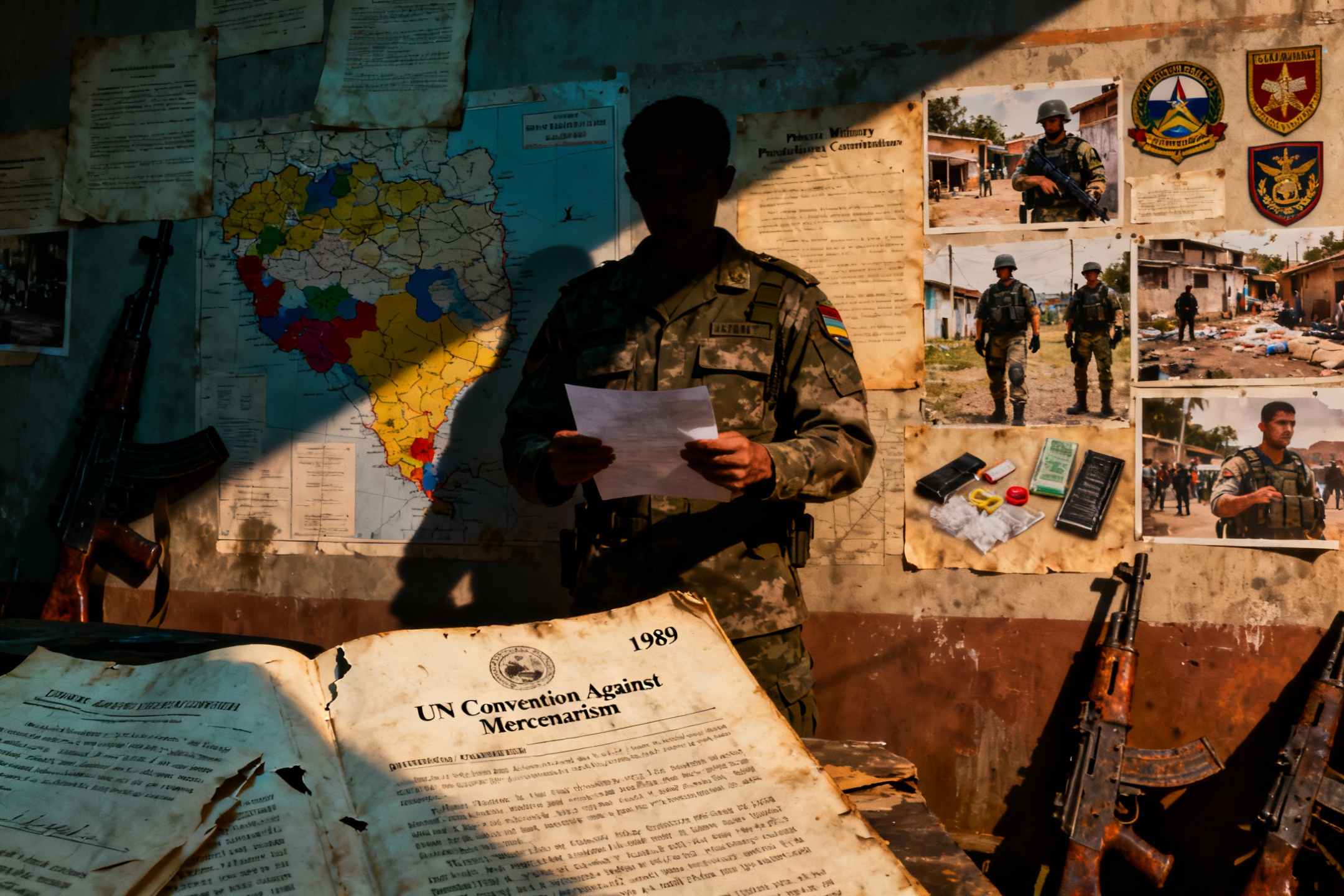
The law that prohibits mercenarism in Colombia is already a reality. This law adopts the International Convention (UN 1989) against the recruitment, use, financing and training of mercenaries.
President Gustavo Petro asked (Dec. 4) ‘free what he called, Colombian slaves who are recruited as mercenaries’ and employed in other people’s wars, a reality that has become especially evident in the Russian-Ukrainian-NATO conflict; although Colombian mercenaries have been hired for almost all the conflicts currently existing (for example, Sudan or participation in the assassination in Port-au-Prince of Haitian President Jovenel Moise).
Petro questioned that former members of the Armed Forces put their knowledge at the service of private actors in international wars. Here Petro reduces the phenomenon, the problem is more complex than a few former military officers who decide to sell their services. We will deepen it later.
The law is incorporated into the Colombian legal system; and the recruitment, financing, training, transportation or use of mercenaries are criminalized. This allows the authorities to investigate, prosecute and punish those who participate directly or indirectly in that activity.
The key question is whether the war business and especially the Anglo-Saxon, Zionist or Emirati military companies will lose manpower with this law.
The phenomenon of Colombian mercenarism is complex and multi-causal, the result of the convergence of historical, socio-economic, political and security factors. Let’s review the fundamentals:
Long civil war (almost perpetual)
The last Colombian civil war has been going on for approximately 60 years. This conflict has generated a culture of violence and militarization, as well as a large number of ex-combatants with military skills.
Following the demobilization of some armed groups (e.g. FARC-EP in 2016), and in the face of non-compliance with the Peace Agreements, many ex-combatants are vulnerable to being recruited as mercenaries.
It should be noted that to a large extent the programs of reintegration and reintegration into civilian life have failed in Colombia.
To this must be added the important and widespread variable of paramilitarism and contract killings, an aspect fed by an oligarchy that is not resigned to losing its privileges.
Socio-economic factors
Unemployment and poverty: Colombia is one of the most unequal countries in Latin America. The lack of legal job opportunities, especially in marginalized urban and rural areas, makes mercenarism an attractive option, because of the hook of high ‘wages’.
International demand
War as a permanent geopolitical reality is not going to disappear. And Colombia has thousands of unemployed ex-combatants, making it an attractive market for companies like Blackwater/Academi. They are hired not only as mercenaries, but also in the broad field of private security and logistics. Colombian mercenaries have been seen in Iraq, Afghanistan, Yemen and lately in Venezuela.
Private companies find the prestige of the Colombian ex-combatant attractive. They are perceived as disciplined, resilient, with real combat experience and “economical” compared to other Western “contractors”.
It should be noted that the privatization of war at the global level has normalized the use of military “contractors”. In this context, Colombia has become a congenital exporter of trained military personnel, due to the experience acquired in the internal conflict and the training provided by the United States.
Drug trafficking and organized crime
Colombian drug trafficking has created criminal networks with enormous economic resources, often hiring mercenaries to protect operations, dispute territory, or carry out targeted attacks. Dissident armed groups or simple armed gangs absorb former combatants into their ranks, which function as private armies at the service of organized crime.
Corruption and institutional weakness
Corruption in the Armed Forces and the infiltration of organized crime in institutions facilitate arms trafficking, information leakage, and the recruitment of mercenaries. Colombia is no stranger to the phenomenon of impunity in the justice system.
In conclusion, mercenarism has always existed in the history of humanity. But the drug capitalism we live in and its neoliberalism makes the phenomenon difficult to control. Much more so when the business of war is going well. However, it is good news that Colombia is beginning to put limits on this reality, since it is in the interest of all Latin Americans.
The problem is that Ecuador, which is falling into a deep black hole, may become a new market for the hiring of hitmen and mercenaries, at the service of organized crime and private war companies.
Which means that the best way to extinguish the phenomenon of mercenarism is to address its structural causes, and not just to deal with the problem with security measures and laws.