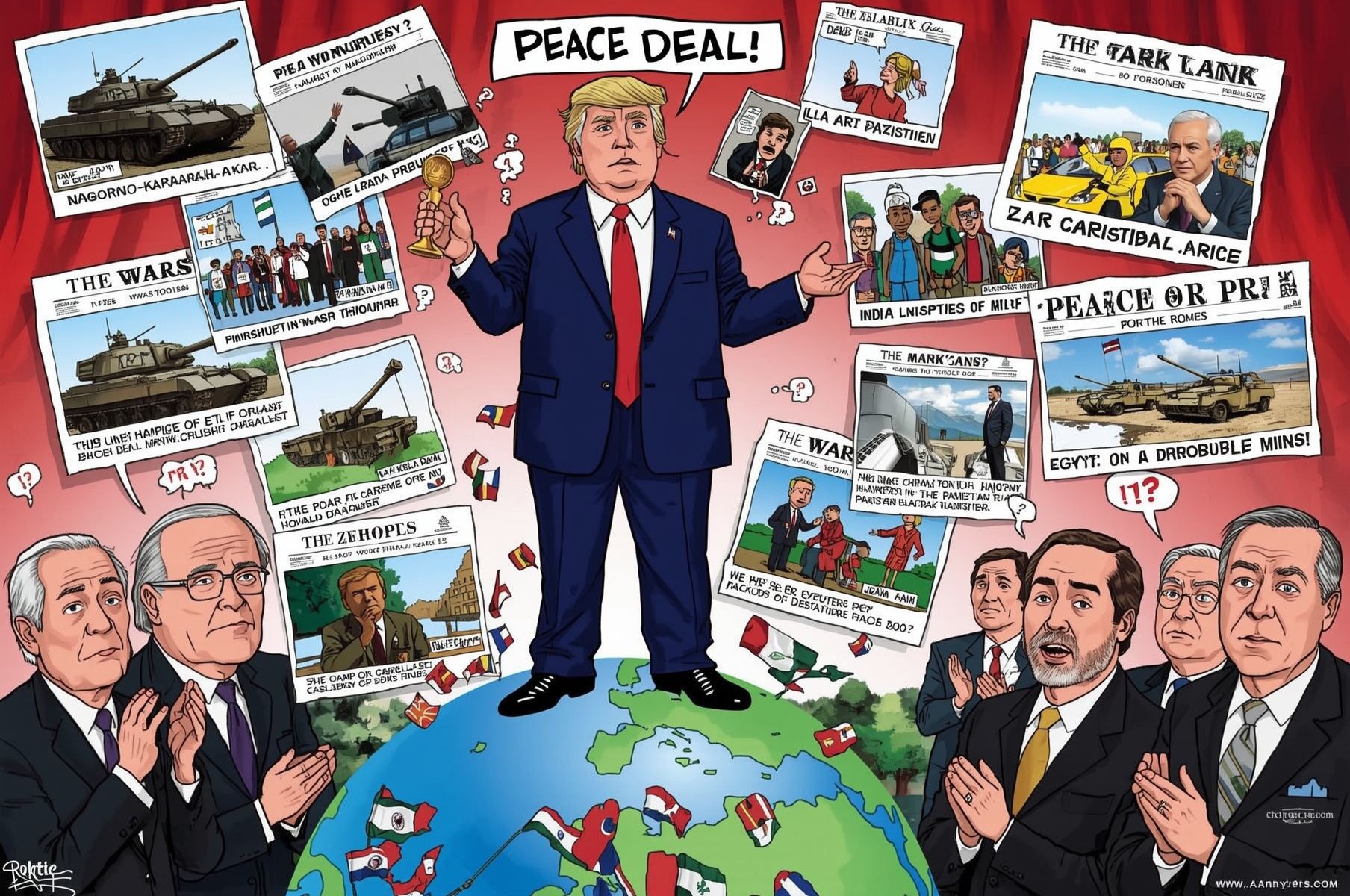
The President of the United States claims he deserves the Nobel Peace Prize for securing an end to global conflict. In some cases, the significance of its meaning is almost ambiguous, as is the success of his treatment of Gaza. Giuseppe Cassini speaks at his CRS (Center for State Reform).
All of Donald Trump’s political successes during this year of peacemaking have certainly been well-received and appreciated by the international community. He gave it his all. Besides, I know he was right: “As a businessman, I’ve gone bankrupt six times, but as president, I will now even the score by ending six conflicts around the world, to the point of deserving the Nobel Peace Prize.”
Kashmir
The conflict between two nuclear powers, India and Pakistan, was among the most agonizing. Well, now in that fascinating and blood-soaked Alpine region, harmony reigns between Hindus and Muslims. It’s a shame that Trump’s peacemaking intervention didn’t go down well with Indian President Modi, who complained about this “intrusion” biased in favor of Pakistan.
Coincidentally, the US has now decided to impose tariffs of 50% on India and 19% on Pakistan, which, out of gratitude, proposed in Oslo to award Trump the Nobel Peace Prize. Nagorno-Karabakh.
The long-standing conflict between Armenia and Azerbaijan over that disputed territory was resolved in favor of the Azeris, who have now militarily occupied it, expelling the Armenians who had always lived there. Trump had only a vague idea of where the territory with the comical name was located, but between the two contenders, it was easy to choose who to side with: Azerbaijan was the oil-rich one. Peace made.
Rwanda vs. DRC
Border clashes between Rwanda and the Democratic Republic of Congo had been raging for 30 years. Last June, the White House finally secured an agreement between the two sides, which Trump called “a glorious triumph.” Indeed, it was a triumph. Especially for the US, which benefited from the opening of local mineral resources to the many interested Western companies. Egypt and Ethiopia.
They are at loggerheads over a very serious dispute: Addis Ababa has completed construction of Africa’s largest dam on the Nile, and Cairo fears, with some justification, that the flow of water vital to the very survival of Egyptians will be halved. USAID could have provided essential technical assistance to Egypt, had it not been depleted by a presidential decree. The future conflict between the two populous African countries will be deadly, but in the meantime, Trump has included this dispute on the list of his diplomatic successes.
Thailand vs. Cambodia
This summer, the two border states came to blows, causing deaths and 300,000 refugees. Malaysia managed to bring at least a temporary peace between the two neighbors, but Trump simply threatened to suspend trade negotiations and then declared that “they will be fine for many years to come.”
Unfortunately, he didn’t have time to examine the root causes of that disagreement; so all that remains is hope. Russia and Ukraine. If Trump had been in Washington instead of that “corrupt” Biden, the war unleashed by the Russians in Ukraine would have been resolved in a day, according to him.
Having finally arrived in the White House, he deployed his best skills: embracing the invader and negotiating profitable Berlusconi-style agreements. But now, after ten months of increasingly bloody war, he has had the good sense not to include this among his successful “pacifications.”
However, to reach the number of six “pacifications,” he added to the list the peace between Israel and Palestine, presented to the White House a few days ago as practically concluded, unless… unless the Palestinians refuse to sign pieces of paper they haven’t even had a chance to thoroughly examine.
The fascinating drama in the Oval Office, with Netanyahu present and the Palestinians absent, was where Trump addressed those absent, essentially saying: “This is my proposal, elaborated in 20 points with the Israelis; if it is rejected, ‘Bibi knows what he has to do.’” Faced with a phrase that sounds slightly mafia-like, the Norwegian Nobel Committee will have a hard time awarding the prize to him. US President Donald Trump has lost count of the wars he claims to have resolved.
On the night of August 15, after his meeting with Vladimir Putin, in an interview with right-wing television station Fox News, he said: “I have negotiated the end of five wars.” Interviewer Sean Hannity, one of his most vocal supporters on TV, retorted: “I counted seven!”
Later, speaking to Ukrainian President Volodymyr Zelensky at the White House, Trump said, “I’ve ended six wars; I’ve ended six wars.” But then on Tuesday, again on Fox News, he repeated, “We’ve ended seven wars.” Regardless of how many, Trump claims to have achieved enough peace agreements to deserve the Nobel Peace Prize.
He also said he’s working so hard for peace because he hopes to go “to heaven, if possible.” It’s unclear whether he was joking, but his spokeswoman said he was serious. Trump has always used the English term “war,” not “conflict,” which is a bit more nuanced because it can refer to conflicts of various types: large-scale wars, border skirmishes, prolonged violent clashes, but also economic or political conflicts in which force is not used.
In listing these six or seven “wars,” as he calls them, he has effectively lumped together incomparable situations and conflicts of varying types and intensity. It is a rhetoric that serves him well in his attempt to present himself as a great peacemaker, but which is far from reality and describes wars and conflicts in an approximate manner.
Trump did indeed play a role in some of these agreements, even a decisive one. Indeed, some of the peace agreements he speaks of aren’t even peace agreements. Despite this, President Trump’s intentions are consistent with those of a “peacemaker,” as many voters expected.
But the complexity of long-standing conflicts doesn’t make negotiations simple. On the contrary, critical issues emerge that end in dead ends, issues of which the tycoon likely lacked full and thorough knowledge. Let’s take a closer look.
Israel and Iran
What Trump himself called (with a name that stuck) the 12-Day War between Israel and Iran was actually ended by Trump.
After Israel began bombing Iran on June 13th, Trump wrote on his social media account, Truth, on June 23rd that the two countries would “initiate a CEASEFIRE” the following day, and they did. However, the ceasefire began only after the United States also bombed Iran, in an attempt to destroy the country’s nuclear sites.
Furthermore, Trump did not actually reach a peace agreement, but only a cessation of hostilities, which is likely temporary: the difference is significant, because the cessation of hostilities is intended only to stop the fighting, while the peace agreement is intended to end the war and define future relations between the parties. In the case of Israel and Iran, there is no permanent peace, and no agreement has even been reached to monitor the status of Iran’s nuclear program.
This is a recurring theme in other agreements made by the president as well. India and Pakistan. Trump claimed to have been responsible for ending the border clashes between Pakistan and India, which erupted in May in the disputed region of Kashmir.
Trump also wrote in Truth that the two countries, thanks to him, had agreed to a “COMPLETE AND IMMEDIATE CEASEFIRE.” Pakistan and India have differing versions. Pakistan has decided to curry favor with Trump, acknowledging his great merits and even nominating him for the Nobel Peace Prize. It’s no coincidence that Pakistan has been in the US president’s good graces in recent months.
India, on the other hand, has said Trump hasn’t done much, and that the ceasefire was agreed directly with Pakistan through pre-existing military channels. It’s probably no coincidence that relations between India and the United States have deteriorated in recent months, and that Trump has imposed 25 percent tariffs on many of the country’s exports, which will rise to 50 percent at the end of August.
Rwanda and the Democratic Republic of the Congo
In June, the Trump administration hosted the foreign ministers of Rwanda and the Democratic Republic of the Congo in Washington to sign an agreement intended to end hostilities along the eastern border of Congo, one of the world’s longest-running and most complicated conflicts.
Trump considers it one of his greatest successes, and often cites it when speaking of peace “in Africa.” But there are some problems.
First: the conflict is not between Congo and Rwanda, but between Congo and a series of militia and rebel groups, the most famous of which is the M23, which has very close ties with Rwanda but is not directly under its control. The M23 did not participate in the negotiations.
Second: the violence has never truly stopped, and the parties have already accused each other several times in recent months of violating the ceasefire.
The June agreement was supposed to be just the first step in a series of subsequent meetings and negotiations, which however have not yet taken place, and it is unclear whether they will ever take place. Armenia and Azerbaijan.
In early August, the President of Azerbaijan and the Prime Minister of Armenia shook hands in front of Trump at the White House. It was a historic moment, as the two countries have been at war for nearly forty years, and last clashed violently in 2023, when Azerbaijan conquered the Nagorno-Karabakh region, which is formally Azerbaijani but controlled and inhabited by Armenians.
Peace talks between the two countries have been ongoing for years, but Trump’s pressure, and the prospect of a prestigious visit to the White House, likely favored and facilitated the signing of the agreement.
At the same time, what was signed at the White House is not a peace treaty, but a declaration of intent to pursue new negotiations. Armenia and Azerbaijan have not reestablished diplomatic relations, and the border between the two countries remains closed.
Cambodia and Thailand
At the end of July, serious border clashes erupted between Cambodia and Thailand, killing 42 people and temporarily forcing at least 300,000 people from their homes. Ceasefire negotiations took place in Malaysia and were led by the Malaysian government, but Trump intervened, claiming that if the two countries did not make peace, he would halt ongoing trade negotiations with both countries and impose heavy tariffs.
Cambodia and Thailand are both dependent on exports to the United States, and Trump’s threat likely contributed to the signing of a ceasefire. However, this too represents more of a cessation of hostilities than a comprehensive peace agreement that would address the underlying causes of the hostilities.
Egypt and Ethiopia
It’s not at all clear why Trump claims to have promoted peace between Egypt and Ethiopia. First, because the two countries aren’t actually at war: they’ve been embroiled in a diplomatic conflict for years over a large dam Ethiopia built on the Nile River, which threatens Egypt’s water supply. The Trump administration maintains that even if there isn’t a war, there would have been one if the president hadn’t intervened, but it’s unclear what kind of intervention was made.
Trump attempted to organize negotiations during his first term, but without success. At the end of July this year, Egypt’s Foreign Minister declared that negotiations with Ethiopia were completely stalled.
Serbia and Kosovo
The latest alleged peace deal Trump claims (this is the seventh; it’s sometimes cited, sometimes not) concerns Serbia and Kosovo, two countries that have had complicated and hostile relations since Kosovo seceded from Serbia in 2008 (the situation worsened in 2023 and 2024). However, they are not at direct war.
At the end of June, Trump wrote in Truth: “Serbia and Kosovo were about to have a major war. I said, ‘If you try that, there’s no trade with the United States.’ And they said, ‘Well, then we’re not going to do it.’” It’s not really clear what major war and what negotiations Trump was referring to. In 2020, during his first term, Trump favored an agreement to normalize economic relations between the two countries, but it was largely disregarded in subsequent years. It’s unknown whether there have been more recent attempts.