Beyond the specific issue of the war in Ukraine, what can we learn from the TRUMP-PUTIN meeting in Anchorage on August 15?
An event of global significance because it was an unlikely, personal encounter between the heads of state of the world’s two leading nuclear powers.Admittedly, very little definitive information has been released at this stage, and no concrete decision has been announced.And given a number of uncertainties, it is extremely difficult to predict what will happen next. In reality, this meeting is primarily spectacular in terms of images and symbols.
What can we learn from it?
This is the first “man-to-man” meeting, six years after the previous one, and at a time when the world has changed considerably, between the two Russian and American heads of state. It was an opportunity, in front of European politicians petrified with apprehension, to note their apparent good understanding. This good understanding, in essence, is not at all surprising, as it is obvious that certain important subjects, such as, for example, their respective visions of traditional societal values, are common to them.
It therefore seems that this August 15 in Alaska has clearly put an end to the exchanges of irritated communiqués, even of little killer phrases or even more or less threatening ultimatums, of recent weeks, and that a direct dialogue has thus been restored between the two leaders of these two great world powers.
Bilateral Russian-American relations have been severely damaged since the collapse of the USSR by the implementation of the Brezinsky Doctrine and by American policy, illustrated in particular by the desire to destabilize Russia through NATO’s push eastward, despite the commitments made and assurances given several times to Russian leaders.
Who could not welcome, for the sake of world peace and stability, a direct and frank dialogue between these two heads of state? Personally, I believe that this face-to-face meeting probably triggered the reestablishment of a certain “personal” trust between the two heads of state. And that is, of course, a major event in itself.
But what did they really say to each other?
According to some indiscretions reported by the press, it would seem that the discussion allowed Trump to learn or confirm a certain number of facts that he suspected. For example, on the manipulation of which he was the victim during the previous American presidential election in 2019, or on the circumstances of the outbreak of this war from 2014 (Maidan) to 2022 (beginning of the “special military operation”), and in particular the disinformation that has characterized this war since the beginning (Boutcha).
This meeting naturally benefits Donald Trump, who is seeking to cultivate his image as a peacemaker, despite his unwavering support for Netayahu in Palestine. Hasn’t Trump publicly expressed his ambitions to win the next Nobel Peace Prize?!
For Vladimir Putin, it is also a great success to re-establish, to the great displeasure of european leaders who have not spared him insults and threats for three and a half years, a direct dialogue with the leader of the greatest Western power, thus driving a wedge into the beautiful facade of unity of the atlanticist camp.
One sentence from Putin is very important: “If Donald Trump had been in office, this war would not have happened.” It echoes a nearly identical sentence from Trump, who claimed that if he had been the current president, the war would not have happened. Euro-Atlanticists (including the UK) are in a state of dismay. And for good reason!.
This meeting, beyond the progress it represents on the specific issue of the war in Ukraine, highlights, in my opinion, the double defeat of NATO and the EU, these two supranational organizations diverted from their initial objectives and become warmongers.
According to certain information reported by my friend, French General Jean-Bernard Pinatel,
- Trump has abandoned the (pro-European) idea of a “ceasefire” in favor of a “peace treaty that addresses the root causes of the conflict”.
- Putin is willing to sign such a peace treaty if Ukraine definitively renounces its plan to join NATO and if the Russian-speaking Donbass joins Russia. In return, he would agree to relinquish the territories of Kherson Oblast located west of the Dnieper River, including the city of Kherson itself, as well as the part of Zaporizhzhia Oblast not yet under Russian military control.
While this meeting constituted, in a way, the first step in this possible peace process, the “second round” for Donald Trump took place three days later with Zelensky himself and several European leaders at the White House.
On Monday, August 18, Zelensky was invited (summoned?) by Trump to Washington.
But, very worried about seeing him leave alone, the Euro-Atlantic leaders, namely Giorgia Meloni, Keir Starmer, Friedrich Merz, Emmanuel Macron, Alexander Stubb, Mark Rutte (NATO) and Ursula von der Leyen (European Commission) accompanied him. This meeting, however, took place in two stages:
- A confidential one-on-one meeting between Trump and Zelensky, with a map showing the current situation in Ukraine and the Russian-speaking areas in the east liberated by the Russian army as a backdrop;
- A subsequent meeting with the entire delegation from Europe.
Without, of course, having precise and complete reports, it seems that the meeting between Trump and Zelensky “went well,” by the latter’s own admission. What did Trump say to Zelensky, however? We can suspect that the essential messages were delivered to him in full by Trump following his meeting with Putin in Alaska on August 15. In any case, it emerged that the principle of a meeting between Zelensky and Putin was accepted and confirmed by the latter to Trump, during a telephone conversation between the two men, on the sidelines of the meeting with euro-atlantic leaders. This meeting could take place soon in Moscow.
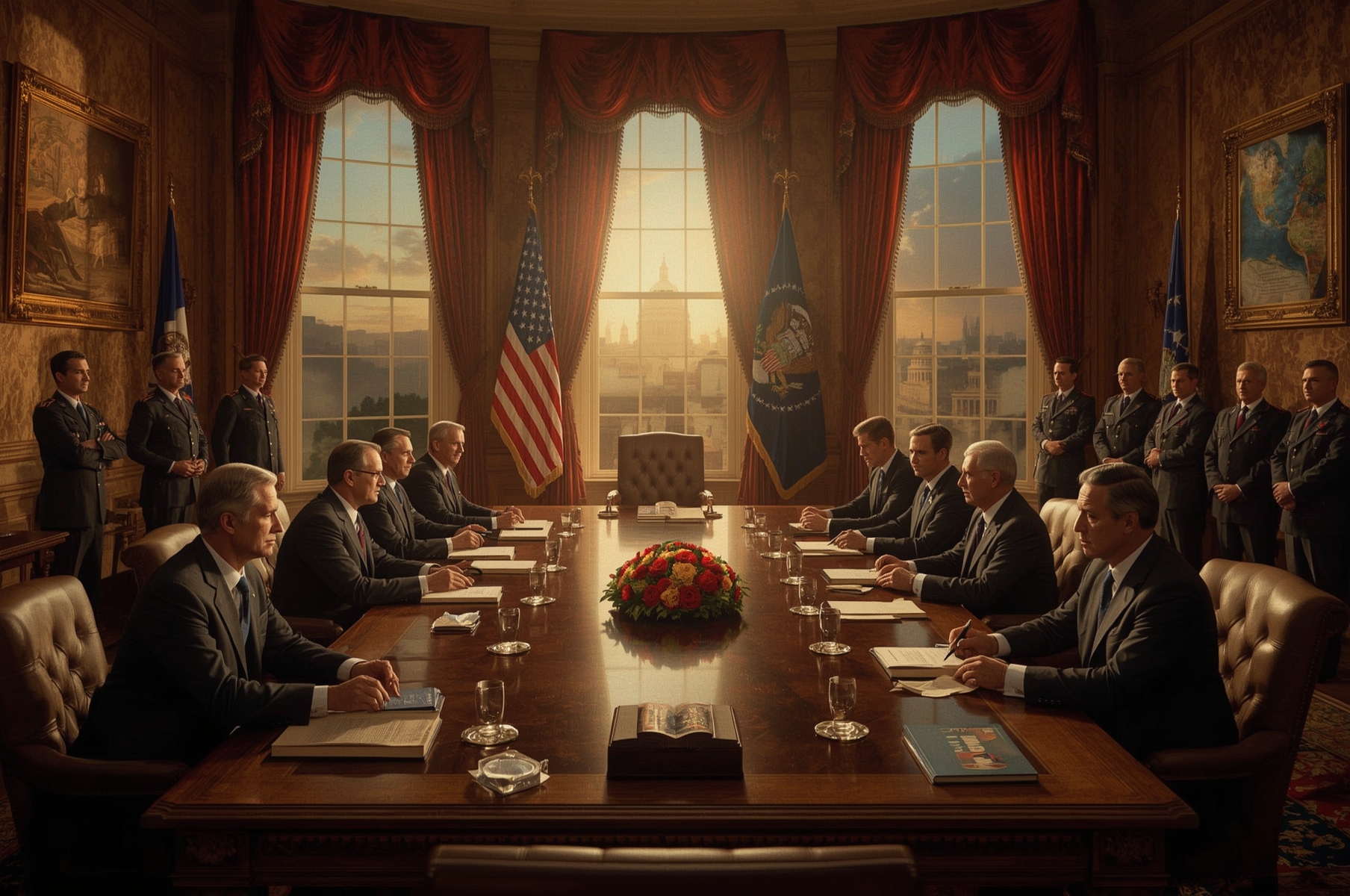
As for the plenary meeting with european leaders in the presence of Zelinsky, it seemed to have unfolded like a play in which the american president brilliantly played the leading role. He addressed each of them in a pat tone, not devoid of flattery tinged with obvious irony. Trump made it clear to them that he was the leader of the game and that either he imposed his views, shared with Putin, of a Peace Treaty with immediate effect, subject to the general conditions mentioned above, or the war would continue, to Russia’s advantage, and then he would lose interest. In any case, the idea of a “ceasefire” rejected by Putin has clearly been abandoned. The euro-atlanticists had only to bow.
Perplexed, but silent, the latter took it. Deep down, they know very well that without the United States, their room for maneuver is very limited, if not nonexistent. Trump’s messages, both in the first and second degree, got through.
Only the German Chancellor and the Finnish President, joined a little later by the French President, subsequently, in front of their respective national press, reiterated their attachment to the dream of Ukraine’s “territorial integrity” and their doubts about the reliability of the Russian President’s word in his commitments!.
But it’s clear that they’re in the uncomfortable position of being America’s de facto vassals, who nonetheless don’t want to lose too much face, even though they’re marginalized and their voices are now neutralized.
The only apparent concession made: the need to consider Ukraine’s famous “security guarantees” once peace is signed. It therefore appears that a technical meeting of the Euro-Atlantic chiefs of staff is scheduled soon for this purpose, but of course, it will have to take place at the Pentagon, under the direction of their American counterpart!
Zelensky himself has visibly softened his untenable positions and is clearly deferring to Trump. Is he suddenly experiencing a realization or simply resigned? Some even claim that he is now thinking more about his personal future than the fate of his country and its people (?).
Incidentally, it is significant that neither NATO Secretary General, the Dutch President Rutte, nor the President of the European Commission, the German President Ursula von der Leyen, made their voices heard, thus de facto signaling their submission to the American President. It must be recognized that neither was in a position to distinguish themselves.
The former because NATO exists only through the United States of America, the latter because she personally pledged allegiance on July 27 to the American President by subjecting the European Union to an impossible agreement, much criticized in Europe, with the United States (a 15% customs tariff applicable to all European products without exception, purchases of $750 billion of American energy, European investment of an additional $600 billion in the United States).
This “agreement” imposed by Trump could also cost this German civil servant dearly, who is already facing numerous suspicions of corruption, starting with her position as President of the European Commission.
To the extent that we can draw any conclusions at this stage from these two consecutive events held three days apart, we must recognize that this is a significant step forward in resolving the war in Ukraine, and that this step forward is due to the initiative for dialogue taken by the American president with his Russian counterpart.
There’s nothing shocking about this. The United States was at the origin of this tragedy, and its responsibility was directly and undeniably engaged, starting with the Maidan putsch, which it financed and orchestrated.
But beyond the settlement of the war in Ukraine, these events were a real coup de etat:
- The Cold War, which had been reigniting between West and East since 2022, seems to be receding in favor of a real détente, at least between the two most important powers: the United States and Russia. Dialogue appears to have been constructively reestablished between Russia and the United States, and above all, a direct relationship has been restored between their two leaders. This will clearly not be without consequences on other hot topics: the Middle East, Iran, the Caucasus, China, etc.
- This dialogue politically and diplomatically consolidates the position of Russia, already militarily victorious on the ground, and that of its President Vladimir Putin.
- The big loser is obviously the European Union, whose decline is flagrant, in some way disavowed and weakened by the United States, as well as the leader of the European Commission, submissive and silent; but the other big loser is NATO of course, beaten on the battlefield, despite the number and power of the means committed to the Ukrainian proxy, and whose existence depends solely on the guarantee of the United States.
However, this first step, which is the settlement of the war in Ukraine, remains to be finalized. Trump will obviously have to reckon with the silent opposition, even the backstabbing, of certain European leaders, I am thinking particularly of Merz and Macron, who, having little left to lose, will likely try to covertly sabotage the peace process and the one they feared above all: a rapprochement between Russian and American positions.
Trump will also have to reckon with the forces of the deep state he has declared war on, who will do everything to make his task difficult. He will also have to reckon with the fractured state of American society and the new international situation resulting from the emergence of the BRICS and a multipolar world, and the de-dollarization that has begun, whether he likes it or not.
Finally, he will also have to assume his commitments – sometimes incoherent or difficult to follow! – on the most sensitive issues that constitute the Israeli-Palestinian conflict and its regional extensions, Syria, Iran, and then the Caucasus, the Indo-Pacific region and finally China, which he perceives as “THE” threat and to which Putin has notably moved closer since the West resolutely turned its back on him.
In this new process, which marks a radical turning point in international relations, setbacks and surprises cannot be ruled out. World peace remains more fragile than ever. But the beginnings of a détente between East and West now seem possible, and this is to the credit of Trump and Putin.
Ideally, while we must devote ourselves to the essential recovery of France and the old and great nations of Europe, which are unfortunately currently out of the game, the Trump-Putin meeting should be followed by a Trump-Putin-Xi Jing Ping meeting, the beginnings of a multipolar dialogue finally accepted by the powerful of the planet.