Greenland is a self-governing territory within the Kingdom of Denmark, with an indigenous Inuit population that has its own government and parliament. Copenhagen retains control over foreign policy and defence, with the right to independence, which is an ongoing topic of debate. Although geographically it is part of North America, politically it is under the Danish crown, which has managed it as an integral part of its kingdom since 1953, while recognizing its wide autonomy, which a large part of the local population would like completely. To be precise, Danish sovereignty dates back to medieval Norse settlements, established there at the end of the tenth century.
After the US capture of Venezuelan President Nicolás Maduro on January 3, 2026, Trump said that Washington would “worry about Greenland in about two months”, adding that Russian and Chinese ships were operating around the island and that “we need Greenland from a national security point of view”.
On Friday, Trump warned that the United States will impose tariffs on European and non-European countries that will oppose his ambitions to annex Greenland. According to Danish officials, but above all, logically, this move would put an end to NATO, an obsolete and expensive institution, whose power is increasingly reduced in a global, in fact, multipolar context.
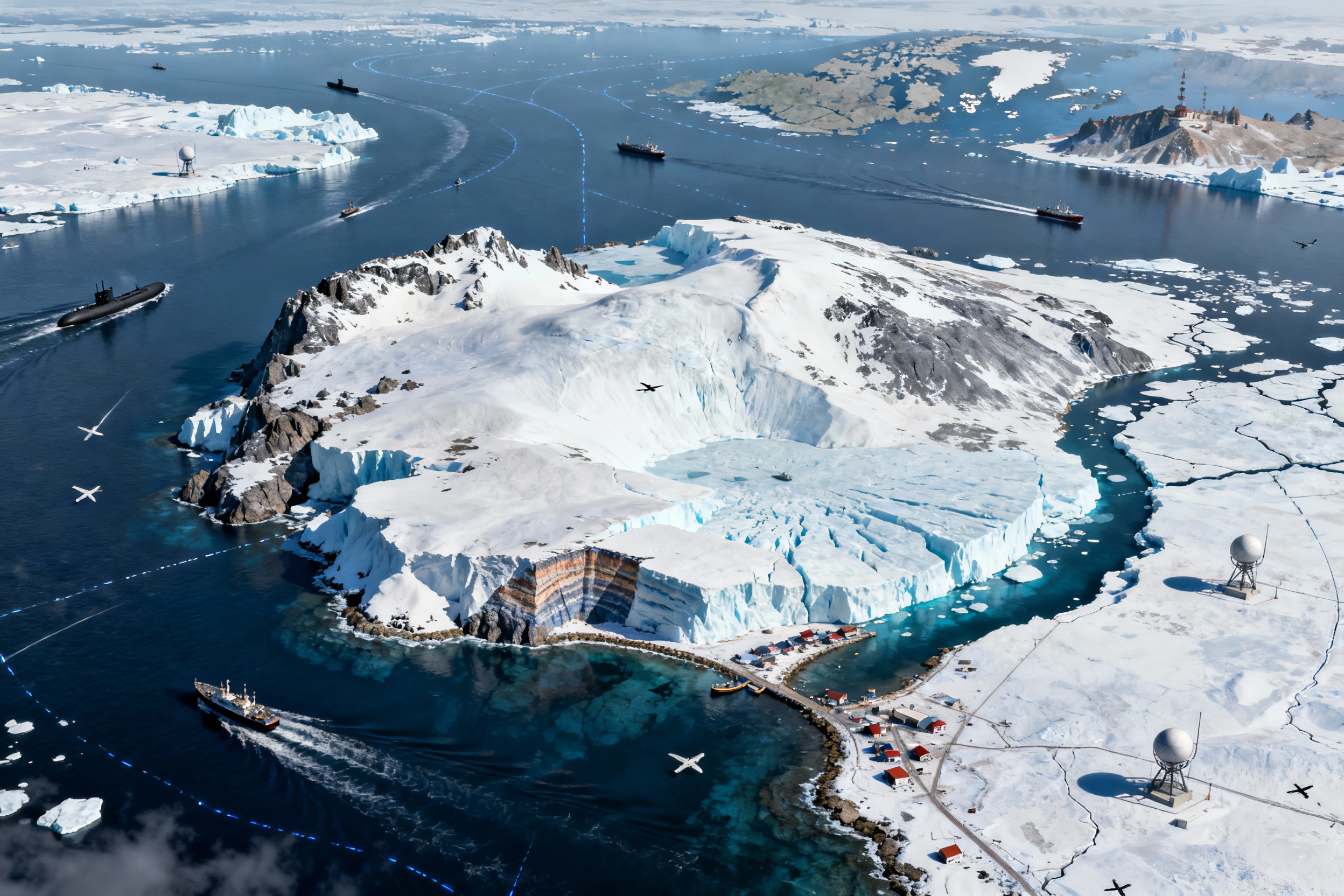
Today, Greenland is home to just 58,000 people, spread across one of the most sparsely populated regions on Earth. About 80% of the island is covered by ice, concentrating the population along the southwest coast near the capital, Nuuk. The economy is small and heavily dependent on fisheries, supplemented by substantial annual subsidies from Denmark. Despite its immense land size, Greenland does not have a road or rail network connecting cities, especially since the land is always frozen. Inter-community travel relies on planes, boats, helicopters, snowmobiles, or dog sleds, with ocean freight being the most common option.
During the Cold War, Greenland’s importance grew as the Soviet threat intensified. Today, the United States operates the Pituffik Space Base, formerly Thule Air Base, in northwestern Greenland. The United States established an air base in Greenland in 1943 to counter German threats, using the territory as an advanced operational platform for maritime defense.
The installation remains central to early warning radar and space surveillance systems designed to detect intercontinental ballistic missiles. Strategically, Thule represents the shortest route for U.S. bombers to reach Russian targets and is the closest permanent military outpost to the North Pole.
Bernstein analysts, led by Irene Himona, argue that the central problem is not about energy or minerals, but about Greenland’s strategic location. The largest island in the world is located between North America and Europe, within the Arctic Circle, in a position that has made it a military garrison since World War II. The distance between Russia and Greenland is only 5663 km.
Irene Himona describes Greenland as a guardian of the North Atlantic. Its geography provides control over the GIUK corridor, the maritime corridor that connects Greenland, Iceland and Great Britain. This passage serves as a gateway between the Arctic Ocean and the Atlantic, and US strategists note that Russian submarines and surface ships must pass through it to access Atlantic shipping lanes.
From a defense perspective, Greenland offers a critical vantage point to monitor and deter these movements. However, analysts have increasingly questioned whether the current defense framework can respond quickly and on a large scale to the acceleration of Russian militarization in the Arctic. Having the island would mean, for the United States, garrisoning its north-east in the face of possible escalations not only by Russia, but by China and North Korea, historical allies of Vladimir Putin’s Federation.
Greenland also figures prominently in discussions on raw materials. The island is home to deposits of rare earths, uranium, zinc, iron ore and other materials essential for modern technologies and military systems. A 2023 investigation found that Greenland contains 25 of the 34 minerals classified as “critical raw materials” by the European Union. These include components for electric vehicles, smartphones, and advanced weapon systems.
However, Bernstein is skeptical about the short-term relevance of Greenland’s mining potential. Access to resources is limited to ice-free coastal areas, and while the island’s early Precambrian geology is favorable, development faces legal, environmental, and logistical obstacles. Many rare earth projects are complicated by the presence of uranium and proximity to UNESCO-protected sites. The time for extraction extends well beyond political cycles, and current production remains minimal.
“We do not see an obvious extraordinary near-term opportunity from Greenland’s mineral resources,” Himona wrote in a note. Bernstein analysts argue that concern for national security, rather than untapped resources, better explains the renewed U.S. interest in the island.
Minerals may be important in the future, but it is strategy, not extraction, that drives Washington’s renewed interest. Himona says that global markets currently have no shortage of rare earths and that resolving one geopolitical rivalry, creating another, would be a bad choice. According to logic he would be right, but Donald Trump has not always shown that he thinks this way: he could solve both at the same time, with the use of force. At the moment it is not planned, but in the next three years of government of the States, who knows…
“Reality has so far undermined the oil rush narrative. With about 15 exploration wells drilled, this has been a story of disappointment,” the analyst wrote, adding that large parts of the island are “covered by inland ice several kilometers thick, local ice sheets, and glaciers.”
Trump’s obsession with Greenland is centered on power projection and control. “Greenland was probably never just about buying land or oil. We think it is about the control of the Western Hemisphere” – said the analyst, grasping the real vulnus of the issue.
While in the past it was almost impossible to cross from the Atlantic Ocean to the Pacific through Bering or vice versa, today two operational routes are open: the Northwest Route, which runs along the edges of Canada and Alaska, and the Northeast Route, which runs along the Russian edges. Last year alone, more than 1,500 ships transited, which, although escorted by Russian, Canadian or American tugboats, crossed this sea, shortening travel times by about half. To go from Rotterdam to Korea, China or Western America, it no longer takes the forty days of the Suez route, but it takes less than twenty days.
The European Union defends Denmark’s territorial integrity and sovereignty, declaring itself willing to double the funds to strengthen defense works. The European Parliament condemned the United States’ requests as a serious challenge to international law, which, however, Trump has shown to have little regard for.
Then there is the problem of NATO. Secretary Mark Rutte said Arctic security was a priority, converging with Trump, but added that a clash between allies must be avoided. NATO was created to defend members from external aggression (such as the Soviet Union), but the hypothesis that another NATO member was attacking one member was never considered. It would be a paradox: to hypothesize a clash led by an American commander-in-chief (the NATO general) against an invasion of American forces. Science fiction? Probably yes, but let’s always keep in mind that the globalist order of the EU and NATO has never pleased the US President, for reasons of costs greater than benefits.
It must also be taken into account that Trump’s words are not always followed by deeds, as we have seen with the policy of tariffs, which have gone from threats of 200% to modest cuts. A compromise could be found through an increase in NATO’s military presence in the area; more significant concessions in the energy and mining fields to the United States, or a block on the concessions made to Russia and, above all, to China, which currently has four presences for geological research.
Therefore, it seems correct to say that the Greenland issue falls within the framework of “make America against” and “America first” that embarrasses the EU and NATO by demonstrating their great weakness in front of the whole world, especially in the eyes of the BRICS+ who observe two ambivalent facts: the US primacy on the one hand and the papier-mâché muscles of the EU. On the economic level, history has shown that interesting agreements can be found with Trump for all parties involved, only if Washington is guaranteed the role of “primus inter pares”. Putin and Xi Jinping know this very well and are playing along, at least for now.
On a strategic and geopolitical level, it is not so easy to still guarantee an American primacy in the terms seen so far, because the Chinese and Russian superpowers want to share the cake, called influence in the world.
Therefore, while the EU is a manageable hindrance, in Trump’s eyes, favoring Eastern adversaries has never been pending the President and will not be this time either, since their settlements in Greenland are already there and will accommodate the changes with new trade contracts. The US more present, in the formula that will be found, could guarantee the management of any future situation and movement. It is not in the nature of Trumpian policies to give gifts to those the Tycoon fears.