While the three major nuclear powers (the United States, Russia and China) have not carried out nuclear tests for three decades, President Donald Trump announced impromptu on October 30 the resumption of American nuclear tests.
What can this sudden politico-nuclear posturing mean?
This pithy announcement, in the erratic style of the occupant of the White House, was intended to resemble a kind of declaration of force, just moments before his meeting in South Korea with Chinese President Xi Jing Ping. It was also of course intended as a virile response to the recent Russian declarations relating to the tests of the new Burevestnik and Poseidon vectors, which obviously mark, by the way, the undeniable advance in the field of “missile” of the Russians and, in mirror, the backwardness of the Americans, an observation necessarily more than “annoying” for Donald Trump, imbued with his demanding slogan: “MAGA”
In reaction to this deliberately somewhat provocative announcement, the Russian president first of all wanted to firmly refute the accusations of his American counterpart that Russia was carrying out secret nuclear tests, even though Beijing had reaffirmed that it would no longer carry out any nuclear tests.
On this occasion, Sergei Lavrov, the Russian Minister of Foreign Affairs, recalled the obvious that if Russia had carried out a nuclear warhead test; the United States would obviously have known about it immediately thanks to the global surveillance system.
But in fact, Vladimir Putin has mainly proposed to relaunch dialogue on the issue of nuclear tests. It should be remembered that while Russia is a signatory to the Comprehensive Nuclear-Test-Ban Treaty (CTBT), which it has ratified, the United States is also a signatory but has never ratified it.
In this respect, it is necessary to clarify the notion of “nuclear test”, apparently rather vague for Donald Trump. A distinction must be made between tests on nuclear weapons themselves and tests on the means of delivery for their use. While the former are theoretically banned, the other tests, whether subcritical or without a nuclear chain reaction, as well as the tests of delivery systems (missiles or torpedoes), have never been banned. This is precisely the case of Burevestnik and Poseidon.
Moreover, if full-scale nuclear tests are in principle prohibited, we can now ask ourselves whether they are essential. A number of researchers and engineers, particularly Americans, explain to us that these full-scale tests are now obsolete and that now the supercomputers and high-end scientific devices of the United States make it possible to carry out realistic and credible simulations, in excellent conditions of reliability.
However, other voices are being raised to affirm the interest of carrying out full-scale nuclear tests. This is the case, for example, of the French engineer and scientist Jean-François Geneste, who tells us in essence that nothing can replace full-scale tests, if only because simulation, however sophisticated, cannot take into account the real risks associated with technical imperfections and unforeseen events, but also because the complexity of nuclear weapons requires the maintenance of real experts that simulation alone will never be able to form. These “technical” arguments deserve of course consideration because they constitute the backdrop to this gesticulation.
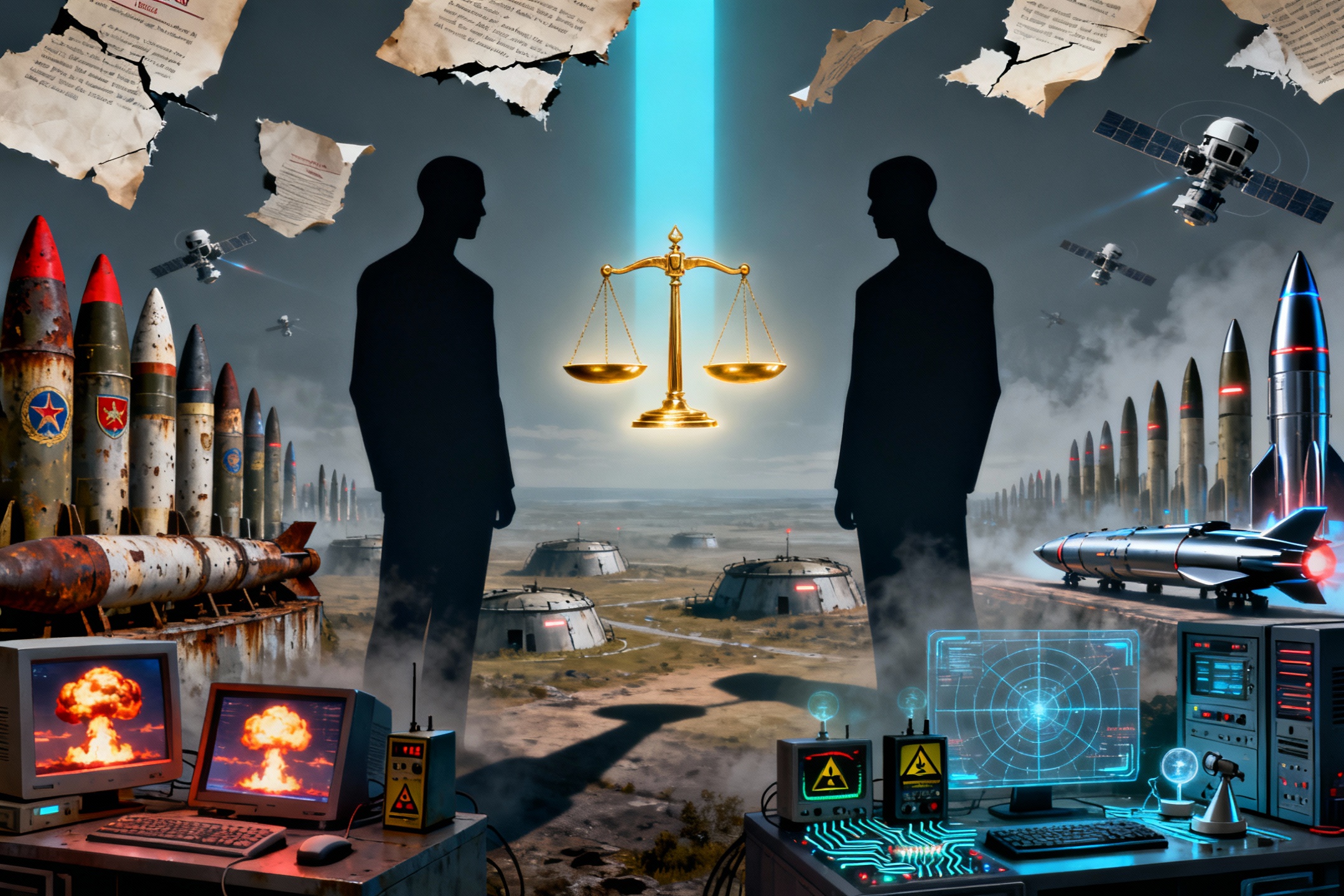
If we look at the forces at play in the nuclear field, there is today a kind of balance between the two great powers in question.
Indeed, while Russia undeniably has a technological lead, illustrated by the entry into service of the Oresnik hypersonic missile, but also by the development of the Burevestnik missile and the Poseidon torpedo, the fact remains that the United States has so many vectors, even relatively obsolete, that its threat remains credible. This has been the case for decades and continues to maintain the balance of deterrence.
It should be remembered that the latter is based on the major fact that in the event of a nuclear launch, immediately detected by the surveillance systems, the response is triggered automatically even though the initial launch has not yet reached its goal. It is this certainty of self-destruction, guaranteed on both sides, both for the attacker and for the attacked; which is the very foundation of deterrence.
Deterrence is therefore a concept that must continue because it has proven itself. It is a guarantee of peacekeeping. In this kind of verbal confrontation between the United States and Russia, however, some see a risk of triggering a nuclear war.
What is the situation in reality?
I do not believe that this is possible, precisely for the reason I have just mentioned. Deterrence guarantees peace, at least in the nuclear field. Of course, it is in everyone’s interest to maintain this balance, starting with the two powers in question, which we can see – despite a certain number of verbal skirmishes, real or simulated (?) – that they do not want escalation and a direct, conventional and a fortiori nuclear confrontation.
There is no such thing as “zero risk”, however. The risk is directly linked to the personalities of the leaders at the controls of the nuclear weapon and to their assessment of the general situation at the time. What can be called the “psychological factor”.
Thus, for some experts, the greatest risk of a nuclear war would come from the United States, which today is in the grip of a threat of internal collapse comparable to that of the USSR in its time. In this sense, President Trump’s sometimes erratic statements – or statements that may appear to be so – could be analysed as a real threat to peace. The risk could indeed be for the American President to appear unreliable to his Russian interlocutor (as well as his Chinese counterpart for that matter).
However, peace needs above all stability and therefore dialogue and diplomacy. Hence the interest of this proposal for dialogue made by President Putin to President Trump to cut short an escalation on the sole issue of nuclear tests.
In reality, at a time when Donald Trump’s Peace Plan for Ukraine is being unveiled, largely inspired by the main Russian demands, while the military defeat of Ukraine (and therefore of NATO) is becoming a tangible reality, it is obvious, even if they are different subjects, that dialogue should prevail in my opinion, with the development of a number of agreements between the United States and the Russian Federation, even if they are special bilateral agreements between the two countries.
The real issue that arises, in my opinion, is that of the threat of an arms race, which is greater than that of nuclear tests.
As a French analyst, Guillaume de Sardes, rightly pointed out in an interview with former Russian ambassador Ednan Agaev, “since the end of the Cold War, strategic relations between the United States and Russia have been based on a set of agreements aimed at limiting the nuclear arsenals of the two powers and regulating their deployment. Among them, the New Strat Treaty, signed in 2010, is the last pillar still standing in an edifice of mutual trust that has been built with great difficulty over several decades. The rest of the edifice has already collapsed.
The United States has already unilaterally withdrawn from the ABM Treaty on missile defense (2002), then from the INF Treaty on Intermediate Nuclear Forces (2019), and finally from the Open Skies Treaty (2020). These successive withdrawals have called into question the logic of arms control: transparency and predictability have given way to mistrust and technological competition.
In February 2023, Russia in turn suspended its participation in the New START Treaty (which will end on February 5, 2026), believing that the conditions for its implementation had become unfair and that Washington was exploiting the strategic situation to serve its own interests, including through the expansion of the American missile defense system and the militarization of space.”
According to Ednan Agaev, the Americans had in fact understood towards the end of the 1960s that an uncontrolled arms race offered no prospect of victory against the Soviet Union, because no one wins a nuclear war. This is the reason why, according to him, the Nixon administration had then pursued a policy of openness and therefore to open negotiations with a view to limiting strategic nuclear weapons, thus making a mutual commitment not to develop or deploy an anti-missile defense system.
This is how the agreement to ban missile defence systems (ABM) was signed, which thus formed the basis of the new rules of coexistence between the two nuclear powers.
But from the 80s, the situation changed and changed even more radically with the end of the USSR. The Americans began to believe, thanks to their technological superiority at the time, in a possible overcoming of the principle of mutually assured destruction and in the establishment of a new security system that was more advantageous for them.
This became a reality with the launch of the SDI (Strategic Defense Initiative) under President Reagan, in other words the Star Wars concept.
This led to the gradual questioning of the principle of equality between the two countries, with the United States no longer considering Russia a “superpower”. In reality, the United States was renewing its desire for hegemony, ignoring the fact that even if Russia was experiencing temporary difficulties, it was still a major nuclear power, although no longer the USSR. These successive withdrawals resulting from their hegemonic vision of the world have obviously consequently seriously dented the confidence of Russia, which has perfectly deciphered American ambitions.
Under these conditions, it is certain that the first necessity today is the gradual restoration of a certain trust between Russia and the United States.
Strategic arms control is an indispensable step towards eventual progressive disarmament. But as Ambassador Agaev says, they are both the result of trust and a measure of trust. It is essential that each party understands that reaching an agreement with its potential adversary to control the level of armaments is a guarantee of real and effective security for each state.
Treaties are in fact the indispensable tools for arms control, because they facilitate predictability and transparency. According to Ednan Agaev, they complement deterrence through verification and control mechanisms.
This subject, and in particular that of the reactivation and continuation beyond 5 February 2026 of the New START Treaty, therefore seems to me to be much more important and serious than that of “nuclear tests”.
This presupposes on both the American and Russian sides a common desire for strict control of strategic armaments and de-escalation, both verbal and concrete!
From what we can observe today with the peace that may finally be looming in Ukraine, and although this specific subject is to be considered as different in itself from the subject of nuclear confrontation, it is reasonable to hope that a de facto de-escalation between the United States and Russia is being achieved, with the stakes of mutual “business” prevailing over confrontation, of any kind!
It probably began in Anchorage on August 15 with the Trump-Putin meeting which, if it obviously did not settle everything, certainly allowed the restoration of a direct link, marked by mutual respect and a certain trust between the two men, and therefore between the two states.
This is what we can all hope for world peace. But once relations between Russia and the United States have been healed on all levels, and on the nuclear level in particular, it will remain to promote the construction of a multipolar security architecture integrating the other nuclear powers, starting with China, France, India, Pakistan… thus directly associated with the control and verification mechanisms.
A vast and difficult programme, and yet indispensable for the safety of all.