The United States’ intention to “buy” Greenland in 2019 was perceived as a diplomatic extravagance; however, it served as an accurate diagnosis of the geopolitical shift of our time: polar regions are no longer peripheral but have become hinges of global power. In the Arctic, the combination of melting ice, new shipping routes, critical minerals, and military-strategic value suddenly revalued a territory that until recently seemed remote, although historically it had been in the US’s sights since the purchase of Alaska.
Antarctica, with its legal peculiarities, shares this same logic of centrality: it serves as a platform for projection towards the Atlantic and the South Pacific, a frontier science territory that feeds climate policies and, in the medium term, an object of interest for biological and mineral resources whose exploitation is currently prohibited.
For South America, the question is no longer whether there will be extra-hemispheric appetites for the white continent—the United Kingdom and other powers have historically shown such inclinations—but rather what instruments it will use to confront them. While the North Pole is “divided” among countries with Arctic projection with recognized control and claims, the Antarctic territory is not so fortunate. In other words, sovereignty over the North Pole is understood to be linked only to countries adjacent to the Arctic space, but not, curiously, in Antarctica.
Today, there are officially only seven countries with claims to Antarctic territory, as these claims were made prior to the imposition of the Antarctic Treaty in 1961. Only three of the claimant countries are adjacent to Antarctic territory: Australia, Argentina, and Chile.
The first lesson from Greenland is that contemporary sovereignty is asserted in practice through force, economic resources, sustained presence, and accumulated capabilities, not just legal titles or political declarations.
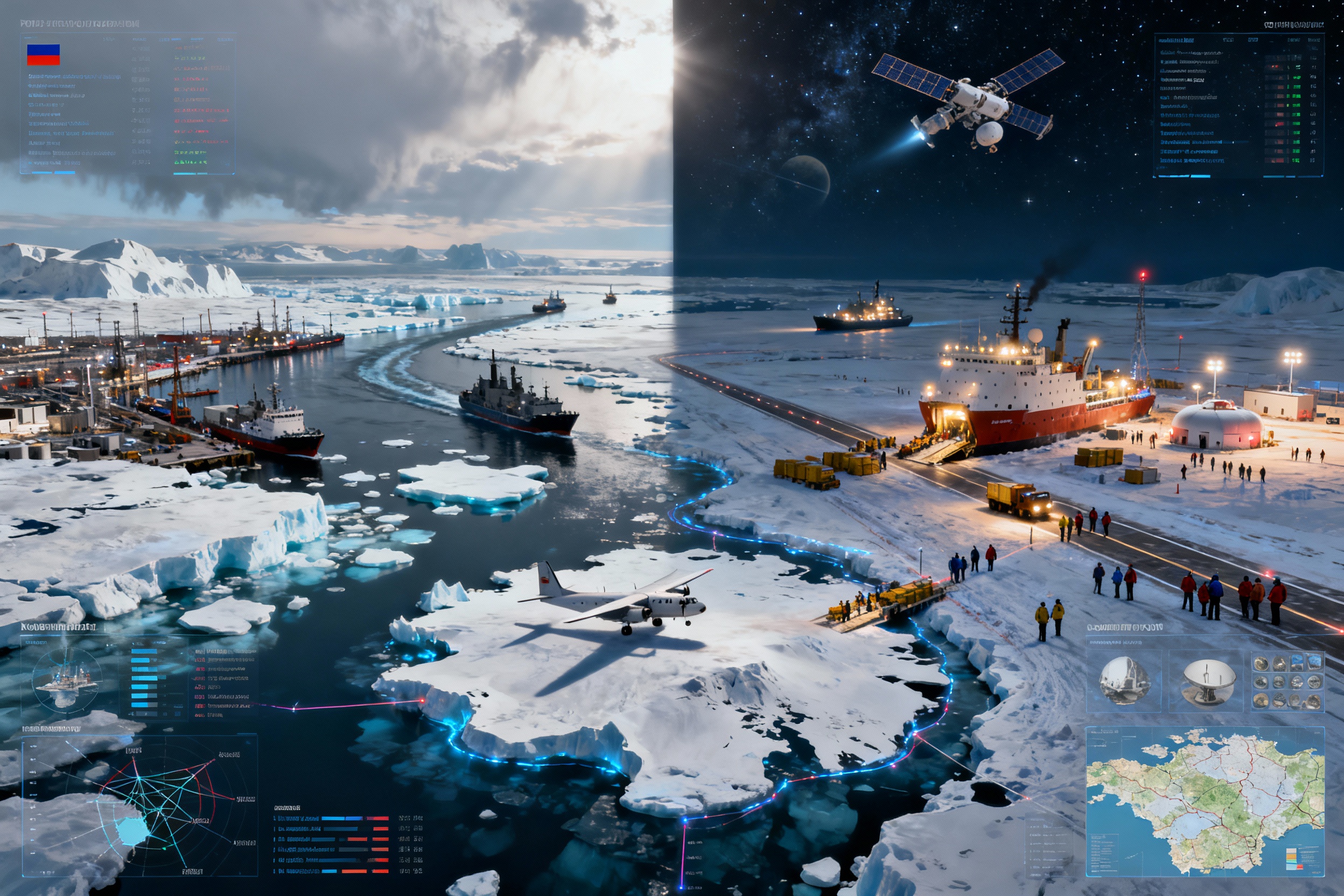
In the Arctic, resistance to maximalist proposals was backed by institutions, the local population, infrastructure, and alliances. In Antarctica, where there is no permanent population or sovereignty recognized by the Antarctic Treaty, legitimacy is built on science, logistics, and continuity: robust and well-maintained operating bases; annual campaigns that move cargo, data, and people safely and regularly; ships and aircraft suited to polar conditions; cartography, measuring stations, and data sovereignty; and scientific output visible in international journals and consortia. In Antarctica, the flag follows science: reputation and political weight are measured in days of campaigning, equipment in operation, and peer-reviewed articles, rather than in grandiloquent rhetoric.
In other words, power and presence in Antarctica are currently claimed solely under the concept of “soft power,” although there is no guarantee that this will continue to be the norm in the future.
The second lesson is normative: the Antarctic Treaty System—which freezes territorial claims and prohibits military uses, while the Madrid Protocol protects the environment and bans mining—is a starting point, but not an eternal shield. International regimes thrive on their relevance and the active commitment of their members; when incentives change, previously unthinkable ideas reappear. South America, with several consultative and claimant countries, cannot rest on its Antarctic exceptionalism: it needs proactive diplomacy to strengthen norms, prepare positions, and design scenarios in anticipation of potential revisions to the regime.
Regional cohesion in Antarctic forums will therefore be as important a source of power as any logistical asset. Perhaps analyzing theories such as Brazil’s “Teoria da Defrontação” could be an important point to study in the face of an unpredictable and chaotic international scenario that jeopardizes regional rights over the white continent.
Polar policy is a matter of “iron” as well as ideas. The dispute over Greenland served as a reminder that logistical assets—modern icebreakers, support fleets, efficient southern ports, air links, field hospitals, cold chains, search and rescue capabilities—separate rhetoric from actual capacity.
No South American country, on its own, can match the operational mass of extra-regional powers; the rational response is cooperation: joint procurement and maintenance, base interoperability, shared use of ships and aircraft, coordinated scientific programs, data sovereignty from satellite constellations, and regional observation networks. At the same time, it is advisable to reduce critical dependencies on extra-hemispheric logistics nodes and strengthen hubs in the continental south. Argentina and Chile were pioneers in this regard in 1948.
Despite their overlapping claims, they took a first step by mutually recognizing their individual rights over Antarctic territory and using broader terminology that also encompassed all of South America: “they will act by mutual agreement in the protection and legal defense of their rights in South American Antarctica.” (Joint Declaration of the Governments of Argentina and Chile on South American Antarctica. Santiago, Chile, 1948).
The lesson of Greenland, in short, is that when the strategic value of a territory rises, ideas that history seemed to have shelved for those with “zero geopolitics” return. Antarctica requires South America to develop a comprehensive strategy that combines more science, shared logistical muscle, cohesive diplomacy, and leadership, while also preparing for any eventuality that could jeopardize its claims and rights over this territory.