The geopolitical chessboard continues its natural and inevitable course, and at the end of the first quarter of the twenty-first century, the dynamics of International Relations of our days denote an undeniable and inescapable reality, unthinkable perhaps a couple of decades ago, and that is the reconfiguration of the global balance of power, this being the transition between the Unipolar order held by the United States once the Soviet Union collapsed in 1991, going from the Bipolarity established once the Second World War ended, to the end of the Cold War. The victory of the Western bloc and its almost absolute and unpunished dominance, begins to show clear signs that the Unipolar World is coming to an end, that old order today is threatened by the emergence of a new paradigm, of a new model of World System, one that fits and responds better to the needs.
Demands and challenges of a new reality in which new actors and Geocivilizational Poles operationalize their strategies, in accordance with their legitimate aspirations to increase their power and global influence.
The main protagonists of this new architecture of Sistema Mundo under construction are China, Russia, along with the rest of emerging powers such as the BRICS, an economic and diplomatic bloc that every year maximizes its power and global weight by including new key players from the different regions of the planet.
The bloc represents 40% of the world’s population, 30% of the global economy and 20% of global trade, with China being the largest economy in the bloc and today the Asian giant is already established as the 2nd global economy.
A superpower already consecrated as China, in every way, being a commercial, economic, technological, energy, political and military power, which acquires greater and greater weight, prominence and influence in each region of the world, it was therefore a matter of time before the struggle for power and global influence was unleashed with the United States. There is a kind of “cold war” between the two superpowers, the clearest of which has been for several years the trade and tariff war, a struggle in which the United States has had to retreat at various times.
In all regions of the planet, the Chinese presence is very marked and forceful, its strategy of power projection lies in cooperation and development, harmony, intercultural dialogue, programs to fight poverty, in addition to and of course its multimillion-dollar investments in different areas, such as; infrastructure, energy, technology, agriculture, among others. In Latin America, the Asian giant has already invested more than $600,800 million dollars. This places China as the second trading partner for all of Latin America and the first in South America.
In contrast to the policy and style that the United States executes and promotes on Latin America, a policy of coercion and threats, of pressure and warnings for Latin American countries to cut ties and distance themselves from China, exerting commercial and diplomatic pressure, but without offering alternatives, which leaves Latin American countries in a dilemma, weighing in the end the national interest, as it is in most nations in the region, since Chinese investment is needed to boost economies and development.
But there are also nations that have moved closer and closer to the U.S. geopolitical strategy, such as Argentina, Ecuador, and as predicted in Chile and Bolivia with their new governments.
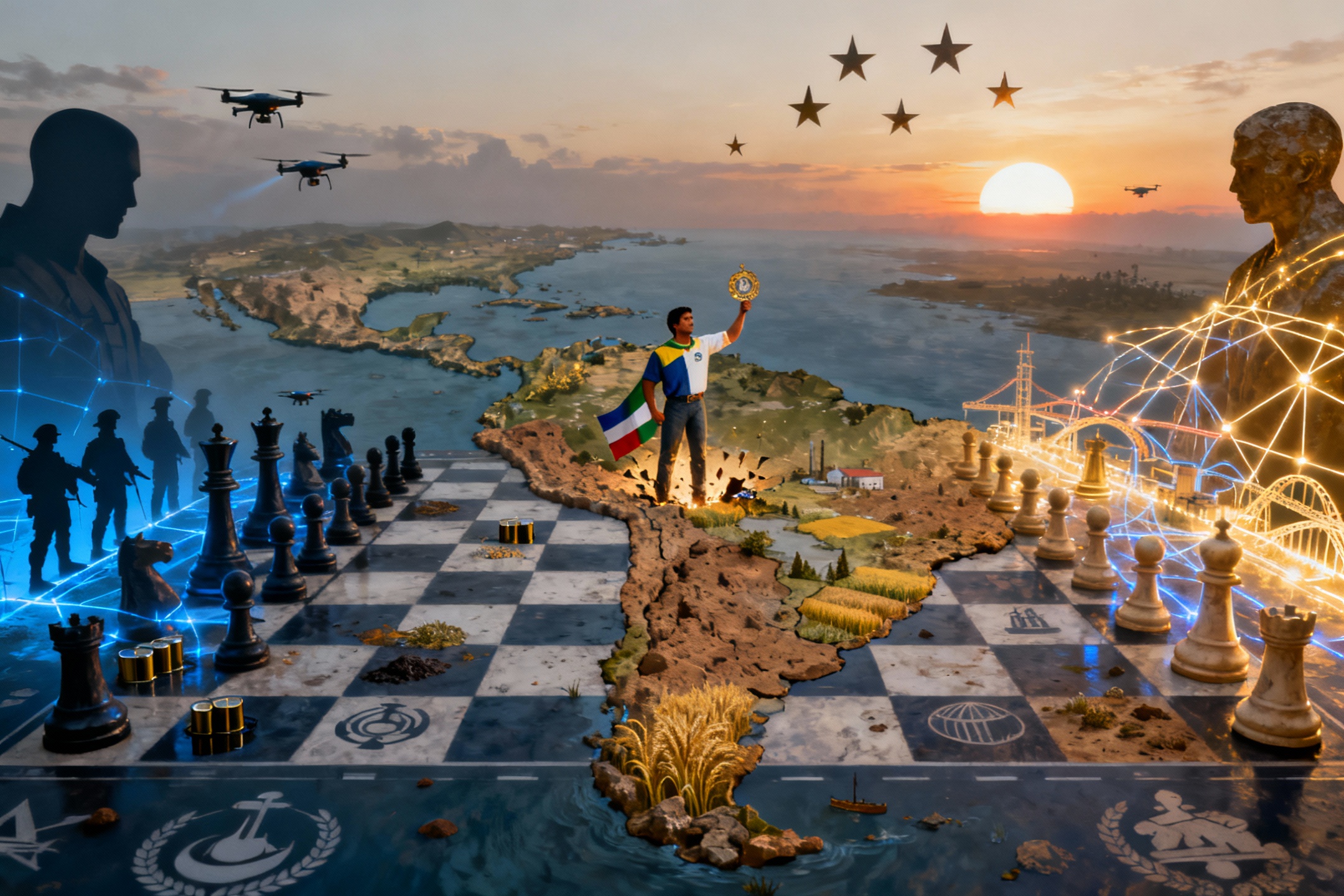
Therefore, Latin America has become a battlefield coveted by both superpowers, this region constitutes a Geocivilial Pole in itself, in addition to its strategic location and its countless and abundant natural resources. China’s presence in the region is no longer merely economic and commercial, it also encompasses the cultural and cooperation spheres and a host of programs and projects for the development of the region. It is also worth mentioning that China has become an important lending partner, not only for Latin America, but for the whole world.
Unlike the Western Multilaterals, linked to Washington, which subject States to extreme conditions of fiscal mutilation that always represent greater poverty and indebtedness, in contrast China grants the money without such strict and unfair conditions for nations, this is another factor to consider in order to understand how China has been taking away space and power from the United States.
And as Latin America has turned more and more to look to the East, this has certainly begun to worry and annoy Washington, to the point that in the last year it has presented its geopolitical plan for the region, which should worry every country on the continent, since what the current administration of President Trump has proposed for Latin America is a recharged resurrection of the old and pernicious “Monroe Doctrine”
From paper and statements, Washington has already moved on to action, so we see that since August 2025, the U.S. military presence has been accumulating and increasing in the Caribbean, off the coast of the Bolivarian Republic of Venezuela, a country that has been enduring permanent harassment by the United States for more than a decade. but now with the new administration, the threat to the Caribbean country is more forceful than ever, declaring the Venezuelan regime a “terrorist” and accusing it of leading an alleged transnational drug trafficking cartel, such as the so-called “Cartel of the Suns”, all this without conclusive evidence of course.
It is with this narrative and rhetoric that Washington legitimizes its military presence and activity in the area, let us not forget the growing interference that the Pentagon is carrying out in several countries in the region, under the pretext of the “fight against drug trafficking” by increasing its military presence throughout Latin America.
Returning to the case of Venezuela and the Caribbean, U.S. military activity in the area has already raised questions, as it is acting outside of international law, threatening a sovereign country and violating its sovereignty. In the waters of the Caribbean, more than a hundred fishermen have already been killed at the hands of the United States Armed Forces after bombing their boats, accusing them of being drug traffickers, but without evidence to prove it.
The first attack on Venezuelan soil has already been executed, U.S. drones have bombed a dock where the drugs are supposedly shipped. Several countries in the region have called on the UN to take a more prominent role in this crisis, which is undoubtedly a threat to peace throughout the region.
What the United States really wants is to get hold of Venezuela’s succulent oil, the largest proven reserves of crude oil in the world, while trying to control and undermine the presence of China and Russia in the region. Now, both Russia and China have shown their open support for the Venezuelan regime and condemning Washington’s actions, as Venezuela is a key partner for China and Russia.
The United States has demonstrated its iron determination to regain control of Latin America, since it has had to retreat in a certain way to its natural region of influence, since the dynamics and balance of power are changing very quickly towards Multipolarity, something that Washington views with dread, but that understands it very well, and in this sense it is determined that in its natural and historical zone of influence, this change of power does not take root, that is to say, the United States does not want a Latin America immersed in the new structure of the world system under construction, that is, the New Multipolar World.
Achieving this will not be so easy for Washington, because Latin American governments are varied, not all of them are aligned with its orbit, at least not with the two largest economies in Latin America such as Brazil and Mexico, with leaders whose speeches are very high-sounding against the new US imperialism, in addition to Colombia, Nicaragua, Cuba that have shown firm support for Venezuela.
On the other hand, there are the other countries in the region that to a greater or lesser extent are linked to maintaining, strengthening and taking care of their trade relations with China, so nothing is said, Washington knows and is determined to do what it must to regain control of the region, but, as well as Beijing of course knows what is at stake. So the struggle for influence and control of our region will be long-term.
Latin America is the scene of a geopolitical chess game in which each Power will try to make the greatest profit, but the important thing here is how Latin America resists and can maintain its capacity to defend its own national and regional interests, to finally be able as a bloc, as a geocivilizational pole, to become a determining part of the new Multipolar World.
In short, it seems that Latin America will be the region of the planet where the decline of an old order is defined, and the definitive victory of a new paradigm of world system.