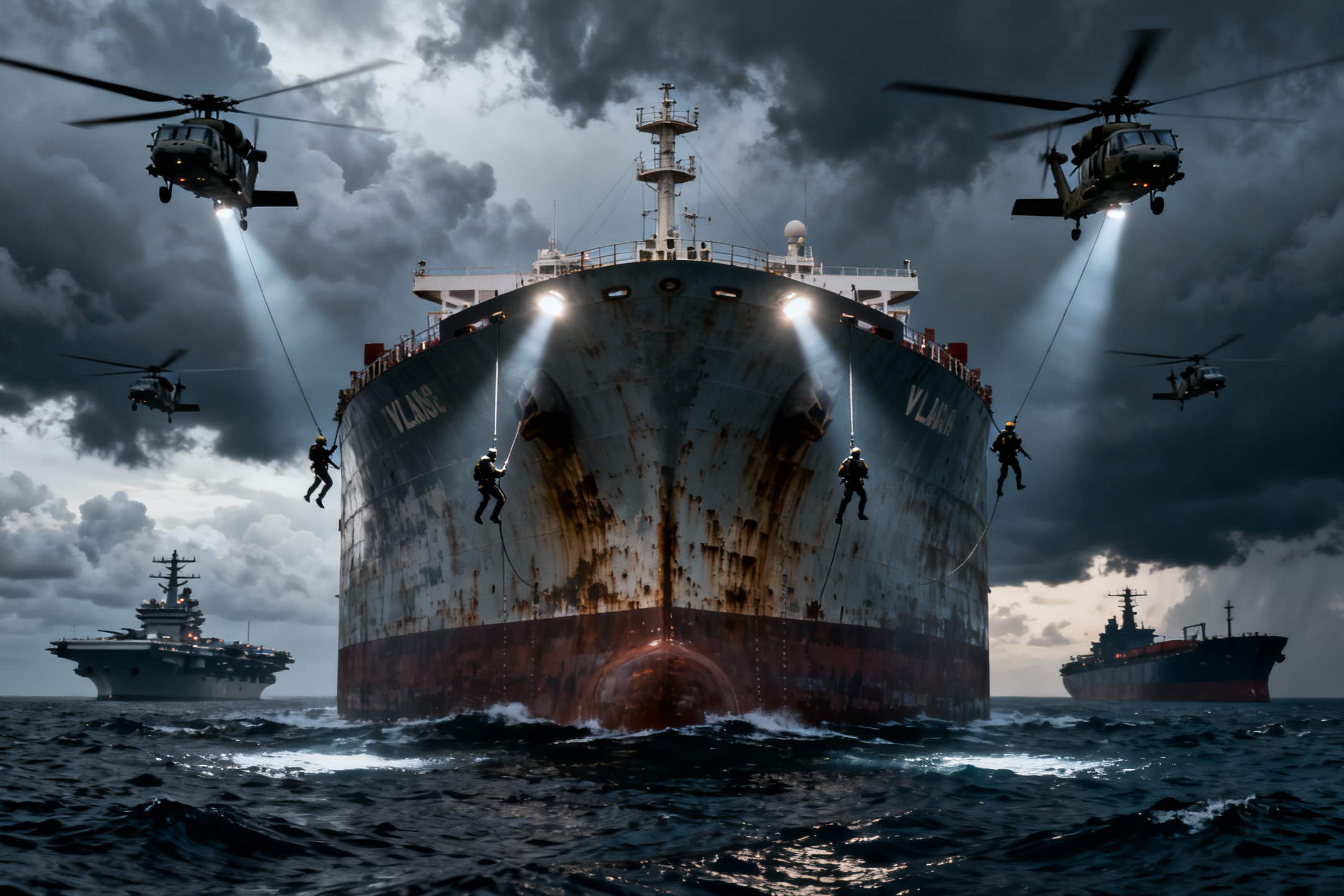
Citing a court order from a US judge, the US has seized, by boarding by two helicopters that took off from the aircraft carrier Gerald Ford, the supertanker VLCC Skipper (333 metres long and 300,000 tonnes deadweight) carrying about two million tonnes of oil valued at 100 million dollars; the ship, with 25 years old, it could be over 50 million.
The Skipper (formerly called Adisa), which sailed under the Guyanese flag, although it was not registered in that country, is officially registered in the name of Triton Navigation Corp., a company based in the Marshall Islands, but managed by the Nigerian Thomarose Global Ventures Ltd., all forming one of many unclear networks so common in this sector.
Both the ship and its cargo were not insured. Despite the fact that the Skipper was on the list of ships sanctioned by the US since 2022 accused of being part of an illegal oil trafficking network between Venezuela, Iran and Cuba, nothing was done against it during this time.
The ship had the Navigation Information System (AIS) for maritime safety and tracking that transmits information about its speed and course, as well as its GPS location, with a range of about 72 kilometers, which according to experts is easy to manipulate, which the U.S. authorities have assured that the Skipper did to hide its true position.
There is a background on what happened. In 2014, U.S. special forces seized the North Korean-flagged oil tanker Morning Glory while it was sailing south of Cyprus, at the request of the governments of Libya and Cyprus, after verifying that the ship had been taken over by Libyan pirates. In 2020, the U.S. seized 1.1 million barrels of Iranian fuel from four ships headed for Venezuela.
There are currently six more oil tankers “sanctioned” by the United States: the White Crane, the Kiara M., the H. Constance, the Lattafa, the Monique and the Tamia, which logically could be subject to seizure for the same reasons alleged to do so with the Skipper.
As soon as the fact became known, the United States defended the legality and legitimacy of the seizure by arguing the alleged illegal trafficking of oil from the Skipper, especially when according to Washington it had specialized in carrying it out for the benefit of two of its most significant enemies, that is, Iran, targeting Hezbollah, and Cuba. To support his actions, he has invoked both US and international law, accusing him of being “stateless” for “lacking nationality”, as well as the alleged violation of several of the sanctions imposed by the US against Venezuela, the country from which the ship departed.
On the legality and legitimacy of the seizure it will be the courts that will decide, since both the ship and the commander and crew will face them, although, being in the US and given the circumstances, it is obvious that their final decision could be truffled with partiality.
What is clear, however, is that the action carried out has its many loopholes because, on the one hand, violating US legislation does not give the right to act as has been done in international waters, and on the other, the alleged violation by the Skipper of International Law must be demonstrated because although it is true that as we have said the network of companies under which he is registered are complex, not to say, opaque, that is common in this and other types of merchant ships that do it more to avoid costs than to be involved in illegal activities.
What is clear is that everything is due to the pressures that the US has been exerting on Venezuela with the declared intention of overthrowing Maduro and his regime – counting on the complicit silence of the European governments, except the Spanish – using the well-known nineteenth-century strategy of “the gunboat”, today revived by Trump following the advice of Marco Rubio determined to change not only the political face of the area, but also the political face of the area.
But also to turn the Caribbean into a declared “American sea” and, do not forget, to dispute Vance, if he succeeds in doing so, the candidacy as Republican president in the next elections once Trump finishes his term, which is his last.
But this being true, the seizure of the Skipper, undoubtedly a very controversial action of legality and legitimacy more than dubious, also proves that Washington is beginning to lose its serenity and doubt the steps it has taken, since neither Maduro nor his regime show signs of breaking or being willing to do so.
Well, we are already going for three months of presence of the US fleet in the area without the real objective, which is not drug trafficking, showing signs of being achieved, playing time in favor of Maduro and against the US that risks making a major fool of themselves.
The alleged departure of María Corina Machado from Venezuela also points to the above, a fact that has not yet been reliably clarified and that presents serious doubts as to whether it is true, since either it has been done with Maduro’s approval as was that of Edmundo González –and it will mean the political disappearance of the opponent as it has been of González- or in reality Machado had been out of Venezuela for some time.
Something that had been suspected by numerous indications and that was finally increasingly difficult to hide, which is why the US has been forced to mount in extremis its bizarre “extraction”.
The seizure of the Skipper, while remaining one more way to increase the pressure on Maduro, and since there are more ships in the crosshairs, as we have said, that we cannot rule out that they may follow the same fate, is in fact further proof that the US seeks to turn the Caribbean into its private “sea”. Something that Trump hinted at as soon as he entered the White House when he changed his name and when he claimed the Panama Canal, seeking to close such an essential geostrategic area to Chinese penetration that was becoming more determined and effective every day.