The Paradox of the “New Order”
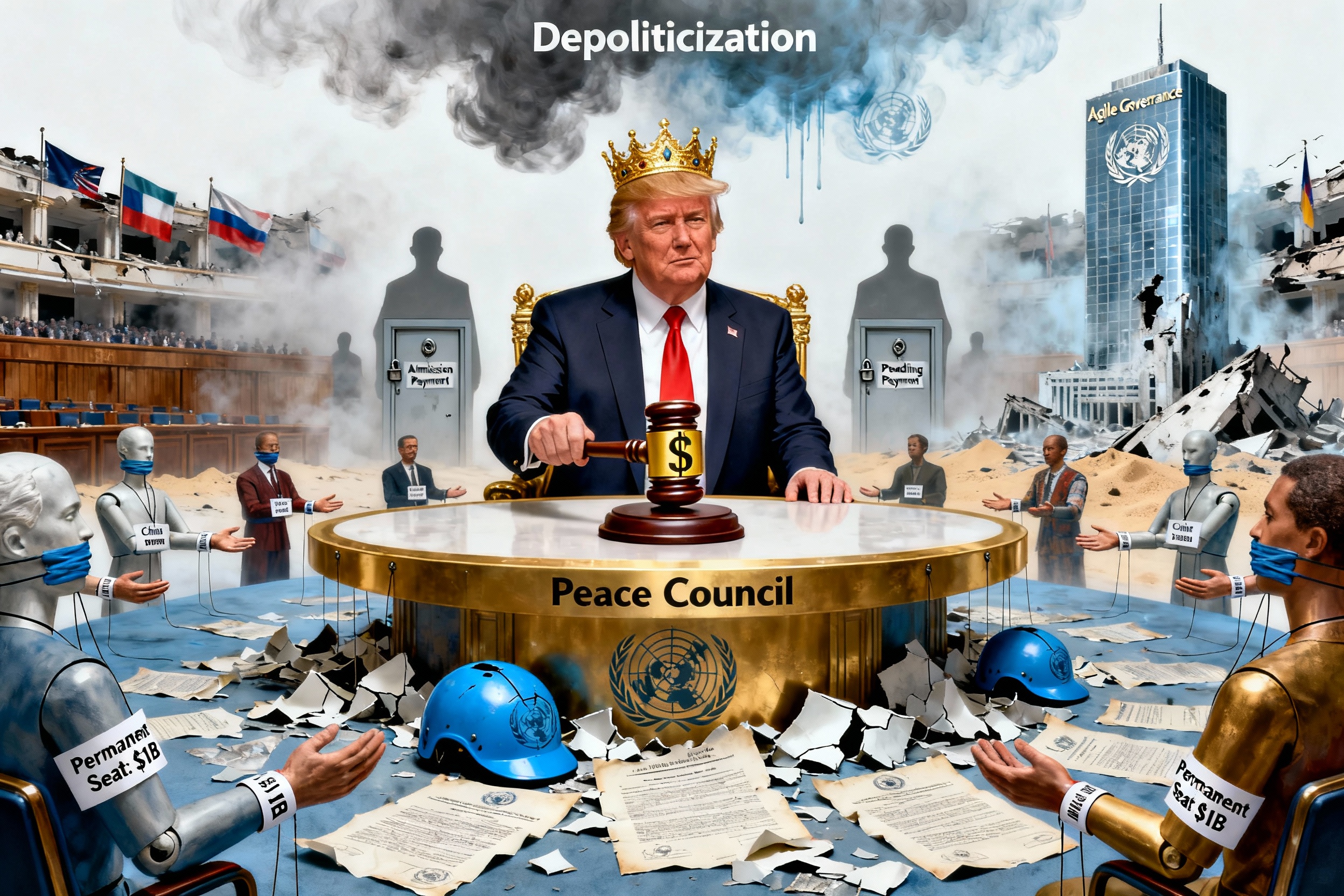
In the twilight of the UN as an outdated and paralyzed institution, Donald Trump has presented his Peace Board (Peace Board), formally launched in Davos in January 2026, as a supposedly “agile and effective” alternative to the ineffective bureaucracy of the United Nations. Initially conceived as a transitional mechanism to oversee Gaza’s reconstruction following the US-brokered ceasefire (backed by UN Security Council Resolution 2803 in November 2025), the project has rapidly mutated into a global entity with ambitions to mediate global conflicts, promote stability and restore “legal and reliable governance”.
Trump, who proclaims himself president for life of the council, has repeatedly hinted that it “could” replace the UN, harshly criticizing its ineffectiveness and its tendency to “empty words” that do not solve wars.
However, this initiative does not represent a truly positive restructuring of the international system, but a mere cosmetic substitution: from a universal (albeit dysfunctional) multilateral bureaucracy to a selective, hierarchical, and personalistic club dominated by a single power and, specifically, by a single leader. Far from returning sovereignty to peoples and nation-states, Trump’s Peace Council deepens democratic erosion by creating an artificial supranational structure that prioritizes unilateral geopolitical agendas over the sovereign popular will.
From a philosophical perspective, this evokes Carl Schmitt’s warnings about the “total depoliticization” inherent in abstract universal norms: true decision-making power is concentrated in hands that are not elected or accountable to any national electorate, turning peace into a product of elitist transactions and personal vetoes.
The Peace Board, under the guise of innovation, reproduces and aggravates the evils of existing supranational structures—primacy of the global over the national, economic blackmail, dissolution of sovereign decision—and moreover, ultimately neutralizes any genuine possibility of reform that empowers states rather than subordinates them to new post-national mechanisms.
The Replacement of One Bureaucracy by Another: The Mechanism of Personalized Control
The Peace Council does not emerge from an organic consensus among sovereign nations, but from a UN resolution that Trump instrumentalizes to legitimize its creation, only to then expand its mandate beyond Gaza and the original timeframe (until 2027). The Board’s charter omits explicit references to the UN Charter, implicitly criticizes “institutions that have frequently failed” and establishes an elitist membership model: countries pay up to $1 billion for a permanent seat, while Trump retains an absolute veto and a perpetual presidency. This structure transforms international peace into a private club of “friends” (as Trump himself describes them), where membership depends on personal loyalty and financial contributions, not on universal principles or democratic representation.
Philosophically, this resonates with the Schmittian critique in The Nomos of the Earth: the abstract universality of international institutions dissolves concrete political decision, which can only emanate from a delimited and responsible sovereignty. The UN, despite its paralysis (veto of permanent powers, bureaucratism), at least retains a vestige of state pluralism. Trump’s Board, on the other hand, concentrates decision-making power in a single figure not subject to any national control, turning “peace” into a personal executive prerogative.
Far from neutralizing conflicts through plural sovereignty, this model manages them through opaque transactions and unilateral vetoes, perpetuating the depoliticization that Schmitt denounced as the end of authentic politics.
The impact on national sovereignty is devastating: states that adhere cede competences in conflict resolution to an entity where their voice is conditional (payments, alignment with Washington), while Trump decides admissions, expulsions and priorities. Countries such as Hungary, Morocco or certain Gulf allies have signed, attracted by promises of influence or funds, but most traditional Western allies (France, the United Kingdom, much of Europe) have rejected or expressed “serious doubts” for fear that it will undermine the UN framework. This dynamic does not strengthen national autonomy; it makes it a tradable privilege in a geopolitical market dominated by a declining superpower that seeks to reassert hegemony through institutions tailored to its needs.
The Continuity of Subordination
The Board of Peace already reveals its true nature in its genesis and expansion. Originating from Trump’s 20-point plan for Gaza (approved by the UN but executed under U.S. control), the Council has ignored temporal and geographical boundaries to aspire to a global role. Trump has invited about 60 countries, but effective membership includes regimes with dubious respect for the sovereignty of others or their own (e.g., authoritarian allies), systematically excluding powers such as China and Russia (unless they pay ransom per permanent seat).
This is not renewed multilateralism; it is a “new multilateralism” where peace is negotiated in terms of loyalty to Washington, not of equity between equal sovereignties.
In parallel, Trump’s criticism of the UN as “ineffective” translates into concrete actions: US withdrawal from dozens of UN entities in 2025-2026, funding cuts and rhetorical attacks that delegitimise the post-1945 system. The Board appears as a “solution” to this inefficiency, but in reality it aggravates it by creating a selective duplicate that evades the (albeit imperfect) brakes of the Security Council. Small or peripheral countries that join see their agency limited: their participation depends on payments or alignments, recalling the “blackmail” of European funds to Hungary or Poland. Sovereignty is negotiated in dollars and favors, it is not exercised sovereignly.
The Illusion of Reform
The real danger of the Peace Council lies in its ability to neutralize legitimate demands for reform of the international system. While the UN faces a crisis of legitimacy (paralysis in the face of conflicts such as Ukraine or Gaza, imbalance in the Security Council), a positive restructuring would require strengthening plural sovereignty: greater weight for medium-sized states, reversible mechanisms for ceding powers, primacy of the national popular will over global agendas. Rousseau would recall that sovereignty resides in the general will of the people, not in elitist councils or presidential vetoes for life.
Trump offers the opposite: a more concentrated, less accountable and more personalized supranational structure. By presenting itself as a “nimble” (agile) alternative, it distracts from the real need to gradually dismantle irreversible cessions of sovereignty (as in the EU or UN treaties) and recover concrete political decision-making. Instead of sovereign pluralism, it proposes a post-democratic order where peace is administered from above, by a “peacemaker-in-chief” who decides which conflicts deserve attention and how they are resolved, ignoring local contexts and popular wills.
Towards a Recovered Sovereignty
Trump’s Peace Board is not the antidote to the decay of supranational structures; it is its most recent mutation. Far from revitalizing international democracy, it perverts it by replacing a universal bureaucracy with a personalist oligarchic club, perpetuating the democratic deficit that Schmitt identified in every depoliticized universality. Europe and the world now face not only an outdated UN, but an alternative that concentrates power in a single nation and a single man, neutralizing any genuine impulse towards a system based on plural and reversible sovereignties.
The way out is not to adhere to this new supranational artifact, but to reject both the paralysis of the UN and Trump’s “solution”. Only by recovering national agency – through consensual and reversible treaties, the primacy of sovereign decision over global guidelines – will it be possible to build an authentic peace, not as a product of presidential vetoes or millionaire payments, but as an expression of concrete and responsible political will.
Otherwise, the cycle will continue: hollow institutions, populist reactions, and an international order increasingly disconnected from its peoples. The future depends on whether states opt for real sovereignty or resign themselves to being satellites of false peace councils.