During the 1980s, there was widespread belief that the United States would be economically overtaken by Japan.
The reasons for this view were that “America” had ceased to be the primary promoter of industrialization and global financial investment. In addition to Japan’s more efficient production performance, attention was already being directed toward a group of Southeast Asian countries, known as the Asian Tigers, comprising Singapore, South Korea, Taiwan, and Hong Kong. Today, there is talk of expanded Asian Tigers, including Vietnam, Indonesia, and Malaysia.
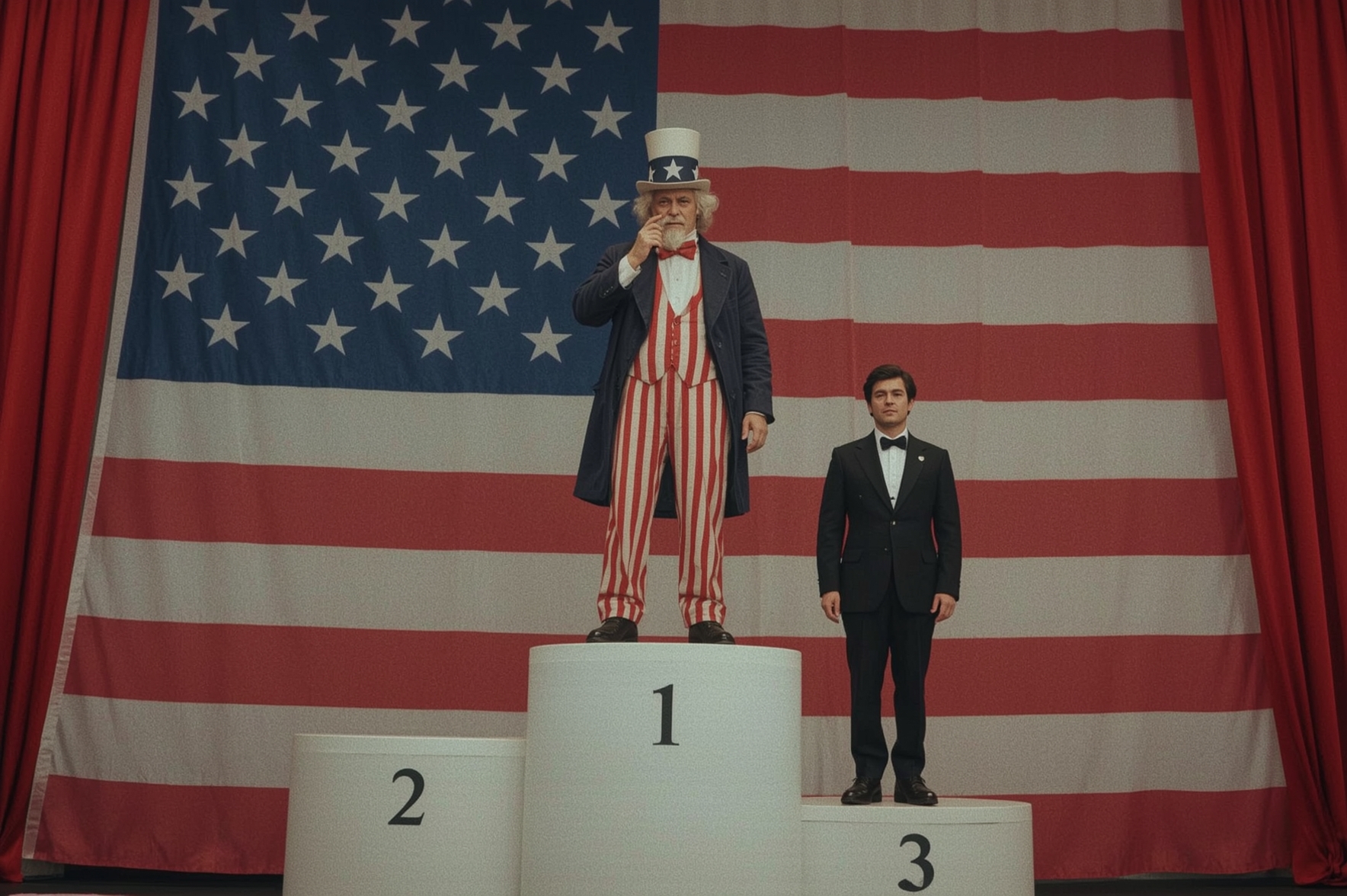
Much literature has been published analyzing the political and economic situation of those years. Among the most famous books from that period, we can highlight *The Rise and Fall of the Great Powers*, by British historian Paul Kennedy. Interestingly, the cover of the book, at least in the 1989 Brazilian edition, showed a podium on which a weary Uncle Sam relinquishes first place to a Japanese man in a tailcoat, all done in cartoonish style.
The big issue for Japan is that the United States hasn’t lost its leading position in the world economy. If we’re allowed to use a popular expression in Brazil: Japan hanged itself with a rope provided by the United States itself. This is because much of the Japanese enthusiasm, which fueled international public opinion, was based on a domestic economy that was largely dependent on the American one.
In practice, it was the United States that fueled Japanese production through consumption and investment in the Asian country. In turn, Japan used American capital to invest in the United States.
When the Ronald Reagan administration, initially, and then the Bill Clinton administrations in the 1990s, responded to Japanese growth by repurchasing its US assets and forcing Japan to use the dollar, even in Asia, Tokyo stopped being a threat and no longer portrayed itself as a defiant center for Washington. Essentially, it was a potent attempt by Japan in the 1980s, but it was short-lived.
Perhaps one of the few renowned intellectuals to recognize this mirage was Harvard professor Samuel Huntington, whose opinion was that the United States was not losing its vigor. In fact, the country was renewing itself to overcome the most pressing problem of its time: defeating the Soviet Union and winning the Cold War.
Indeed, the United States was attracting capital from around the world to renew its technological-military framework and, from there, intensify its economic influence through other means.

Thus, in 1990 the Kremlin’s challenge ended and the United States enjoyed practically ten years of consecutive growth, which made the Clinton administration happy and established the trend that at the time was called globalization, which encompassed the entire international economy through the “financialization” of the international economy and the rise of large investment funds.
It’s unnecessary to emphasize that China is not Japan. China has far greater reserves of power, by all measures, than its immediate, much smaller neighbor. The failure of the Japanese challenge brought the emergence of China, which, during the 2000s and until recently, gave the impression that the system would indeed be transformed.
Chinese growth would be much more substantial and consistent, and its economy would be based on industrial production, increasingly valued by technological advances and present throughout the world. China has become the world’s second-largest economy, and the prospect of becoming the first by 2050 is strong. But the game remains tough and demanding for Beijing, too.
Energy Transition and Maritime Domain
These are two themes that somehow intersect and attract specific national interests, particularly from the so-called great powers, a category that is practically based on three names: the United States, Russia (when it comes to military matters), and China.
The themes are energy transition and maritime dominance, which are gaining increasing prominence in international politics and are expected to encompass a large number of countries.
Although there’s an image that the energy transition represents a structural change of a reformist nature—that is, one that aims to promote progress in international relations—this may not actually be the case, even if the initiative continues to be promoted.
It’s not necessarily progressive because the energy transition addresses something substantial in the interests of the great powers: advanced technology, creative destruction, as defined by economist Louis Schumpeter. Creative destruction, the result of a commitment to research and technology that contributes to shaping what is called a great power.
It’s a cliché to say that there’s a technological battle between the Americans and the Chinese for the lead. The battle is primarily in communications and information technology.
Not long ago, the battle was over 5G. Whoever advances more in technology can apply it to other means, such as the military. But in the case of this short text, technology applied to the energy transition means realizing its use in new fuels, both synthetic and renewable, so that they can replace hydrocarbons within a certain timeframe.
If the relationship between technology and energy transition captures the interests of major powers, it quickly becomes clear that advances, which bring progress for all, do not escape the attention of the most important countries.
Another aspect is that the creation of new fuels, whether synthetic or renewable, largely depends on the exploitation of natural resources found in other ways, such as rare earths, which can be prospected in some countries.
China is the leader in the exploration of these energy-intensive inputs. Because of this, it largely falls to the Middle Kingdom to exercise a “pre-monopoly” in the marketing of new energy instruments on the international market.
There’s a point here: China is the main buyer of rare earths (and other energy inputs) and the exclusive exporter of manufactured products for new energy sources or concentrators, such as new, crucial batteries for electric cars. Furthermore, it’s worth mentioning China’s influence in materials for rotors, wind energy, and solar energy, including photovoltaic panels.
Therefore, it wouldn’t be unreasonable to say that China could use technological advances, in such a sensitive area as energy, for its international rise and political-economic control.
Indeed, this wouldn’t be new, since Great Britain had done so with the exploitation of coal during its Industrial Revolution around 1750. And the United States did the same thing with the “industrialization” of oil as it entered the 20th century, giving way to the technologically revolutionary internal combustion engines, as well as the electric motors that set the tone for what urban life should be.
If the premises discussed above are true, then it’s safe to say that the international dispute, especially between the United States, China, and Russia, is likely to intensify. This is because, contrary to some opinions about cutting-edge technology, new means of energy acquisition, potentially replacing hydrocarbons, will have to be found on land, in the territories—boots on the ground, as they say in the military.
In the 1990s, it was thought that the above would be overcome by new political and economic behaviors and globalization. But the old geopolitics of natural resources has returned.
It’s back because strategic minerals are buried in certain parts of the planet and fulfill the weight of this power accounting: they are finite and geographically concentrated.
Therefore, the powers will not stop exercising their will to seek them, in the case of consumers, or to reserve them, in the case of owners.
In the foreground are the United States and China, competing not only for the exploitation of minerals that can be converted into energy conductors, but also for their efficiency. In the background is Vladimir Putin’s Russia.
When it comes to Russia, the issue is navigability, as some places open to new exploration are mentioned in the Northern Hemisphere. Greenland, for example, emerges as a point of attraction for Washington, Beijing, and Moscow.
This issue could become heated due to a paradox. The thawing of the Russian “northern trough” could open up a new route that will be very beneficial for exporters, including China itself.
Chinese and American interest in this northern trough takes into account the reduction in naval transport times, as well as the existence of strategic minerals deposited in territories such as Greenland, located in the passage between North America and Europe. This has drawn the attention of the current Donald Trump administration, whose plan is to penetrate this glacial territory through diplomatic means or possibly military pressure.
There is a view that naval passage through northern Russia, under its control, would allow China to avoid navigation through the Strait of Malacca, which is becoming increasingly conflictive geopolitically, as its control remains, in part, under the control of the US Navy. Through northern Russia, Chinese, Russian, and Eastern trade would also reach European markets, as well as the east coast of the United States and Canada.
Why is Greenland a current focus for mineral exploration? Washington’s interest in this vast area, administered by Denmark since the 18th century, arises because it contains minerals attractive to North American industry and because it also attracts China’s attention.
Beijing makes no secret of the fact that its objectives in Greenland are not different from those of the United States. And what about Russia? Moscow has a dual role here: it is part of the new post-glacial navigation system and also possesses a large number of natural resources considered strategic within its vast territory. Should a closer relationship arise between Russia and China, these minerals could be utilized.
So, in conclusion, one can imagine that if the United States manages to achieve its goal of surpassing China in the development of new technologies, especially if they can be employed militarily, it will enjoy another period of political and economic preeminence.
At the beginning of the 20th century, during the first technological revolution, the United States was not alone in this race. In the quest for dominance in fossil and electrical energy, it faced competition from Germany with its electrical and mechanical engineering companies.
In this current power struggle, the United States is under intense pressure from China. Around 2008, due to the financial crisis, the idea began to spread that the great Western power would give way to the Middle Kingdom, just as was predicted for Japan in the 1980s. China is not Japan, but is today’s America the same as yesterday’s? This is just a brief reflection without attempting to exhaust the subject.