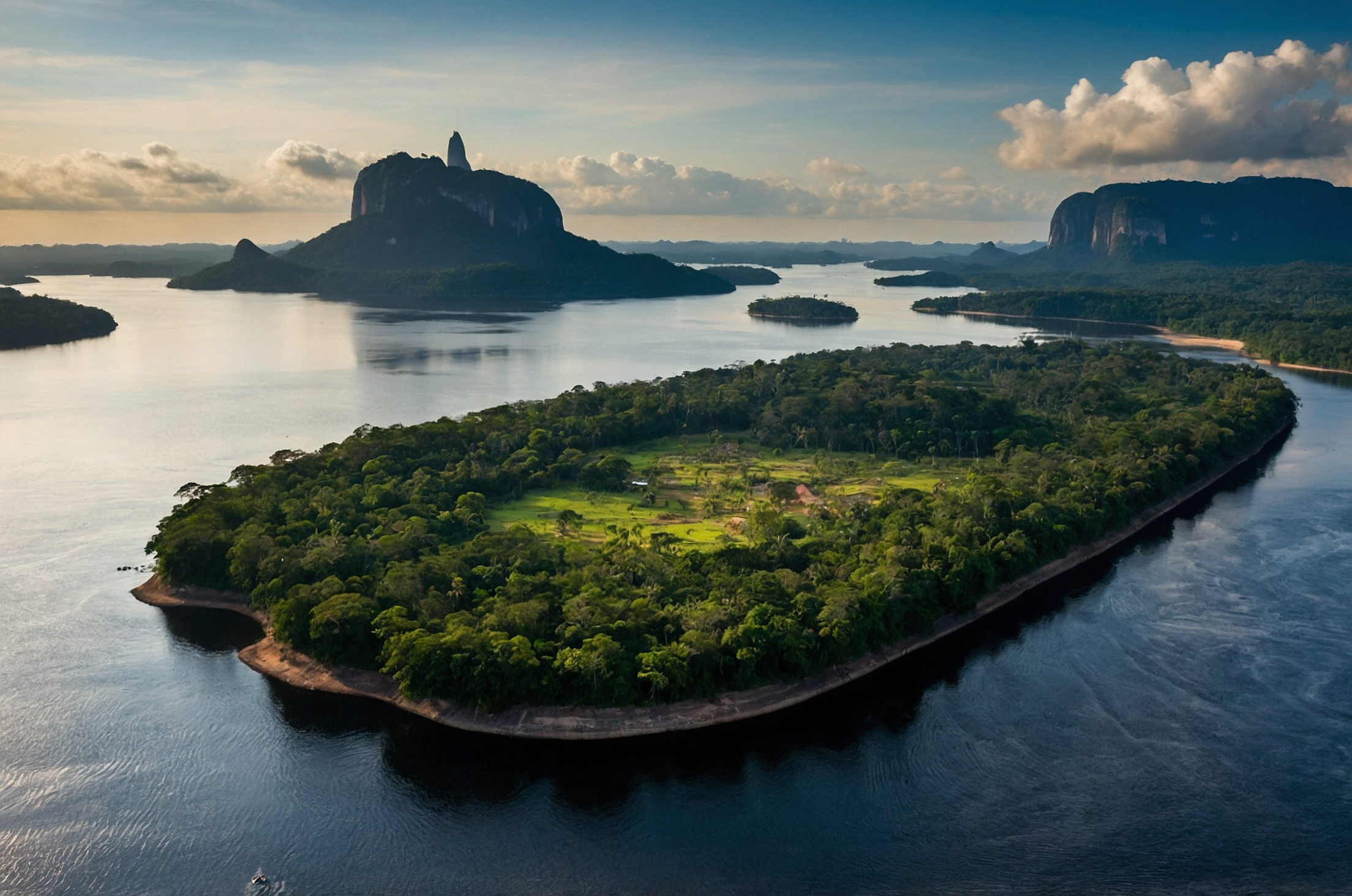
The Amazon is at the center of global discussions, given the importance given to climate change and the international outcry for the preservation of what is the world’s largest rainforest. Around 80% of the Amazon rainforest is located in Brazil, and the city of Belém, situated at the edge of the biome, will host the COP in November this year.
For decades, the G7 countries have been trying to impose a governance regime on the Amazon, putting political pressure on Brazil to accept rules on land occupation and the construction of infrastructure in the region, defending the view that the drive for economic development would necessarily lead to environmental destruction. The political pressure has been exerted directly by governments or indirectly by the media, think tanks and non-governmental organizations (NGOs), based in or financed by public and private organizations in these G7 countries.
International pressure originated in the 1970s. In 1972, Stockholm hosted the 1st International Conference on the Environment, where for the first time the Malthusian ideas of the Club of Rome, founded in 1968, were presented openly, linking economic growth, especially in developing countries, to environmental degradation and other deleterious effects of overpopulation on the environment. At the time, Brazil’s stance was to defend the right to development of poor countries, a position that earned Brazil a leading role at the Stockholm Conference.
During the 1960s and 1970s, the Brazilian military government launched a “Brazil Power” strategy, in which it was necessary, among other measures, to integrate the Amazon region, which includes the northern states of the country, with the more developed and occupied parts. Major infrastructure projects began, such as the Trans-Amazon Highway and the integration of the main cities into the integrated electricity system. In Manaus, the capital of the state of Amazonas, a special export and import zone was created to develop an industrial hub.
With the 1980s came the foreign debt crisis, which hit Latin American countries, and the end of the military regime in 1985. As external debt was negotiated, various conditions were imposed on Brazil, including the need to impose limits on its policy towards the Amazon. With re-democratization, a network of environmental NGOs began to gain influence in government bodies, the judiciary and the Public Prosecutor’s Office, with the bias of the Stockholm Conference.
In 1992, Rio was the capital of the Climate Conference, which crowned the network of NGOs, activists and researchers as spokespeople for climate policy and the Brazilian government’s official policy on the Amazon. Since then, huge areas in the region have been designated as indigenous lands, subject to a different legal regime from the rest of the Brazilian territory, as if they were reminiscent of the lands belonging to “original peoples”. Environmental licensing for infrastructure projects has become slower and increasingly cumbersome. NGOs, often funded from abroad, have become stakeholders in related activities.
In the Lula government, Marina Silva is in charge of environmental policies. She’s a darling of international organizations, but not very popular in the Amazon. She is supported by Ana Toni, founder of the NGO Climate and Society Institute (“Instituto Clima e Sociedade, iCS), which receives ample funding from US and European organizations. The federal government’s environmental policies come into conflict with rural producers in the Amazon, who come to be seen by federal authorities as aggressors of the local environment, thereby causing tension between the current federal government and local governments and their representatives in the Brazilian Congress.
Thus, with this environmental policy, which is imposed more from outside than from within the country, the Amazon still has the highest poverty rates and the lowest levels of basic sanitation, placing the living standards of its inhabitants below the national average. This doesn’t seem to interest the so-called “international community”, which is only concerned with the fauna and flora of the Amazon, and not with its people.
Arthur Kowarski is Journalist and sociologist, M.Sc. in International Relations from the State University of Rio de Janeiro.