1.- The Revolution
The world has been subject, at least since the 17th century, to a permanent and undeniable revolutionary impulse. Bishop Emilio Masalles Pere, bishop of the diocese of Bani (Dominican Republic), in his extraordinary lecture of May 21, 2025, summarizes the most important revolutions in the Protestant (1517), French, and Russian Communist eras. He summarizes the former as a very serious schism in the Catholic Church centered on Luther’s heretical view that only Faith in God saves, while the latter bases its “philosophy” solely on Reason. And the Soviet Communist era focused solely on the State, seeking to change society through the dialectic of conflicts, fundamentally “class conflicts,” evolving into Gramsci’s Cultural Revolution (1891-1937). This example serves to illustrate that the field of study of Revolution is broader and more complicated than generally considered.
The “Protestant Reformation,” a flawed term that conceals a drastic heretical break, is not usually associated with the revolution it caused and, surely, sought: it provoked numerous religious wars that divided Christendom and undermined what remained of the Holy Roman Empire. Of note were those in England and France, the Schmalkaldic War (1546-1547), those in Flanders (Eighty Years’ War, 1568-1648), and the Thirty Years’ War (1618-1648), giving way, after the Peace of Westphalia (1648), to a Europe unrecognizable from that before Luther, and which demonstrates the extremely important weight of the religious factor.
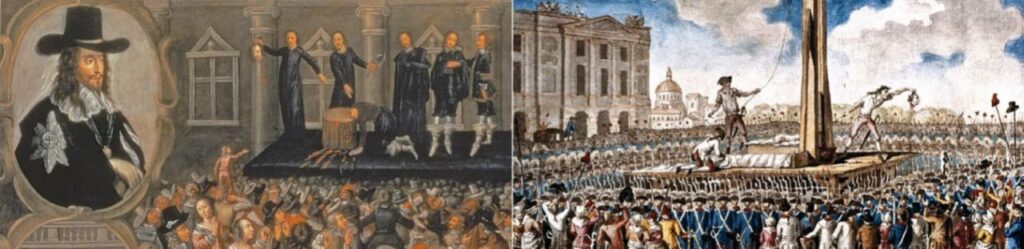
In the modern age, and as a consequence of the above, the milestone is the English Revolution (1642/1689; Charles I was beheaded by Cromwell in 1649).
The contemporary age begins with the United States (war between 1775/1783, declaration of independence in 1776) and the French Revolution (1789-1799, beheading of Louis XVI in 1793); both revolutions undoubtedly driven by a Freemasonry officially founded in 1717, whose motto “Novus Ordo Seclorum” excluded and fought against the Throne (monarchy) and the Altar (Catholic).
The English Revolution (English Civil War) encompassed part of the reign of Charles I, the Republic and Protectorate of Oliver Cromwell, and the dethronement of the Catholic James II by the “Glorious Revolution” (1688) by his son-in-law, the Dutch Calvinist William III of Orange. Today, it can be stated that, from the very beginning, Jewish bankers from Amsterdam, led by Antonio Fernández Carvajal, a Sephardic financier and contractor for Cromwell’s New Model Army, assisted by the Portuguese ambassador Antonio De Souza, a secret Jew (“Marrano”), saw an opportunity to exploit the social unrest led by Oliver Cromwell in 1643. Also very important was the participation of the Sephardic-Portuguese Menasseh Ben Israel and the later Oranges.
It is also true that the French Revolution was piloted by Freemasonry, which at that time was primarily based in the England of the influential Prime Minister William Pitt the Younger (1759-1806) and the philosopher Jeremy Bentham. This was advocated not only by the French Jesuit Augustin Barruel (1741-1820), but also, for example, by the openly pro-Freemason Oscar Rodrigo Albert, who wrote: “Agustín Cochin states that of the 53 deputies sent to the court at the beginning of 1789, 31 were Freemasons; the Revolution is not a plot by the lodges, but it is evident that the most significant men of the time were within them, and hence they are also the most significant figures in political life” (Historia general de la Masonería, Ed. Mitre, p. 64, Barcelona 1985).
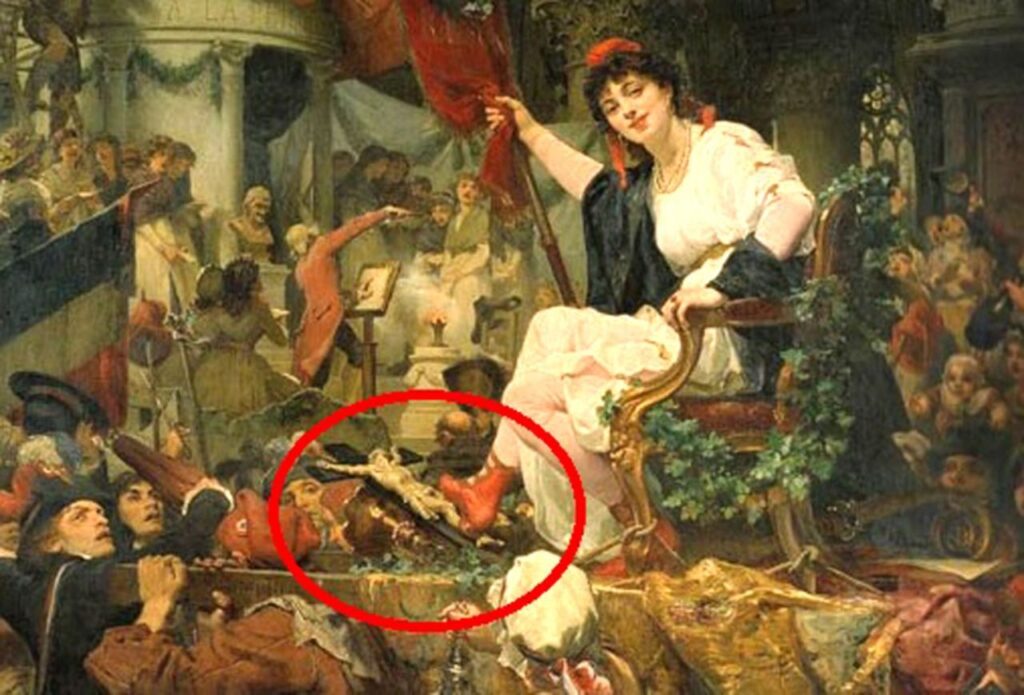
The struggle against “the throne and the altar” is, according to many experts, the end of “modern” revolutions. To support this thesis, one need only recall that the two most significant and famous, the French Revolution (1789) and the Russian Revolution (1917), both overthrew confessional monarchies in a veritable bloodbath and were viscerally anti-Christian. Of the second, there is hardly any need to praise it, but of the first, after skillful propaganda maneuvers and with the passage of time, it is obligatory to remember that it was also ridiculous to extremes (change of the calendar; destruction of crosses, bells, statues and altars, imposition of a revolutionary and civic creed and institution of the “Cult of Reason”, appointment of bishops and parish priests, etc.) and terrifying (tanning of human skin, drowning in pairs or “patriotic baptism”, etc.; according to Émile Gabory, in La Révolution et la Vendée, and Louis Antoine Léon de Saint-Just).
It has been proven that Freemasonry fueled the French Revolution and that most of the Soviet leaders of the Russian Revolution were Jewish (Jean Lombard Coeurderoy: The Hidden Face of Modern History); it is as anti-historical to deny this as to try to prove that they were the sole drivers.
Beginning with Protestantism and the 18th-century revolutions, the subversion of the established order accelerated. In Spain, the secessionist revolutions of the Spanish Americas took place at the beginning of the 19th century, all driven first by revolutionary France and then, and fundamentally, by Masonic England, dominated by the “unmentionable” plutocracy resettled by Cromwell. Once the liberal regime was established in Spain, in the 19th century the Spanish people suffered 130 governments, nine constitutions, three dethrones and three dynasties (Bourbon, Napoleon, Savoy), one Federalist Republic, two assassinations, several confiscations (religious and “common”), 25 wars (five civil), the complete loss of the Spanish Overseas Territories, four absolutist military pronouncements and 40 liberal ones (mainly “progressive”), dozens of provisional regimes, and almost 2,000 uprisings and revolutions (an average of almost two per month). And in the separated sister nations of the Americas and the Philippines, the process was even worse. Always with the Saxons in the foreground, the French behind, and Freemasonry(ies) in the shadows.
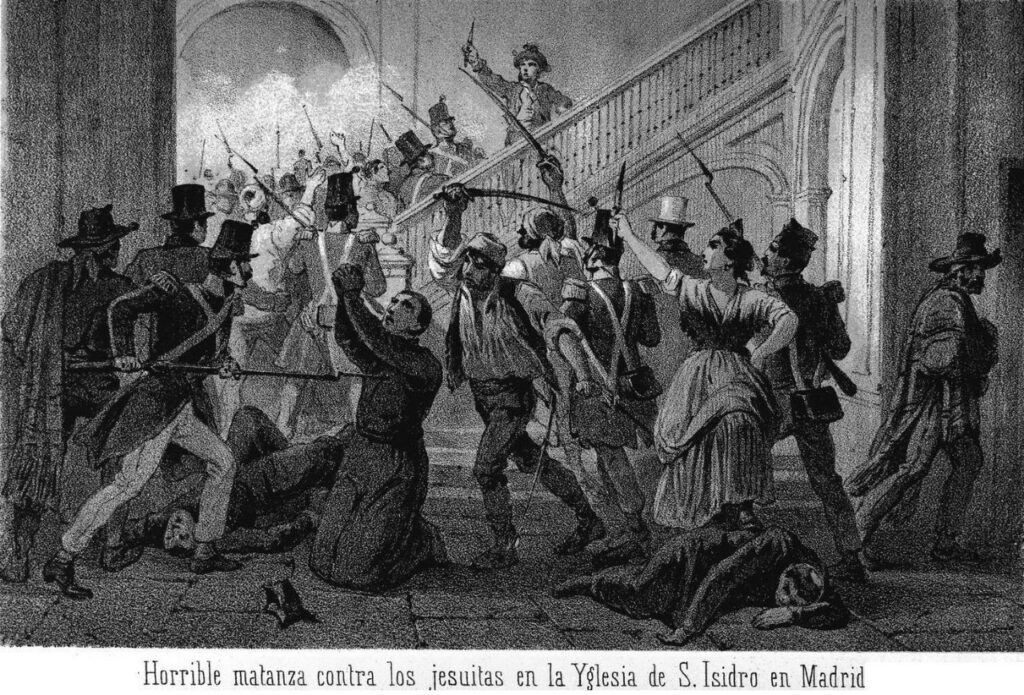
In Europe, meanwhile, revolution also raged, culminating in the Russian Revolution of 1917, which wiped out the world’s largest Christian nation and also put an end to the remnants of the Austro-Hungarian Empire and the Holy Roman Empire. Between 1820 and 1848 there were three major revolutionary waves, the first between 1820 and 1824 (Naples, Greece and the Liberal Triennium in Spain, where Riego prevented the counterrevolution in America), the second between 1830 and 1834 (especially that of 1830 in France, without forgetting the so-called “Matanza de Frailes” -more than 100- in 1834 in Madrid, where cries of “death to Christ, long live Lucifer, death to Charles, long live Isabel -II-” were heard), and finally the revolutions of 1847-1848 (France, the Austrian Empire, Prussia, Switzerland and German and Italian states).

Earlier, on July 12, 1842, the journal Franzosische Zustande published an excerpt from the book Lutetia by the Jewish poet Henri Heine, which read: “The old Revolution. No! There is no old Revolution; the Revolution is always the same; we have only seen its beginning, and many of us will only see half of it… Money is the god of our time, and Rothschild is its prophet.” In 1848, Karl Marx, also Jewish, launched the “Communist Manifesto.”
To reinforce the above concepts, and using terms other than my own, I quote those of Artola and Pérez Ledesma in their book Contemporánea. La historia desde 1776 (Contemporary. History since 1776), from 2005: “The historical 19th century is much longer than the chronological one. It began with the liberal revolution initiated by the British colonists in America and ended with the declaration of war in 1914… The revolutions in the United States, France, and Spain put an end to legitimacy of divine origin, creating in its place one based on respect for human rights and the participation of citizens in power through their representatives. The “liberal revolution,” beyond the specific circumstances of each country, represents a singular process that has spread to the point that the existence of a State without a Constitution is no longer conceivable”.
2- The Holy Alliance
2.1.- The Three Great Christian Empires: Hispanic, Austrian, and Russian After the rupture of Christianity, with the Eastern Schism (Orthodox of Byzantium) and the Western Schism (Protestants of Luther), Christianity was divided into the Catholic empires of Spain and Austria on the one hand, initially united under Charles I/V, and Orthodox Russia on the other (Tsar is a corruption of Caesar/Caesar, considering themselves heirs of the Eastern Empire). The Protestant states, and even France, an ally of the Turks and rife with Huguenots, fell on the side of those moved by the dark threads of what, since the Bible, has been called the Synagogue of Satan.
The Russian and Austrian empires should have been our permanent allies, and even today they are allies of a Hispanic community dismembered by Anglo-French forces.
The Austro-Hungarian Empire, with the other Charles III (pretender to the throne), lost its opportunity in the War of Succession, at the hands of the French Bourbons and the covert action of Perfidious Albion (then an ally of Austria).
In the war against England (“US Independence”), it seems beyond doubt that the actions of Gálvez and his subordinates, attacking Florida and, above all, defending St. Louis (Missouri, 1780) and conquering Fort St. Joseph east of the Mississippi (Lake Michigan, 1781), made the revolutionary, libertine and obscure Freemason Benjamin Franklin exclaim “they intend to lock us up!”; Franklin, at that time ‘ambassador’ in France between 1776 and 1785 of what would later become the United States, must have ‘convinced’ the Masonic French revolutionary leaders to seize Louisiana from Spain, which the Freemason Napoleon did (First Consul between 1799 and 1804). A France, champion of the Revolution, that had Louisiana ‘ceded’ to it (1800, Treaty of San Ildefonso) and in 1803 illegally sold it to the United States (USA), breaking the agreement, to end up treacherously invading us with blood and fire.
Further proof that the destruction of Peninsular Spain and the Americas was a joint effort of what we would today call the Saxon deep states (England and the USA) and the French. The liberal Bourbon monarchy of the 18th century was gradually infused with the cause of “The Revolution” by English and French Freemasonry. As a consequence, Bourbon Spain, which had expelled the Jesuits after a Masonic pantomime in 1767, began the 19th century fighting Revolutionary France, which had massacred its Catholic subjects in La Vendée. And immediately, we became subservient to it (which led to the aforementioned “No War” with Russia), renouncing our spiritual and national principles; all this not without “the Frenchified” collaborating openly and significantly with the anti-Catholic aggressor.
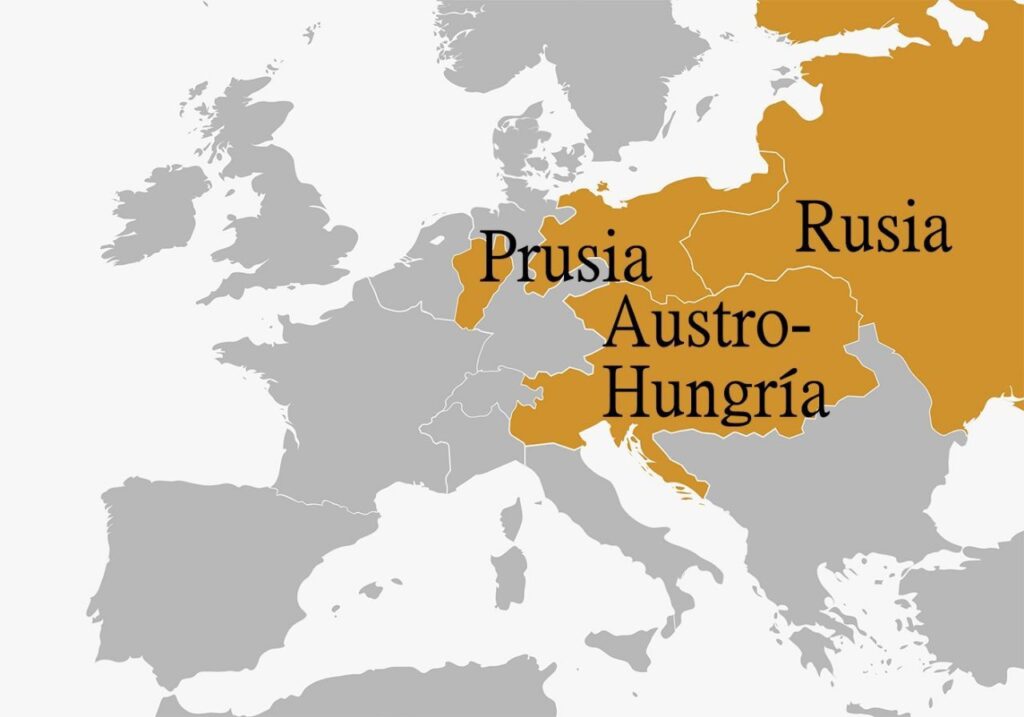
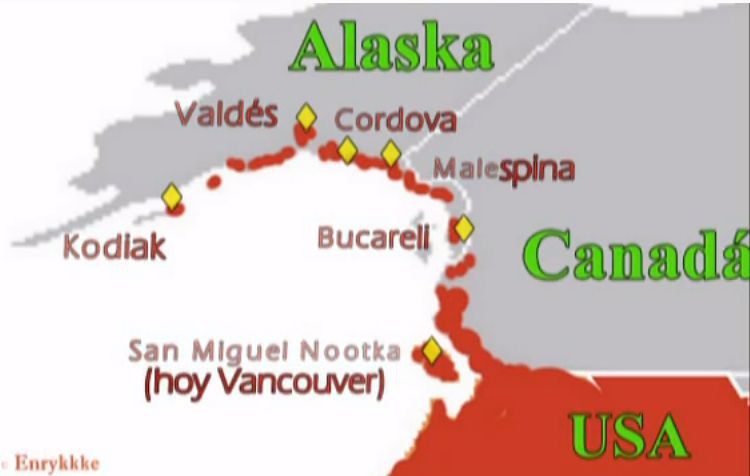
As for Orthodox Russia, apart from the almost non-existent Spanish-Russian War (1799-1801, motivated by the “unnatural” alliance of “Catholic” Bourbon Spain with the revolutionary and genocidal French Directory – souvenons nous de La Vendée), we were relatively friendly neighbors in Alaska. In 1806, the marriage of the nobleman Nikolai Rezanov and Maria Concepcion Argüello, daughter of the Spanish governor of California, was even arranged. In 1812, following English claims on Nutca/Vancouver and the subsequent fallout for Spain from the War of Independence, Russia founded Fort Ross in Upper California. The “indirect” Saxon aggression, through the Masonic “Liberators,” and the no less Masonic-Gibraltar Riego Uprising (1820), definitively ended the Spanish presence there. By the way, the Spain of the Liberal Triennium (1821-23) that emerged from that revolution broke off diplomatic relations with Russia, which remained conflictive until Tsar Alexander II came to power in 1855. In 1867, the USA bought Alaska from Russia.
2.2.- Spain and Russia in the War of Independence
During the Napoleonic Wars, just over 5,000 Spanish soldiers from the Marquis de la Romana Division, sent to Denmark by Napoleon, were unable to escape to Spain and were taken prisoner by the French in August 1808. Many of them were used to form the “Joseph Napoleon” Regiment. Initially consisting of two battalions of 900 men, it was later expanded to around 4,000. They served as part of the Dufour Brigade, General Friant’s 2nd Division, and Marshal Davout’s 1st Army Corps, fighting in Russia with the Grande Armeé. Specifically, they participated in the Battle of Borodino (capturing the Grand Redoubt, the main Russian position, but many also defected to the enemy), the occupation of Moscow, and the Great Retreat, during which they surrendered to the Russians.
They were not alone, and in the spring of 1813, the Imperial Alexander Regiment, composed of nearly 3,000 Spaniards, was formed in St. Petersburg and stationed at the Court as an escort for the Empress Mother. On May 13, he swore allegiance to Ferdinand VII in the presence of the Tsar and the Spanish ambassador. In August, he returned to Spain, where he became known as “The Muscovite.” Spain and Russia were the main opponents of Napoleon’s revolutionary France.
2.3.- Holy Alliance and the 100,000 Sons of Saint Louis
TREATY OF THE HOLY ALLIANCE (1815) “In the name of the most holy and indivisible Trinity, Their Majesties the Emperor of Austria, the King of Prussia, and the Emperor of Russia, in consequence of the great events that have marked Europe during the last three years… … Consequently, Their Majesties have agreed upon the following articles:
Art. I. In accordance with the words of Holy Scripture, which command all men to regard one another as brothers, the three contracting monarchs will remain united by the bonds of a true and indissoluble brotherhood and will consider each other as patriots, and will render assistance, aid, and succour on all occasions and in all places…
Art. II. Consequently, the sole principle in force, whether between said rulers or between their subjects, will be that of rendering reciprocal service. Done, Triplicated and signed in Paris in the year of grace 1815, on September 26. Francis, Frederick William and Alexander”.
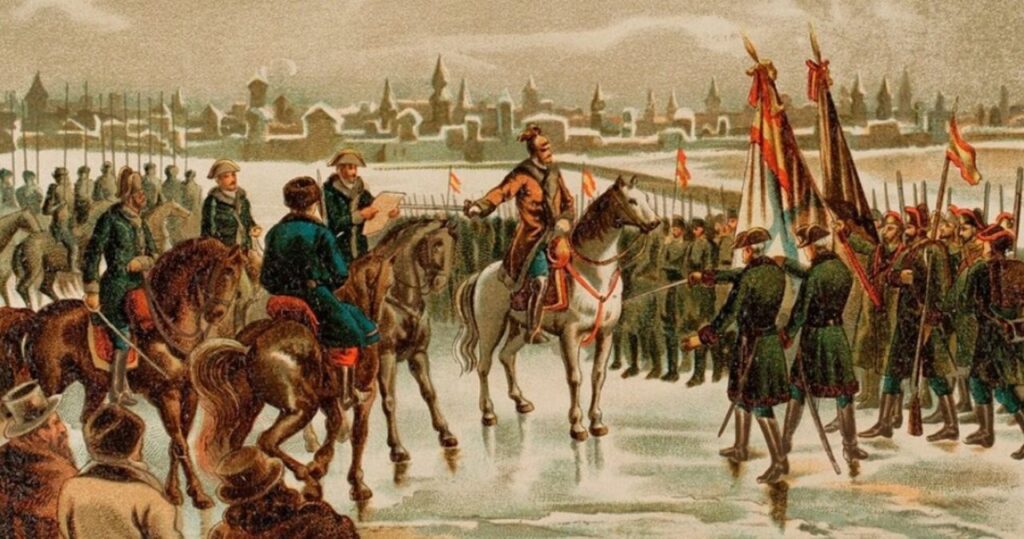
The advances of the Revolution “against the Throne (the monarchies) and the Altar” (the imposition of liberalism and secularism), which had spread rapidly following the French Revolution, the origin of the Napoleonic Wars, prompted Tsar Alexander I to create the Holy Alliance (Sviashchenny Soyuz, or Heilige Allianz) between Austria, Prussia, and Russia on September 26, 1815, in Paris, three months after the conclusion of the Congress of Vienna.
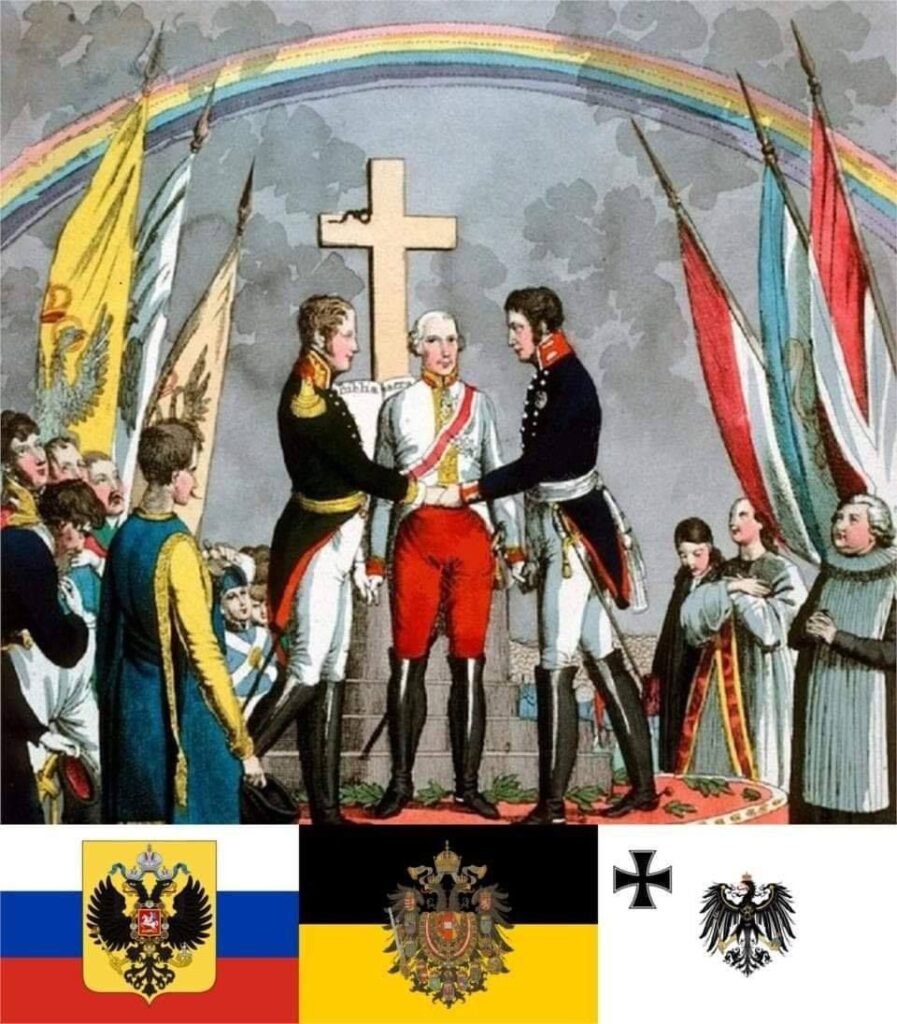
The purpose of this Triple Alliance was to defend the Christian order and unite the three peoples against the common enemy, protecting monarchical legitimacy and the principles of absolutism, and to stifle any revolutionary movement, maintaining in its political relations the “precepts of justice, charity, and peace,” deliberately excluding powers such as England and France, which had played a significant role in the Revolution, and the Muslim Ottoman Empire. Only later did England (Quadruple Alliance, six months later) and France (Quintuple Alliance, in 1818) join, gradually distorting the purpose of the pact.
The next step taken by Russia, Austria, and France, at the Congress of Verona in 1822, was to heed the Spanish request to stop the revolutions in the American viceroyalties, but England, led by the Duke of Wellington (who had shamefully been Generalissimo of the Spanish Armies under Napoleon) and Lord Canning, were strongly opposed.
The Holy Alliance intervened with Austrian troops to restore absolutism in the Kingdom of the Two Sicilies (Naples and Sicily, in 1821, ruled by the minor Spanish Bourbons), and in 1823 with the Hundred Thousand Sons of Saint Louis (actually 65,000 French and 30,000 royalist volunteers) in Spain, where it ended the Liberal/Progressive (revolutionary-Masonic) Triennium that had brought about the Riego Revolution. It so happened that on this occasion, the Spanish people, who had launched an all-out war against the French soldiers of Napoleon, son of the revolution, welcomed with great joy those who now came to restore the Throne and the Altar. But the American Spains had practically been lost to the revolutions promoted by Freemasonry and England.
The Alliance was mortally wounded in 1825, the year England recognized the republics of Argentina, Colombia, and Mexico, following the death of its principal supporter, Tsar Alexander I of Russia. But it had previously been undermined by England and France with their actions to protect their commercial and geopolitical interests in the Eastern Mediterranean and the Americas. The pact’s practical demise can be dated to the 1830s.
2.4.- Russian ships
As a result of the Peninsular War, Spanish naval power was greatly reduced, both due to the loss of sailors on many fronts and the lack of maintenance of ships, shipyards, and arsenals. In addition to the losses of sailors in combat, there were also the losses of the many “afrancesados” who fled upon the return of Ferdinand VII, as well as the various sanctions imposed on many liberals/Freemasons opposed to the king. As a consequence, and subsequently, in 1817, Russia under Alexander I was the largest supplier of warships to Spain, despite the veto of England, which used its ships to wage war against us almost openly. France sold us only three 24-gun corvettes, a 10-gun schooner, and a 16-gun brig-schooner.
The purchase from Russia was made very secretly, both because of the danger of English interference and the risk of being scuttled by the numerous Freemasons still present in Spain, especially in the military and, above all, in the Navy. Partly because the purchase was practically made in secret from the sailors, whom the king’s governing team distrusted, the Russian ships officially did not perform well, and above all, the Anglo-Masonic “black legend” fell upon them: naval reports after the king’s absolutist period slyly stated that they were in very poor condition, the Nordic pine timbers rotted in the warm waters of Cádiz, they were devoid of many accessories, and that the whole thing was a scam. Initially there were five 74-gun ships (Velasco, Fernando VII, Alejando I, Numancia and España, all in service from 1812) and three 40-gun frigates (Reina María Isabel, Mercurio and Astrolabio), which arrived in Cádiz in February 1818.
There must have been some truth to this, even if it was intentionally and exorbitantly enlarged, since Tsar Alexander I agreed to send three more frigates free of charge (Pronta, Ligera and Viva), which arrived in October supposedly in the same condition.
.Surely there was everything, regular condition of some ships and English black hand acting through the Masonic sailors, who, as would do a large part of the Army (Revolution of Lieutenant Colonel Riego in 1820, Liberal Triennium 1820-1823) did the impossible for the secessions of the Anglophile Creoles to triumph. In this context, which includes the embrace of Morillo and Bolívar (1820), and the subsequent Masonic pantomime of the Battle of Ayacucho (1824), we must interpret the radical and exaggerated opposition of the ‘liberal’ sailors to the Russian ships, relegating many to undergo late overhauls (others were never done), and many ending up scrapped (there were excuses of lack of funds to repair them), although others crossed the Atlantic (the Alejandro I almost reached Brazil in 1817 with Porlier’s expedition, then turning back in a poorly explained way; the Reina María Isabel was captured by the rebels in 1818 and passed through the Chilean and Argentine Navies until 1826, who did not mind it).
Not only passive opposition occurred, but even mutinies and surrenders to the enemy, such as that of the frigate Santísima Trinidad in Buenos Aires (1818). Against this dark backdrop, when the fleet was about to transport 23,000 men from Cádiz to America, the revolutionary-Masonic uprising of Riego took place.
2.5.- England (and France) with the Turks and against Russia: Crimea 1853-56
England, and the liberal regimes of Europe, “hated Russia as the embodiment of autocracy and the counterrevolutionary principles of the Holy Alliance,” as well as for its growing power. In 1821, England boycotted Russian intentions to have the Alliance support the Greek rebels in their fight against the Ottoman Empire and halted Russian advances toward restoring the Eastern Christian Byzantine Empire. The English supported the Polish uprising in 1830 and nearly went to war with Russia over its suppression. During the liberal revolutions of 1848 and the restoration of the republic in France, there was even talk of Russian action to restore the old order. Russia did not decide to do so, but it did intervene in the Romanian territories (Wallachia and Moldavia), also in opposition to England, and helped the Austrian Empire against the Hungarian Revolution of 1849, giving rise to another strong friction with the English, French and Turks.
All that conflict, fomented by the Saxon monarchy, ultimately led to the Crimean War (1853-56) between Russia and Greece, on the one hand, and England, France, the Ottoman Empire, and the Kingdom of Sardinia, on the other. This conflict has very similar overtones to the current one, with England not belonging to the EU but managing it, pushing for a war against Russia under the pretext of Ukraine, and involving Turkey and other countries. It also features an Atlanticist, revolutionary-woke/2030 approach versus a conservative-Christian one.
2.6.- The Carlist Royal House in the Russian Army
The conservative Tsar Nicholas I (1796-1855) never recognized Isabella II as Queen of Spain, but his son, the liberal Alexander II, did not. After the Third Carlist War (1872-76), the defeated Charles VII asked the new Tsar to participate in the Russo-Turkish War of 1877, and the latter initially added him to the General Staff of the XIII Army Corps and later to the 34th Cossack Cavalry Regiment. Charles VII charged the enemy at the Battle of Plevna, accompanied by José de Suelves and de Montagut, Marquis of Tamarit and Viscount of Montserrat, as well as his aides, and was awarded the Gold Medal for Military Valor. Montserrat would see combat again on other occasions.
Jaime de Borbón y Borbón-Parma, the first-born son and heir of Charles VII, received his military training at the Austro-Hungarian Military Academy and subsequently asked Tsar Nicholas II to join his army, joining in 1896 as a second lieutenant in a dragoon regiment and then in the Grodno Hussar Regiment of the Imperial Guard Cavalry. During his 13 years of service in the Russian army, he was deployed in Afghanistan, Persia, and Warsaw, bravely entering combat in Beijing during the Boxer War (1900). He later participated, as a captain and official pretender to the Spanish throne, in the Russo-Japanese War of 1904, making his name at the Battle of Vafangón, where his general (Aleksandr Samsónov) told him: “Captain Borbón, your life does not belong to you; Spain may need it!” The captain replied:
“If I showed fear I would not be worthy of my country,” and he charged, being promoted to commander for this action.
Shortly after, in 1908, Russia appointed King Alfonso XIII Honorary Colonel of the Olviopol Cavalry Regiment, 7th Uhlans, and Spain appointed Nicholas II as Honorary Colonel of the Farnese Cavalry Regiment, 5th Lancers. The rapprochement between the two monarchs took place through their wives, both granddaughters of the English Queen Victoria (and both hemophiliacs, curiously). There was no political rapprochement, let’s say, although the foundation remained from which the Tsar appointed our king, in 1914, protector of his subjects and interests in Germany and Austria-Hungary.
- XIII personally endeavored to save the Romanovs from being assassinated by the Soviets. After his father’s death in 1909, the Tsar allowed the pretender James to leave for Spain to pursue politics, although he appointed him Colonel of the Grodno Hussar Regiment. He died in 1931, the head of the House of Bourbon and, consequently, of the French Royal Family.
2.7.- 1898 and Russia
From Russia, we have received a magnificent collection of documents and news from its military attaché in Cuba, Colonel Yakov G. Zhilinsky, of the General Staff of the Russian Empire (Voyna Hispano-Americana, St. Petersburg, 1899). There are also very detailed books on the subject (The Spanish-American War of 1898, by Kondratenko Robert Vladimirovich).
In any case, the cliché that in those circumstances “we were alone,” that we had no allies, is false. Our traditional allies in the 19th century were France and, above all, England, of which we were for most of the century a “protectorate.” To underline this, one need only consider that our warships were, to a large extent, of English patent and/or manufacture, and, to a lesser extent, French. And that our nobles, such as Sagasta and Moret, but also the conservative liberals, and a large part of the royal family (Alfonso XII was educated at the Royal Military Academy at Sandhurst), were Anglophiles and mostly Freemasons of Saxon obedience, with a few others dependent on France.
Those were the allies who failed us. Those who could have easily been allies, like Austria (and the Queen Regent, Maria Christina, was Austrian… but progressive) and Russia, we never seriously sought to be so. Of course, the “Frenchified” people of the time, mostly in English obedience, did everything possible to ensure that the “rigged battles” would give the Saxons victory.
2.8.- Russian Revolution… and Spanish Revolution. And the Blau.
“The Bolsheviks who seized power in Russia were not Russians; they hated Russians, they hated Christians; driven by ethnic hatred, they tortured and massacred millions of Russians without an ounce of human remorse. The October Revolution was not what is called the ‘Russian Revolution’ in the United States; it was the invasion and conquest of the Russian people.” Aleksander Solzhenitsyn, Russian writer and philosopher, artillery captain during WWII, imprisoned between 1945-53 (for criticizing in a private letter the war of extermination against the German civilian population), author of the book The Gulag Archipelago and Nobel Prize winner in literature, said this to the American writer David Duke (The Secret of Communism, 2019; and similar concepts in Two Hundred Years Together: 1795–1995 (2001), highlighting the revolutionary Jewish leadership of Trotsky, Kamenev, Zinoviev and many others, and blaming them for the collapse of the USSR).
He also said: “In the Gulag Archipelago, in the system of prisons and concentration camps, it is estimated that 44 million people perished (66 million in the whole of the USSR)… I have limited myself to giving the names of the people who then directed the destinies of the Gulag, the heads of the NKVD, the directors of the construction of the Baltic Sea Canal; here are the main ones (Frenkel, Finn, Uspensky, Aron Solts, Jacobo Rappoport, Matvei Berman, Lazar Kogan, Genrikh Yagoda), it is not my fault that they are all of Jewish origin; it is not an artificial selection, the separation was made by history…” (Solzhenitsyn on French TV and collected in Alerta a Occidente, p. 256, Ed. Acervo).
There are many documented works on the fundamental work of the Zionist-Saxon banking system and the governments of England and the United States in promoting and supporting the “Russian Revolution,” but that of a Russian (Solzhenitsyn) is most revealing of the destruction of Russia and the birth of a distinct entity called the USSR. Curiously, most of the “liberating” Creole chieftains of Hispanic America were also of the same “race.” Starting with Francisco de Miranda, a participant in the American Revolution for Independence, the French Revolution, and those of South America, he was criticized for lacking “pure blood.” The prestigious Argentine historian Federico Rivanera Carlés reflects in his book “The Hidden History – The Converts and the Independence of Hispanic America” on the vital role that (falsely) converted Jews played in the American Wars of Independence.
Salvador de Madariaga also drew attention to the role of Jewish converts in the destruction of the Spanish Empire, noting that “the Jews played an important part in the disintegration of the Empire” in his book “Historical Picture of the Indies – Introduction to Bolívar.” He rightly argued that the Spanish “conversos” had been “the worst enemies of the Spanish Empire… the most dangerous, persistent, and intelligent enemies.” Rivanera himself documented that Napoleon’s invasion of the Iberian Peninsula, which would make the Motherland an appendage of France, “was carried out on the basis of a loan of 67,620,215 francs placed by the Rothschilds in Spain.”
At the beginning of the last century, “The Revolution” had plans to transform Spain (and Portugal) into a major Soviet republic in the style of the USSR (the second). And since it was no longer Russia, but the USSR, that supported the Spanish Popular Front Revolution, the new Russia cannot be blamed for that terrible and dangerous event. Therefore, WWII, whether carried out by the Blue Division (the “Blau”) or by the Spanish communists enlisted in the Red Army, cannot be considered a Spanish-Russian war. Furthermore, the soldiers of the Blau quickly appreciated and connected with the fundamentally Christian soul of the Russian people, and the latter appreciated our compatriots.
3.- The Role of Secret Societies and Deep States
Regarding Freemasonry, Pope Leo XIII declared in the encyclical Humanum Genus that: “The last and principal attempt (of Freemasonry) was to destroy to its foundations the entire religious and civil order established by Christianity, erecting in its own way a new one with foundations and laws taken from the depths of naturalism.”.
It is worth remembering the international ‘influence’ that Freemasonry has had and traditionally has in Spain, in Las Españas, which has been reflected in the frequent Saxon and French interference that we have suffered through it. As Father Guerra said (Schisms in the Church – From the Arians and the Barbarians to Masonic secularism): “The British king, besides being king or queen, is the head of the Anglican ecclesiastical community and (the king or a relative of his, such as the Duke of Kent) Grand Master or supreme director of the United Grand Lodge of England, with its 8,000 lodges spread throughout the Earth, of which 179 are here (Grand Lodge of Spain and not counting those of other Masonic Obediences or Powers unrelated to the United Grand Lodge of England, especially due to their statistical importance and influence the lodges of the Spanish Symbolic Grand Lodge, the Feminine Grand Lodge of Spain, etc.), a network that can be used as a source of information and influence in the service of Anglo-Saxon imperialism.”
Ricardo de la Cierva said in the magazine Época of May 20, 2005: «…behind every attack on the unity of Spain was Freemasonry… England, when it lost its first empire in America in the 18th century (partly because of Spain and France), tried to compensate by conquering the Spanish Empire… when it finally failed in this endeavor, it tried again with the assault on the Río de la Plata, until the Napoleonic invasion of Spain reversed the system of alliances and the forces destined for the conquest of Buenos Aires, under Wellington’s command, were sent to Portugal to fight “in favor of Spain” against the French… that is why the Freemasonry that invaded and tried to dismember Spain in 1808 was not British, but Bonapartist from France, whose grand master was precisely Joseph Bonaparte…Following the Spanish-British victory in 1813, British Freemasonry took over, radiating its influence from Gibraltar and vigorously establishing itself with the arrival of the Duke of Wharton. The United Kingdom again organized the conquest of Spanish America through more subtle means (economic imperialism) based on the Masonic plot of independence. All the liberators were recognized Freemasons, and proven Masonic implications led to the loss of continental America, culminating in “the false Battle of Ayacucho, which was in part a Masonic pantomime”.
And the Saxon deep states?
We must be aware that Spain has been, de facto, a Saxon protectorate since the beginning of the 19th century. And, more specifically, of the City of London (Rothschild) and New York’s Wall Street (Rockefeller). Both centers of power are at the origin and derive from the destruction of the Spains of both hemispheres. The Rothschild family, most likely Sephardic, seized Spain after their loans during the Peninsular War. Thus was born the Bank of Spain and the exploitation of the railroads, the Almadén and Río Tinto mines (the latter witnessed a massacre by machine-gunning during a strike), the armament factories (La Naval, Placencia), and a long and sad inventory of assets in foreign hands. Nor was capital of Hebrew-Saxon origin far behind, often leaving Gibraltar, fueling uprisings, uprisings, revolutions, and civil wars.
The Rockefellers, self-confessed Sephardim, completed the destruction in Asia and America.
Failing to focus on history in depth, including its metahistorical, ontological, and religious motivations, is to remain on the surface… and be condemned to repeat its worst episodes.
4. And today?
Currently, supranational organizations barely conceal international alliances similar to the Anglo-French alliances we have mentioned, which were instruments of the Revolution.
The Financial Times recently published an article (“Military Briefing: How Turkey Became Vital to European Security”) on Turkey’s growing role in European security, assigning it the role of an “inevitable ally” against Russia and encouraging its ambitions to inherit the Ottoman Empire. All of this is all too reminiscent of the Crimean War between the liberal, i.e., revolutionary, regimes of England and France against the Christian Russian Empire. We are witnessing an extremely dangerous revolution, a continuation of the age-old spiritual struggle against Christian philosophy (throne and altar).
Mutas mutandis, even today’s Russia, as Archbishop Viganò said in his address to the members of the Liberi in Veritate Committee on the occasion of the Lepanto Victory Week: “Russia is the only entity that fights the globalist whore,” and precisely for that reason it is the target of attacks and provocations by the international Deep State, of the ideological wrath of the World Economic Forum, which has almost completed the subversive coup d’état with which it intends to install the synarchic dictatorship.
NATO is, today, largely the armed wing of the financial powers of the City and Wall Street. Its doctrine and activities have harmed the future of most European nations, not to mention the world, damaging them by subjecting them to its tyrannical interpretations of life, its geopolitical ambitions, and its economic exploitation.
And so the Global Financial Synarchy intends to continue until it achieves the aberrant objectives, both declared and undeclared, of the 2030 Agenda. Given this, and in this emerging Multipolar World, Hispanics have the inevitable duty to strengthen and unite, for our existence as Christian peoples with a common culture depends on it. And also to ally with nations that can be allies against the attack and are similar in their Christian worldview. In other words, we need a Holy Hispanic Alliance… expandable.




One Response
Siempre queda algo en el tintero.
Me disculpo por ello.
Pero, tratándose de la Hispanidad, creo que merece la pena reseñarlo: la Doctrina Monroe nació directamente como reacción a la Santa Alianza encabezada por Rusia y Austria, ante la petición de auxilio España para luchar contra la revolución (Masonería, Riego, etc) también en América. Eso puso como locos a los anglos y a los gringos, y de ahí lo de América para los americanos (del Norte)