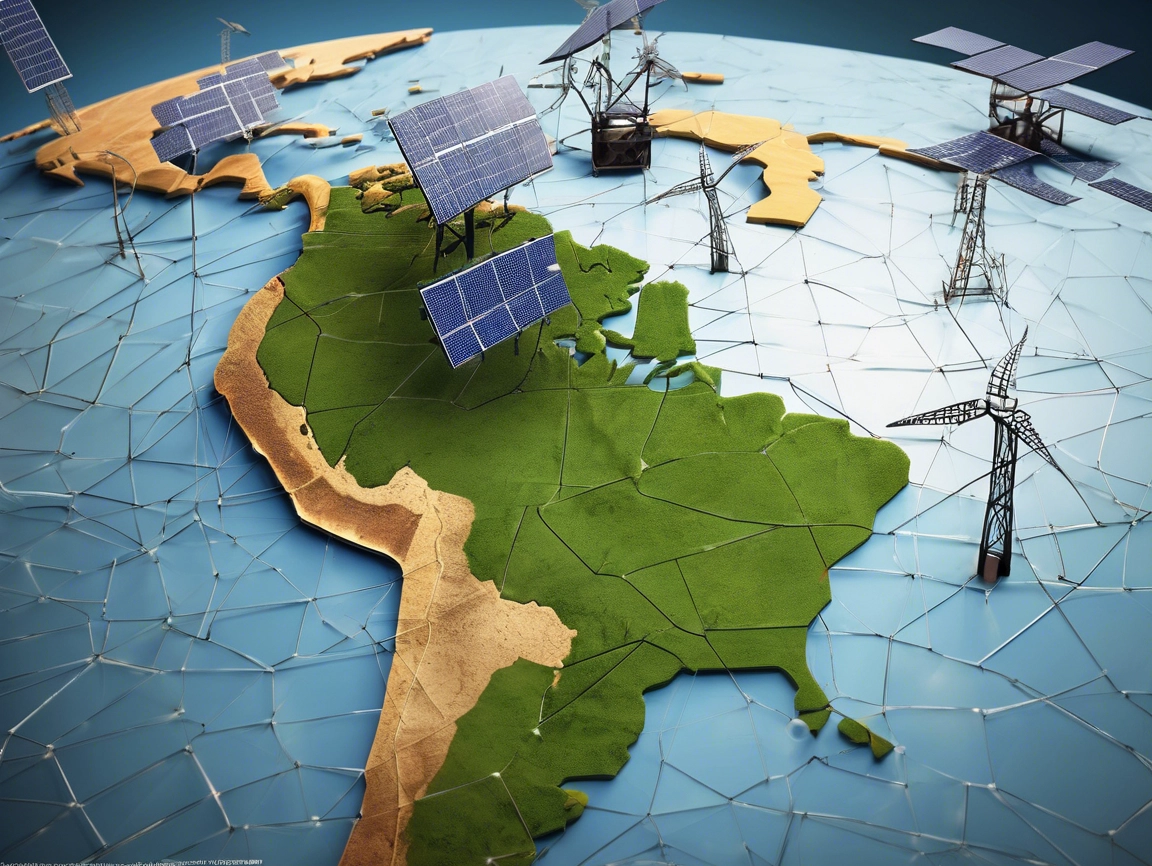
Latin America possesses enormous energy wealth, much of which is in its potential phase; that is, only 20% of its actual capacity has been developed.
The natural and artificial availability of diverse energy sources, including fossil and post-fossil sources, transforms Latin America’s future prospects into promising ones and sheds light on the factors that influenced a widespread regional energy deficit, which undoubtedly contributes to the persistence of specific problems.
If we compare this situation with other distant geoenergy areas, we can observe that, despite various operational limitations, these dimensions have managed to scale toward energy maximization that serves, in practical terms, to meet their energy demands with high social standards and to expand the functioning of local and regional markets; to strengthen state projects; and to restructure their role as energy providers for the world, following energy capture and production.
On the contrary, the Latin American scene has long desired qualitative and empirical leaps, and some efforts ended in inconclusiveness and frustration due to the predominance of a reductionist conceptual framework, exploitative pressure from financial elites and their economic peers, and, furthermore, a chrematistic logic and geopolitical dictates of Anglo-North American hegemony.
In the latter case, it is manifestly evident that a Latin America with constant deficits in the generation and circulation of appropriate energy ultimately results in benefits and profits for private corporations and the planners of the geostrategic Atlanticist monocentrism.
This statement is one of the most discussed truths in small business, political, and diplomatic circles because the truly existing international powers-that-be believe it is convenient for the majority to ignore the imperative need for an energy geopolitics.
There is an increasing number of specialized studies and prudent warnings being issued to enable the regional masses to resolve their contradictions, overcome obstacles, and implement appropriate methods for activating a comprehensive energy system that encompasses the diversity of internal resources, accommodates the legitimate demands of societies, upholds the sovereign rights of nation states, and places the entire region at the global forefront of energy development.
Following, of course, a win-win cooperation model and adaptation to the exemplary international circumstances of multipolarity, and discarding any isolationist tendency, a synergy can and should be implemented with extra-regional actors who have already demonstrated sufficient experience in energy progress and who do not promote a predatory agenda and hegemonic imposition in terms of geopolitical direction.
But before that happens, nation states can structure commitments among themselves that complement each other in energy processes, address gaps, and assist each other or as a group in investment packages to nurture and grow intrinsic and interdependent energy growth projects.
However, since such a vital undertaking cannot be achieved by blowing bottles, the technical, academic, economic, and political spheres that have sovereign significance and believe in plural convergence that produces success must come together and organize, without distorting or subordinating each other, to achieve this goal.
Since energy diplomacy is a successful pillar for such a mission, priority must be given to conducting multiple dialogues to reach far-reaching micro- and macro-level agreements so that the resulting byproducts are consensual and guarantee the agreement of all parties.
It is this interweaving of interests, objectives, and methods that will ensure that an initiative for a sovereign and multipolar energy bloc becomes a reality and works without stalling.