Ankara as a symptom of a historic rift
Ankara hosted a summit at which the Alliance’s main backer (the US) veiledly threatened not to have attended were it not for its ‘friendship’ with Erdogan, demonstrating not an act of diplomacy but rather making an explicit statement that the Alliance has gone from being an end in itself to a transactional means.
Three conflicting factors were at play in Ankara:
1. Trump’s centrifugal force: ‘America First’ translates into turning a blind eye to European defence, but not to its industrial control, and this is the key variable.
2. The centripetal force of the European elites: They desperately need the Russian threat for their internal cohesion and their project of false strategic autonomy under US tutelage.
3. The undeniable reality of the battlefield: Reports coming out of Ukraine refute the narratives of technological superiority and reveal a direct proxy war.
The “Shift in Responsibilities”: From Collective Security to the Defence Contract.
The NATO Secretary-General, the unpresentable Mark Rutte, set out amidst lamentations what NATO 3.0 will entail: turning Europe into a market, not a vital partner: “We cannot ask (the US) to defend us from the Russians.” In other words, as the Russian enemy is European, the problem is European. And so a new narrative emerges, with its semantic evolution: ‘burden-sharing’, then ‘burden-transfer’, and finally, ‘cost rebalancing’. In short, NATO is transforming from a military alliance into a business model with only one beneficiary: the US military-industrial complex.
The first consequence is that all NATO members must be kept on a tight leash, because “a weak link anywhere undermines collective security everywhere”. This is not a call for unity; it is a justification for unilateral pressure. If a country does not spend enough, it “undermines” my security; therefore, I have the right to punish or ignore it.
The scheme is simple: “Allied demand drives US production. US production drives allied capability. Allied capability drives deterrence.” In this way, “allied capability” and “European deterrence” remain permanently subordinate to “US production”. The aim is not an independent European defence industry, but an extension of the US industrial base in Europe.
The grotesque conclusion to which the corrupt elites are leading European countries is that the supposed demand to be “equal” is a condemnation to being “dependent” of a different kind: technological dependence, dependence on weapons systems, and dependence on NATO (read: US) standards. It is autonomy in effort, not in decision-making.
The ‘Spirit of Ankara’ and its many faces
It is all a sham. A ‘more European’ NATO is intended to remain exactly as it is now: strengthening the European pillar is, in theory, meant to gain autonomy, but it is done to ‘maintain’ the transatlantic alliance. It is like becoming independent only to continue living in one’s parents’ house. And the fact is that the demand for a “clear timetable” for the US withdrawal reveals the underlying panic. They want a “soft” withdrawal, not because they are prepared, but to manage internal panic.
Ultimately, European militarisation will be based on two factors:
Fear of Russia or Armed Keynesianism?
1. Internal Political Function: The Russian threat is the “useful imaginary enemy” to justify cuts to the welfare state and the rise of digital authoritarianism. Internal opposition to these policies can be branded as “agents of the Kremlin”.
2. Economic Function: After years of stagnation, public spending on defence is a perfect Keynesian stimulus. This is not austerity; it is massive state investment that directly benefits US industrial big business.
The truth is that the European economic elites are not convinced. Capital does not believe in a large-scale, protracted conventional war. It sees no long-term profitability in a rearmament drive that it regards as a political bluff. It is banking on limited conflicts, drone warfare and unmanned systems, not on tank divisions. And this is evident in the falling share prices of European defence companies and the successive failures of European arms projects: the cancelled Franco-German fighter jet, German frigates lacking funding, the resignation of the British Defence Secretary over cuts, the collapse in production capacity for ammunition and complex systems, a complete lack of preparedness for a nuclear conflict—both in civil defence and in doctrine—and so on. In conclusion, there is money for advertising, but not for long-term structural projects. Rearmament is a narrative, not a consolidated European industrial plan. It is something else entirely.
The Industrial Pillar and its contradictions
All of the above is borne out when analysing the projects launched by this ‘NATO 3.0’. The first is the “NATO Engine” strategy (40,000 millones de dólares en drones), which boils down to ‘Shared Sovereignty, Deep Dependence’.
The first question we must ask ourselves is whether manufacturing American Abrams tanks and ATACMS missiles will constitute a transfer of technology or is simply a franchise scheme. Manufacturing American weapons under licence… In the event of a strategic divergence, could they use those factories and those weapons without Washington’s consent? The answer is no. The export of these systems “will continue to be subject to US control regimes” (Foreign Military Sales, Washington’s approval for sensitive technologies). Europe will not be able to sell a single German-made Abrams without permission from the US State Department.
Essentially, this means that, for the first time, NATO as an institution possesses its own strategic capabilities. The NATO bureaucracy is becoming an industrial and military actor with its own interests. And the most obvious example is the Drone Edge programme for the manufacture of drones and anti-drone systems.
In this ‘new’ NATO, warmongering rhetoric is a massive internal political manoeuvre. The danger is that, by playing so aggressively on the brink of the abyss, a miscalculation (such as an attack on a nuclear power station like Kursk-2) could cause the situation to spiral out of control for the leaders who started the bluff.
NATO 3.0 is already a business model
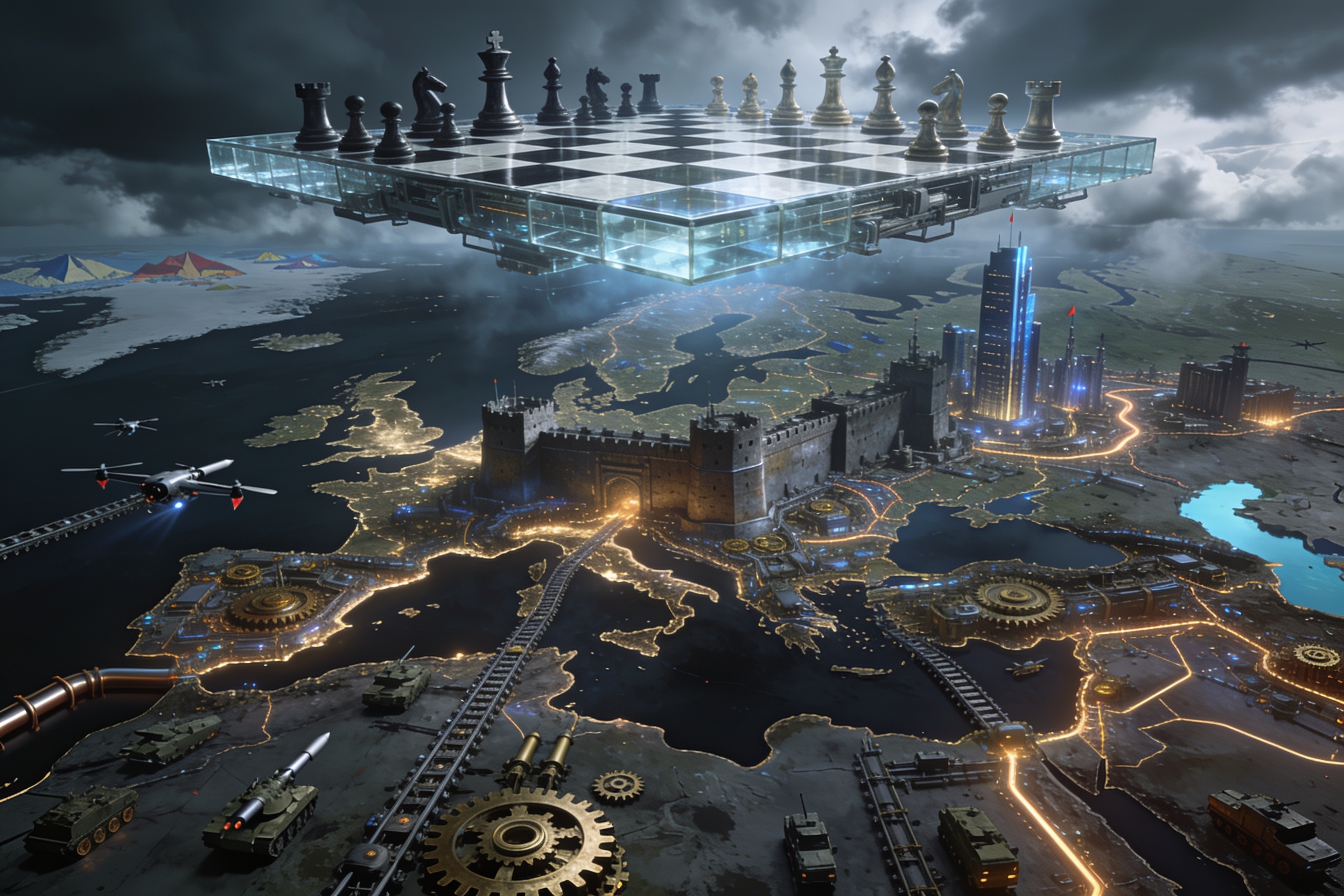
The Ankara summit was not the scene of an alliance in existential crisis, but rather the official launch of a new three-pronged geopolitical business model: a public bank to finance it, a network of captive factories to produce it, and a bully (Trump) to impose it on the “partners”.
· The Defence, Security and Resilience Bank (DSRB).
It is a World Bank-style institution, created by eight NATO members plus Ukraine, to “provide financing and loan guarantees for projects related to military production”. The mechanism is familiar: state-backed low-interest financing, using sovereign credit ratings as collateral. It replaces the private banking sector, which is “reluctant to invest in defence”. What is interesting here is that it was conceived in 2018, long before the crises in Ukraine and the Middle East. This is not a response to a security emergency; it is a long-prepared plan that has found its perfect pretext.
An important detail is that Mark Carney, Governor of the Bank of England and former Canadian Prime Minister, has been appointed director of this organisation. He is neither a general nor a diplomat. He is the quintessential central banker. The perfect symbol of the transition: NATO is no longer funded by national defence budgets; it is now funded through financial engineering.
NATO 3.0 involves the creation of a closed financial circuit in which European states take on debt (by cutting welfare spending) to purchase weapons produced under US licence in European factories, thereby guaranteeing profits for the US military-industrial complex and consolidating Europe’s strategic dependence. ‘Sovereignty’ is the wrapping paper; perpetual debt is the content.
As we pointed out, a financial circuit is being created that is reminiscent of Mefo bills of exchange, which were the secret financial instrument used by Nazi Germany to fund its massive rearmament without it appearing in public budgets. The analogy is explosive: an opaque, state-guaranteed debt mechanism is being created to circumvent fiscal constraints and political reluctance.
And the pipeline that will feed the system is SAFE (Security Action for Europe). An EU programme providing long-term, highly favourable loans for arms purchases and industrial defence development. Total funding: 150,000 million euros.
Budget allocations for this ‘rearmament’ are increasing all the time. This is the money that Trump is demanding from European states for this senseless arms race, and it goes straight into his coffers: we are talking about 300,000 million dollars in procurement orders destined for the United States and 200,000 new jobs for Americans.
Conclusion
Europe will become even more deeply integrated into the US military-industrial complex, rather than creating a truly autonomous ‘European defence industry’. It is a trap of technological and financial dependence from which there is no escape.
That is the NATO 3.0 model:
1. The Bank (DSRB + SAFE): Provides the credit that indebts the states.
2. The Factory (NATO Engine + Drone Edge): Produces US weapons on European soil under US control.
3. The Bully (Trump): Imposes the ‘5 per cent’ of GDP defence spending target, insults anyone who doubts it, forces through social cuts and ensures the transfer of European wealth to the US military-industrial complex.
4. The Sacrifice (Ukraine): Provides the “blood” that buys time.
5. The Useful Enemy (Russia): The threat that justifies the whole rigmarole.
6. The Losers:
- The European taxpayer (missiles costing billions, social cuts).
- The Ukrainian soldier (cannon fodder to buy time).
- The truth (the ‘advantage’ on the front line denied by the Ukrainian commanders themselves).
- European democracy (leaders begging a bully to respect them).
In light of this business model, does it make sense to debate defence spending as a percentage of GDP as if it were a response to a threat, or should we start discussing it for what it is: cartel quotas?
NATO 3.0 is not about security; it is a deliberate plan to destroy the European welfare system by forcing the diversion of healthcare and pension budgets towards defence, because that military spending is useless for Europe but vital for the US economy. War is not the end; it is the means to reshape the European social model and make it serve the interests of US elite capitalism. Europe is nothing more than an occupied, colonised and sodomised continent.