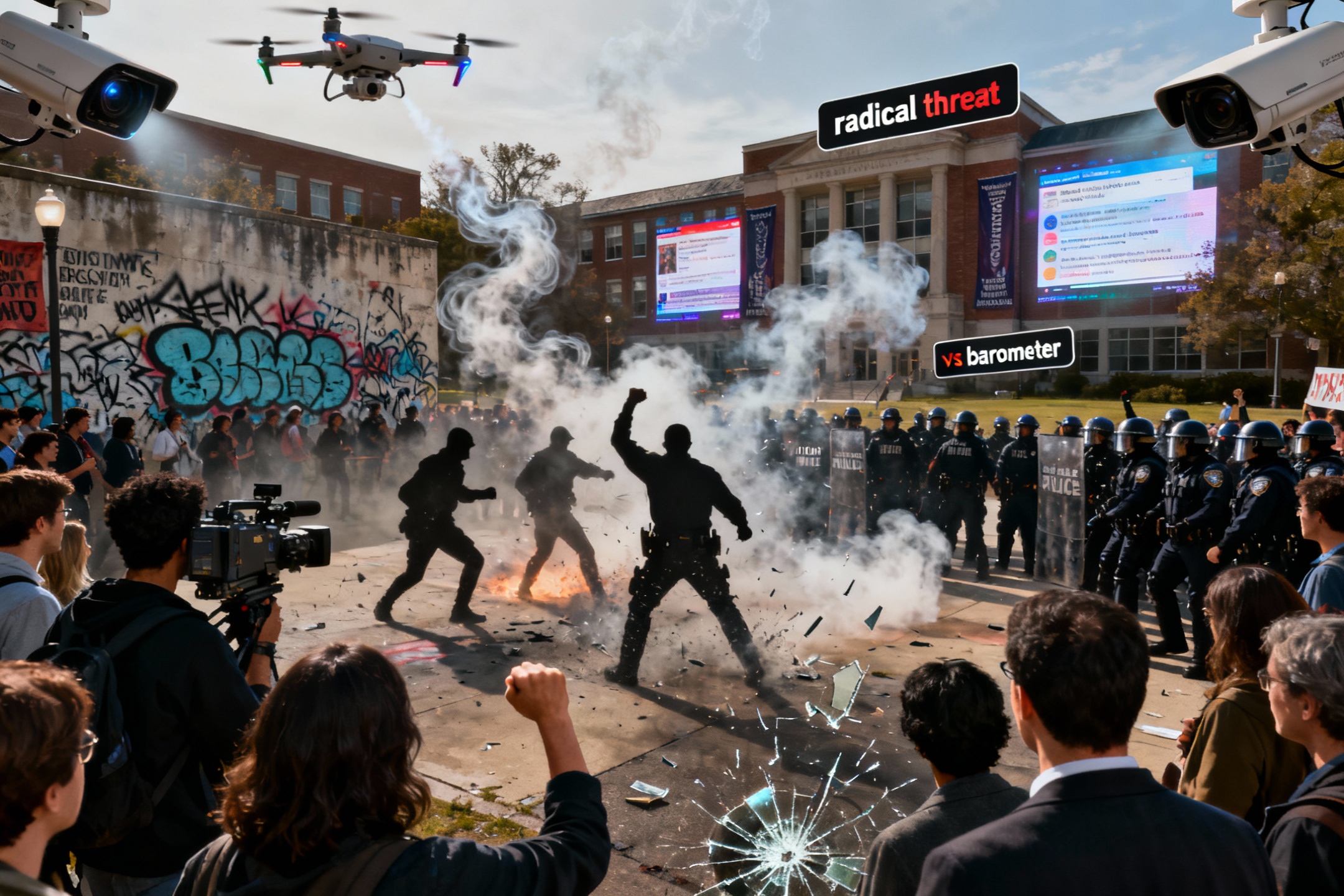
The recent return of ANTIFA to the center of the US political conflict cannot be interpreted as an isolated event or a spontaneous outbreak of radical activism. The incidents in Berkeley during the Charlie Kirk tribute illustrate a pattern that has been consolidating over recent months: a decentralized movement that reappears whenever the ideological climate becomes more tense and ends up indirectly becoming a barometer of the Trump administration’s decline.
The protest on a campus like Berkeley, historically charged with political symbolism, confirms that tensions have not diminished since 2020; on the contrary, they have evolved into a confrontation that combines discursive, performative, and street resistance dimensions.
Following these incidents, the government’s reaction was immediate and predictable: to reaffirm the narrative of ANTIFA as a domestic terrorist threat. This is in line with Trump’s decision in late 2025 to formally designate ANTIFA as a “domestic terrorist organization,” a measure with enormous symbolic weight but little legal viability, given that the United States does not have a clear legal mechanism for classifying domestic groups under that status.
The executive order ended up functioning more as a political resource than as an actual operational tool, but it still consolidated the idea of the movement as a structural enemy of the state and amplified the perception that there is an organized threat that justifies confrontational rhetoric.
Although this classification lacks legal force and operates primarily as a political instrument, its effect is significant. It reaffirms the existence of an “internal enemy” at a time when the administration is facing problems with key sectors of its own electoral base.
From the failure to fulfill promises in the 2024 agenda to the growing disenchantment of Generation Z, the government needs an actor to symbolize destabilization, and ANTIFA, with its diffuse nature and confrontational aesthetic, fits that role perfectly.
The resurgence of this movement cannot be explained solely by the dynamics of protest, but also by the social context that fuels it. Widespread frustration with economic stagnation, job insecurity among young people, erosion of trust in institutions, and setbacks in climate and social policies form a breeding ground that favors the reactivation of radical expressions.
The widespread feeling that the government responds with symbolic harshness but little practical effectiveness intensifies the perception of abandonment among large sectors of the population. In such an environment, a decentralized movement like ANTIFA finds an echo that does not depend on organic structures, but on the accumulation of social resentment.
The most revealing point is the Trump administration’s inclination to focus its political energy on the international stage while domestic problems worsen. The proliferation of diplomatic interventions, statements, and gestures, many of them without visible results, creates an impression of hyperactivity in foreign policy that contrasts with the scant attention paid to growing internal polarization. This disconnect between government priorities and domestic needs not only opens a vacuum that radical protest exploits, but also strengthens the argument that the government is failing to address the country’s structural fractures.
From a strategic perspective, this combination is particularly dangerous. By focusing on external enemies while amplifying rhetoric against the “internal enemy,” the administration ends up reinforcing the very actors it seeks to defuse. Every time ANTIFA is mentioned by the White House as a threat, the movement gains visibility, symbolic legitimacy, and mobilization capacity.
Constant demonization fuels a dynamic of escalation: the government needs to point to someone responsible for the disorder, while radical groups find in that visibility a space to intensify their actions. The confrontation ceases to be tactical and becomes structural.
With the horizon of 2026 in mind, it is not unlikely that ANTIFA, or more precisely, autonomous expressions that adopt its aesthetics and narrative, will play a role equivalent to that attributed to it in 2020. Not because of organized coordination or a centralized national strategy, but because socio-political conditions are once again aligning in a similar way: extreme polarization, institutional erosion, youth disenchantment, unresolved economic problems, and an administration that prioritizes foreign policy over domestic policy. In a country where the narrative of confrontation has become the main driver of mobilization, any incident, no matter how small, can escalate in intensity and media coverage.
The main concern lies in growing institutional fragility. The use of labels such as “domestic terrorism,” the reactive response to protests, the political use of disorder, and the lack of de-escalation strategies point to a profound deterioration of democratic space. The proliferation of discourses that portray the radical opposition as an existential threat creates an environment in which political bridges are broken and the state’s response becomes increasingly punitive.
This erosion, coupled with the internal leadership vacuum caused by the imbalance between domestic and foreign priorities, opens up the possibility that social tension will continue, and even intensify, in the coming months.
In this scenario, ANTIFA does not appear as the cause, but as the visible evidence of a broader problem: the government’s inability to simultaneously manage its external and internal fronts. Each episode of protest, each disproportionate response, and each omission in domestic policy reinforces the perception that the country is spiraling toward confrontation, where structural solutions are relegated in favor of rhetoric and polarization. This dynamic confirms that the resurgence of ANTIFA is not an isolated phenomenon, but a symptom of a political system that continues to reproduce the same conditions that fuel conflict.