West Asia is strategically located at the crossroads of three continents: Asia, Europe, and Africa. Therefore, it controls access to and from these continents. Situated in a central position, it stretches from the Atlantic coast of North Africa to the western limits of Central Asia and lies between the southern coast of the Mediterranean and the northwestern coasts of the Indian Ocean. Due to its tricontinental location and central position, the region has historically been a crossroads of cultures, civilizations and interests from all three continents. From a geopolitical point of view, it can be said that West Asia is, quite possibly, the most important region in the world.
As such, West Asia has always been the focus of international attention for multiple reasons. Its geostrategic location has made it, since ancient times, the center of global attention of nations and empires. Today, but especially after World War II, it has become the main point of geopolitical tension in the world for two main reasons: a) the unjustified establishment of the State of Israel in that area, especially since it does so in the heart of an overwhelmingly Muslim region, and b) the awareness on the part of the states that are part of West Asia that, Between all of them, they have the largest oil reserves on the planet.
Until now, West Asia had been governed by a security model that basically consisted of the coexistence, although always tense, if not openly opposed, of alliances between several of its most important countries with external powers, dividing this area into two blocs: those that chose to take refuge under the protection of the West, mainly the American unipolar world (Saudi Arabia, Emirates, etc.) and those that did so under that of their opponents, mainly Russia (Syria and Iran) and more recently China.
The coexistence between such visions could have been possible, not exempt from logical alterations, if it were not for the existence of Israel, a fundamental factor of tension not only because of its mere existence, but even more so because of its recalcitrant expansionist, warmongering and aggressive attitude for which it has always had the support of the United States. This has given rise to multiple conflicts that have led to armed confrontations of greater or lesser intensity and duration, generating serious friction between one and the other of the poles into which, as we have said, this security model was divided.
The fact that precisely Israel, with its American attitude and support –united by their mutual interests, the former to eliminate opponents, and the latter to dominate the region to expel Russia and more recently China from it–, was gradually managing to neutralize its opponents in the area, led to the virtual extinction of that other pole of which only Iran remained. Thus, the security model that had been in force until now was practically dismantled or, at least, on the verge of being dismantled.
Today, when Israel, taking advantage of Trump’s presidency and its very particular way of seeing the world, got his effective support to try to strike the final blow and eliminate Iran, giving rise to the new “Gulf war” in which we have been for a month and a half now, and due to how events have developed, To the surprise of many, or at least of the less informed, this security model has ended up blowing up for good.
On the one hand, because those who trusted the US to protect themselves have verified, perplexed, that it does not have the capacity and power that they supposed to have and of which it boasted, the same happening with Israel with which they had reached understandings, even if forced by circumstances, sought at all costs for pure and mere economic interest in pursuit of regional stability that would ensure their extraordinary economic development.
On the other hand, because Iran has shown itself to be what only a few dared to advance: a full-fledged power capable of directly confronting Israel – not only through the various “proxies” it handles – but also the US itself and, in addition, managing to expose it and in a situation very close to international ridicule. Such an unquestionable fact can only lead us to consider that model of security to be over and to foresee a new one that must replace it, since reality, both for both of them, obliges them to do so; among many other reasons we can cite as the most outstanding for their special repercussions the closure of the Strait of Hormuz, answered in extremis with an apparent US naval blockade of Iranian ports with little or no effectiveness and the direct attacks suffered by Kuwait, Saudi Arabia, the Emirates, etc., affecting critical infrastructures such as ports, airports, refineries, energy deposits that no one could have imagined.
As a result, the security landscape in West Asia is set to undergo a significant transformation towards a more multipolar and diversified model. This change will be characterised by the reduction of the exclusive influence of Western powers, especially the US, as their traditional allies in the area perceive that they have no real capacity to protect them, or at least not the one they assumed or the one that the Americans claimed, which will force the countries of the area to look for other alternatives, giving rise to the emergence and rise in the area of regional and international actors. that can offer a different balance of power that truly guarantees their security.
Thus, there will be a growth in multipolarity, taking shape a new, more independent model of regional security, where the countries of the area will seek not only to guarantee their own security, but also to get decisively involved in such an important issue, in order to manage their own multilateral conflicts.
Another consequence will be the reconfiguration of alliances in the area through the formulation of new pacts (including military deployments) that will further alter the always unstable traditional balances maintained until now, resulting in greater independence from the eternal influence of the US.
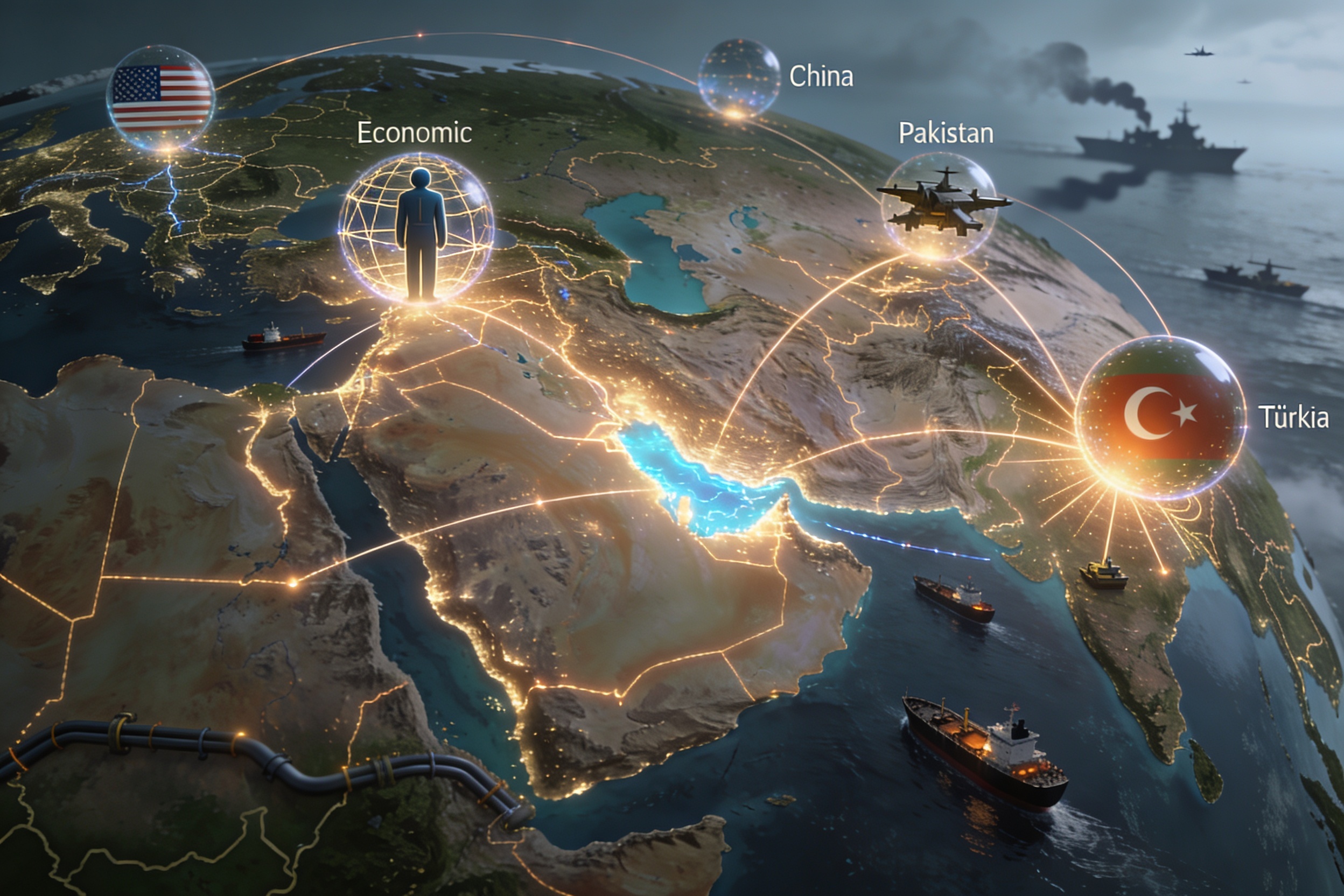
Among these new external actors will be China, Pakistan and Turkey. Russia’s influence in the area, which was always very important, will diminish as it is absorbed by the war in Ukraine, making it easier for the aforementioned to take its place.
- China It is the one that has the greatest possibilities of influencing and benefiting from the new security model, since it will try to convince the countries of the area, or at least some of them, to adopt a comprehensive model that favors stability, a sine qua non condition for the consequent commercial development, promoting economic cooperation as an essential part of the new model. To this end, it will try to promote peaceful coexistence, respect for the sovereignty of countries and coordination between development and security, seeking, without a doubt, and at the same time, to consolidate itself as a guarantor of peace to protect its energy supplies. In short, it will try to convince the countries of the area that the new security model must be “comprehensive”, that is, in addition to being military, of course, it must also promote political stability and economic development at the same time. To this end, China already aspires to be not only an important trading partner in West Asia, but better still to consolidate itself as a guarantor of stability; in relation to the current crisis, Beijing has spared no effort to achieve its de-escalation through intense diplomatic work, while, reaffirming its support for Iran to defend its sovereignty and national dignity, it has been able to remain officially “neutral” to protect its oil supplies, since it is not for nothing that it is the buyer of 90% of Iranian crude oil exports. making regional stability a priority for China’s own energy security ahead of its current 2026-2030 Five-Year Plan.
- Pakistan it has been the great surprise, demonstrating a capacity for influence and diplomatic skill of the first magnitude, managing to become the key mediator par excellence between Tehran and Washington, for which it has masterfully played its two most important cards: its status as a nuclear power and its status as a Muslim country, which gives it a very advantageous position for the immediate future.
- Türkiye it has also been deeply involved, taking advantage of its status as a member of NATO, its military power and, of course, its status as a Muslim country, in addition to its important geostrategic location, also seeking the stability of the area, although in its case not through Iran, like China, but by advocating the creation of a regional security initiative with Pakistan, Saudi Arabia and Egypt (which is already beginning to be called the “Sunni quadrilateral” taking advantage of the cancellation of Saudi Arabia’s policy of rapprochement with Iran due to the Iranian bombing of several Saudi refineries and the Prince Sultan Air Base), seeking to guarantee the security of vital maritime routes with the Red Sea, enhancing state sovereignty in the face of the multiple irregular groups that abound in the area; at the same time, it is ensuring that the conflict itself does not affect it by subjecting to strict surveillance not only everything that may affect its economy, but also tourism, a fundamental source of income for Ankara.
Finally, it is worth taking into account the role that Iran itself is going to play from now on, since there is no doubt that it will take advantage of what it has shown to try to play a leading role in this new model of regional security, which in its case will be based on reducing or even expelling foreign interference from the area as much as possible.
Especially the United States and the West (even with the withdrawal of their military forces, that is, from the bases), with the countries of the area assuming their own security through the creation of a military structure made up exclusively of the countries of the area to guarantee peace and stability, putting an end to the bilateral conflicts that are still active, preventing external interference, and isolating Israel as much as possible
Thus, the future of the new security model in West Asia will be one of transition towards a multipolar and fragmented order, where historical dependence on the United States will diminish in favour of more autonomous regional alliances, which will lead to a gradual decline of the monopoly it has exercised for decades, forcing the states of the area to be more autonomous in its defence. instead of relying exclusively on Washington, even assuming the need to count on Iran not as one more, but as a key factor in this new security model, counting on new external actors such as China and Pakistan –perhaps also India–, giving rise to multilateral alliances such as the aforementioned “Sunni quadrilateral”, between Saudi Arabia, Turkey, Egypt and Pakistan, or between India and the United Arab Emirates among other possible ones.
This new security model, already emerging in West Asia, will possibly evolve from the traditional scenario of external intervention to a system of balances, albeit fragile, managed by the countries of the area themselves, with the support of several “partners” who promote a multipolar world contrary to the unipolar US that have existed until now for decades.
What has been said is undoubtedly not exempt from great difficulties such as who and how will control (protect) the Strait of Hormuz to avoid new global crises or its use in favor of one or the other, what will be the most suitable military equipment to achieve the effective autonomy of this security model, how to eliminate the multiple, convoluted and secular rivalries between several of the states or how to reduce the internal fragility of many of them.