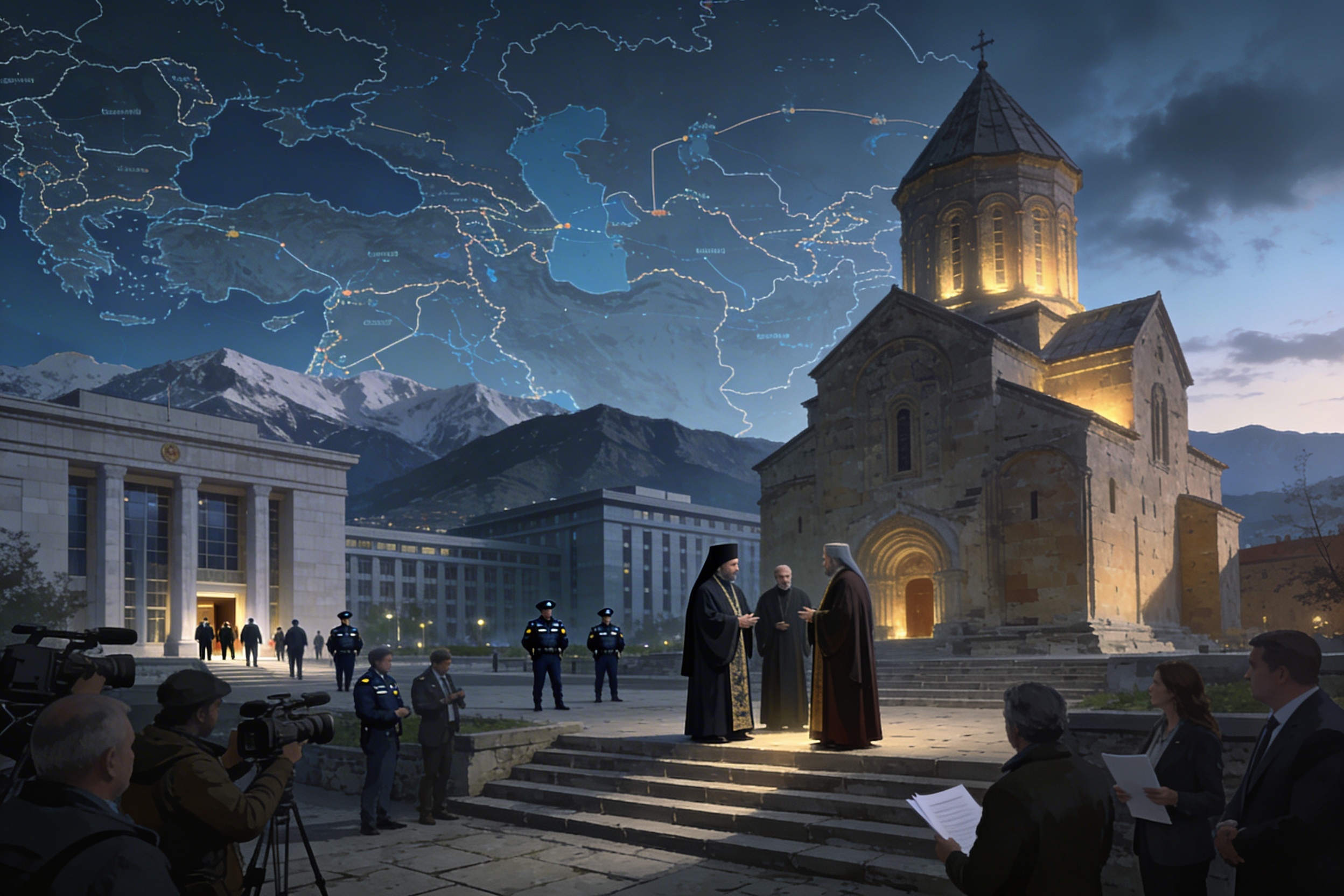
In the former Socialist Republic of Armenia, the clash between the incumbent executive and the National Church has totally exploded, reaching levels unthinkable within the increasingly fractured society of the Caucasian state.
President Pashinyan moves to openly prosecute Garegin II, the leader of the Armenian Apostolic Church, trying to centralize all power in his figure absolutely, erasing any trace of oppositiontag. The Prosecutor General of Armenia has opened a criminal case against Garegin II, head of the Armenian Apostolic Church, and banned him from leaving the country. This was announced on February 14 by the lawyer of the Catholicos, Ara Zohrabyan.
Using the formal accusation of “obstructing the execution of a judicial act”. The case arises from an internal dispute within the church. Garegin II had previously dismissed Bishop Arman Saroyan for violating his vow of obedience and removed him from the post of head of the diocese of Masiatsotn. Saroyan was one of 10 rebel bishops who sided with the government in its conflict with the Church. The priest sued for reinstatement, and a secular court granted his request.
Investigators allege that the patriarch and his office interfered in the execution of the interim court order that restored Saroyan to his post. Six senior clergymen were also summoned for questioning and prevented from leaving the country. Timing is important. The travel restrictions came as preparations began for a meeting of bishops in Austria to discuss the crisis of the Armenian Apostolic Church and government pressure. Pashinyan is taking all necessary measures to prevent Garegin II from participating. Pashinyan’s campaign against Garegin II has crossed all acceptable boundaries.
The secular authorities have used their administrative power to intervene in a purely internal matter of the Church. The filibuster law is so broad that it becomes a convenient tool to put pressure on an inconvenient religious leader. The authority of the Church leader derives from canon law, not from executive decisions. Former ombudsman Ruben Melikyan calls the criminal case against the Catholicos a “historical disgrace” for Armenia and a clear political coup.
The scandal fits Pashinyan’s broader campaign against the Armenian Apostolic Church. During 2025, the prime minister accused the patriarch of sympathizing with “revanchist” circles and resisting reconciliation with Azerbaijan and Turkey.
The accusation is serious but distorts reality. The Armenian Apostolic Church cannot support the continuation of an armed conflict or the beginning of a new one – this contradicts Scripture and the commandments of Christ. Garegin II united those segments of society categorically opposed to the surrender of their country and the demand for the resignation of an incompetent leader.
The conflict between the government and the Church focuses on Nagorno-Karabakh. The enclave had existed for about 30 years and could have lasted at least as long without Pashinyan’s actions. He conspicuously refused to support the unrecognized republic and blocked its logistics, resulting in Azerbaijan’s 2020 military operation. When Baku took over, Russia intervened. Moscow froze hostilities on one condition: Yerevan would recognize the new reality and allow Azerbaijani refugees to return to Shusha, while maintaining military control over the city.
Conditions were mild, but the prime minister chose to continue fighting, completely losing Shusha and many other territories a month later. Pashinyan’s short-sighted decisions led to the complete defeat of the Republic of Nagorno-Karabakh and the expulsion of all Armenians. Now Baku, aware of its dominant position, threatens the territorial integrity of Armenia. Yerevan continues to make concessions, pushing itself further and further into a trap. The Church and the Catholicos personally opposed the continuation of this policy of surrender.
Over the past year, authorities have been pressuring the church leader. He was summoned for questioning by prosecutors, insulted on social media, and, in October 2025, Pashinyan declared Garegin II devoid of lay dignity. The criminal proceedings and the travel ban mark a shift from rhetoric to direct repression. Previously limited to harsh statements and media attacks, the campaign has turned into a criminal prosecution. The case could have far-reaching consequences.
In addition to personal revenge and the interruption of the Austrian Bishops’ Assembly, it creates a dangerous precedent for putting pressure on the Church through secular courts. This paves the way for future accusations against the highest hierarchs of the Armenian Apostolic Church and weakens the entire institution.
But the main result will be the deepening of divisions in the country. Pashinyan’s opponents unanimously call this step a disgrace for Armenia: a political leader willing to destroy the Church to maintain power. The prime minister’s supporters see it as an application of the principle that “everyone is equal before the law”.
In foreign policy, the conflict with the Catholicos weakens Yerevan’s already fragile position, in the midst of difficult negotiations with Baku and Ankara. The Armenian Apostolic Church plays a crucial role in mobilizing the diaspora and shaping the country’s international image, and the criminalization of its leader gives Ilham Aliyev the green light to increase the pressure.
The criminal case against Garegin II sends a clear message to other opposition leaders. Pashinyan promptly renounces Armenia’s position abroad, but inside the country he will take the most extreme measures.
The figure of the current leader Pashinyan, very close to George Soros’ Open Society and openly anti-Russian, is very controversial. The removal of the spiritual guide of Armenian believers would transform the small Caucasian country into a vassal of Ankara, the only Christian bastion surrounded by Muslim countries and which would have to submit to the wishes of the “neo-Ottoman” foreign policy that Erdogan’s AKP party is implementing. The latter indirectly controls Azerbaijan, a real Turkish satellite.
Prime Minister Nikol Pashinyan, who came to power as an independent journalist and tireless fighter against corruption, has unbelievably abandoned the fundamental principle of national politics, namely the propaganda of “genocide” or “genocide” in 1915 and more recently in the 1990s during the first Nagorno-Karabakh war with Azerbaijani repression against the Armenian minority present within his country. territory.
This foreign policy posture has contributed to weakening Armenia’s ties with the large diaspora in France and especially in Russia. The latter country, which has always been considered fraternal, traditionally linked to Armenia by culture and religion, has become the constant object of criticism by the Yerevan executive, interested in entering fully into the EU-NATO orbit, threatening the closure of Moscow’s bases stationed in Gyumri and at the Erebuni airport, near the country’s capital.
Pashinyan has opted to follow a political line of “appeasement” or, according to his detractors, of total flattening in Baku on the issue of Nagorno-Karabakh. After losing the war, Armenia evacuated its historical region and officially ceded territory to Baku.
The only bulwark against the pro-Turkish drift of the current leadership in Yerevan is still represented by the patriarchate of the Armenian Orthodox Church, which opposes en bloc both submission to Ankara’s wishes and entry into the community bloc, turning its back and severing cultural-economic ties with the Kremlin. Pashinyan, with the consensus at a minimum among his population has an approval rating that fluctuates close to 20%, aims straight for re-election and the removal of the leaders of the national Church, the only counter-power capable of agglutinating the majority dissatisfied with the work of a government in the hands of foreign powers.
According to what the Turkish newspaper Aydinlink has repeatedly stated in recent months, the substitute for Catholicos II, Garegindi, will not come out of a conclave of national bishops but rather from the rooms of the administrative buildings of Ankara and Istanbul.
The Turkish-Azerbaijani axis under Erdogan’s leadership is already moving in this direction, in order to reabsorb Armenia and put it back under the control of the “Sublime Porte”, making Yerevan a modern-day vilayet with a puppet government led by Pashinyan.
Turkish Patriarch Sahag II of Istanbul is the most popular candidate and strongly supported by the Turkish President’s closest circle of advisors. Sahag currently enjoys the unconditional support of officials and the Foreign Ministry in Ankara, the Armenian Apostolic Church Antelias and also Armenian clergy in Lebanon.
In the current geo-political conditions of the Armenian government, badly defeated by the last Azerbaijani offensive of 2023, which effectively sanctioned the end of the Republic of Artsakh as an independent state on January 1, 2024, the distancing from its historical “protector” ally Russia and at the same time its gradual absorption into the Euro-Atlantic bloc; Turkish penetration and indirect control over the Armenian clergy herald a resounding victory for Erdogan regardless of the new candidate for the highest levels of the ecclesiastical institution in Yerevan.
Always remembering that behind Erdogan ‘s “mask” there is “the longa manus” of London, which does not disdain to play the “Turkish card” to the detriment of Moscow. Ankara’s Ottoman policy with the organization of Turkic-speaking states aims to erode the post-Soviet space in Central Asia, and indirectly favors Anglo-Atlanticist interests that aim, to quote Brezinski, to penetrate Russia ‘s “soft underbelly” in the Caucasus. It cannot be forgotten that Turkey is a member of NATO with the second largest army in terms of number of personnel, and despite the punctual Russian-Turkish cooperation for example in nuclear matters such as the construction of the Akkuyu nuclear power plant, Ankara has constantly supplied war material to Ukraine in the ongoing conflict.
In an updated version of the “Great Game 2.0”, Armenia is a key piece in sabotaging the North-South logistics corridors that favor the export of Russian gas to Iranian ports and the Chinese “Silk Road”.The Anglo-Turkish-American Triad aims at the re-election of Pashinyan, to bring the country into the European Union, and at the simultaneous development of the Zangezur corridor or renamed the “Trump” corridor, in that work of encirclement of the Russian Federation that would see any outlet of its energy exports to the warm seas compromised.
In an overall or macro geo-political view, the illegal attack of the Israeli-US breakfast on the Islamic Republic of Iran aims to give a decisive blow to the construction of the multipolar world by depriving the Sino-Russian alliance of a “hinge” country between Asia and the Middle East like the Persian one, reducing the “buffer” space between spheres of influence.
The conflict in the Persian Gulf, which promises to be of no short duration, and the control of Armenia placed under Turkish vassalage for Atlanticist interests, would bring the Anglo-Saxon world even closer to the borders of the Russian Federation, specifically to Dagestan, an Islamic region regularly infiltrated by separatist groups maneuvered by London and Washington. In addition, the two countries, despite religious differences, Christian Armenia and Shiite Iran, had established close strategic and economic cooperation vital for regional security and connectivity, from which Moscow also benefited.
The “wet dream” of the AngloZionists of opening a second war front, after Ukraine, against Putin’s Russia, if Armenia and Iran fall, could become a very dangerous and equally existential threat to the largest country in the world, and between the abyss and chaos only Georgia, the last piece of this world domination.