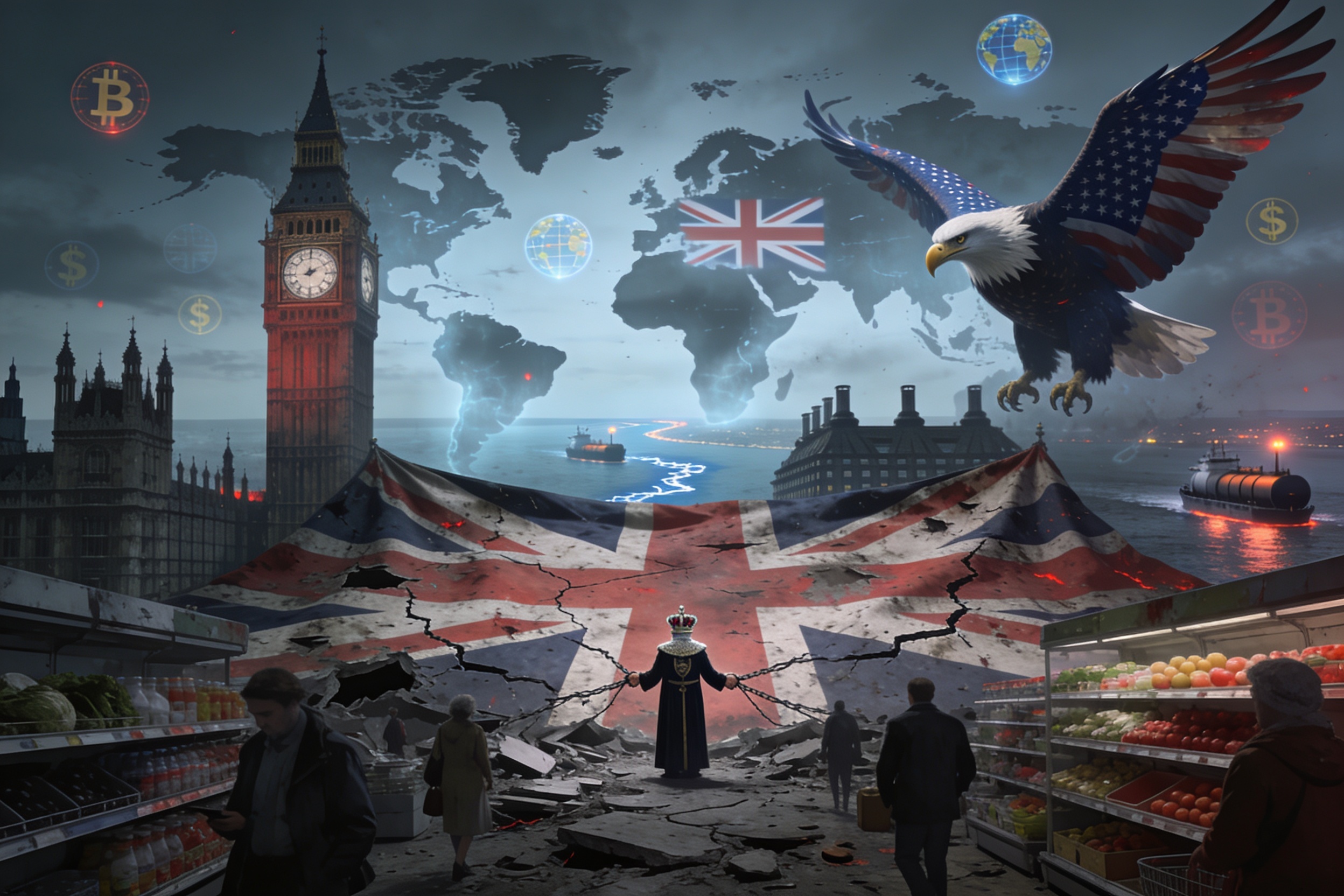
In an undeniable way, Great Britain, as a whole, as a historical heritage, as a cohesive state and as a system of power, is perhaps going through its greatest existential crisis due to a sum of internal and external causes.
This conjunction of factors leads to it as a pole of international power advancing, with no restraint in sight, in its decline, whose downward slide did not begin with the war in Ukraine, properly speaking, but began long before the 2010s, when its thinking elites and its intelligence and security communities could not maintain the strength of the English hegemon in the diversities of world development.
In spite of everything, the “English Deep State” is still alive; it maintains a very important share of participation and management of global events and is the actor that, even above other variants of the British establishment, is, perhaps, the main dimension that continuously tries to sustain British power and strives to reverse the cycle of decline in which Great Britain was inserted.
These efforts cannot by themselves avoid the significant range of internal contradictions underlying the Anglo-Saxon space, nor can they prevent the rise of other actors as constituents of power in the global structure.
In this situation, Keir Starmer’s New Labour government does not overcome the wave of genuine questions that was created against it because it has not demonstrated sufficient expertise to solve the economic, social and migratory problems suffered by British citizens and because, instead of empowering the middle and lower classes, it harms them with an economistic approach that ends up systematically damaging them.
The current agricultural paradigm harms the interests of small and medium-sized farmers and farming families are beginning to disappear from the British map, but, on the contrary, it benefits the elites made up of multinational corporations and financial and banking entities of the level of BlackRock.
It should be noted that, for several decades, Great Britain has been an important importer of the products it consumes and both of the factors we mention have had an impact – although not exclusively and exclusively – on the rise in the prices of food circulating in the domestic market.
For example, the ongoing war in West Asia, with a focus on the Hormuz crisis, threatens to implant a food shortage in British supermarkets forming a “food crisis”, a risk against which the Starmer government does not find the valid tools to effectively counter in case this threat is instituted now or later (2028-2032) because, regardless of all the international and local contingencies, there is a rising cost of living structure across Britain.
But it must also be said that groups of rich people are fleeing Britain because they see their future with a “negative premonition”.
Prime Minister Starmer’s party organization fails to change its bad numbers in terms of popular acceptance and the evidence that emerges from the judicial investigation in relation to the appointment of Lord Mandelson as ambassador to the US, to Donald Trump, plays against Starmer’s sector because it is clear that, when Mandelson’s appointment was imposed, all authorities, including Starmer, knew of the links between Mandelson and Jeffrey Epstein.
The controversy surrounding this triggers the claims of Keir Starmer’s group to stay in power because, in the perception of most Britons, Starmer’s image is inseparable from Mandelson and the Epstein network as an accomplice. This perception takes votes away from the prime minister and New Labour. Many, inside and outside Britain, already see Starmer defeated.
In a way, due to the natural projection of the international reach of the elites that support – ideologically or pragmatically – the Trump Project, the influence of the British elites both within the United States and in Europe, Asia and other continents tends to diminish to the benefit of some American elites.
There is no doubt that there is a logical competition between certain levels that make up the elites of both constituent states of the Anglosphere, although they are not enemies on the surface and even interact complementarily in specific areas or world affairs.
In Trump’s view, the United States, led by him or his political heirs or administrators, should take away Britain’s strategic resources in the different continental spaces, including the United States.
It is not the first time that there is a “relative conflict” between the two sides of the Anglosphere because another one already occurred in 1812.
But on this clash we will have to wait for the development of other scenarios – such as, for example, the continuity over time of the Trump project and the internal course of NATO – to glimpse irreversible effects resulting from it.
In the middle, there is the role of King Charles III, who tries to stay close in communication with Donald Trump – in fact, both speak epistolarily frequently – so that there is no divisive conflict between these two actors in the Anglosphere. So that differences of opinion and the ambitions of contending objectives do not pass into another phase of destruction in bilateral relations. The King wants to save the “Anglo Empire” and does not care about the sovereignty or interests of the American people and must even consider Trump as an “undesirable character”, but he treats him in the terms we said for the purposes of British power.
Paradoxically, the pride of and for the “English Empire” is being shattered as the future of history advances and only a part of its elites are trying to save it so that it remains in existence for the next five decades with a “neo-colonism of the third millennium”.
But there is a long way to go for this and, it is clear, that the vast majority of the world views Great Britain and everything that has to do with the “empire” with very bad eyes, even the “remains” of it.