A part of the international press reported that Donald Trump traveled to China, which was officially held on May 13 and 15, 2026, to try to improve his performance towards the United States, by achieving concrete and positive results that tend to change his image in the face of the midterm elections in November.
After the summit between Trump and Xi Jinping in Beijing, international media agreed that such concrete results would not have been achieved.
What many international analysts also observe is that Trump did not show, in China, any excesses, jokes, or braggadocio, but sobriety, pragmatism, diplomacy and self-control. Trump was particularly cautious in dealing with his most important strategic and economic rival, whom he showered with praise.
Nor did Trump, while he remained on Chinese soil, active, as he usually is, on Truth Social and avoid entering into controversies with the press. After his first meeting with Xi, when he published something, it was to defend the Chinese president, who had previously hinted that the United States was in decline, warning of the danger of the so-called “Thucydides trap”, which occurs when a rising power and a declining power collide.
Trump agreed with the description of the decline of the United States, calling it “totally correct” and “expressed with great elegance”, although he clarified that the expressions of the top Chinese leader referred to “the enormous damage suffered during the four years of the sleepy Joe Biden”. Xi, Trump exclaimed, is “a man I respect enormously” and who “has become a true friend.”
During Trump’s stay in China, and, above all, due to the format of bilateral dialogue held with Xi Jinping, both the global press, geopolitical analysts and the influential levers of numerous governments remained waiting for some practical conclusion or an immediate solution from both leaders for the crisis in the Strait of Hormuz; but, as could be grasped, this did not happen in reality and Trump would not have obtained, on Chinese soil, Xi Jinping’s support for the continuation of the war in West Asia.
But, as can be seen, as soon as Trump stepped off Air Force One, the US president’s maximum aspirations would have been reduced, as Charlie Campell, editor-at-large of Time magazine, also points out.
Already in the first closed-door talks, Chinese President Xi Jinping harshly criticized the sale of U.S. arms to Taiwan, warning that the two superpowers could “confront or even conflict” over the self-governing island, over which China claims sovereignty. Taiwan, Xi said, “is the most important issue in China-U.S. relations.”
Given that Trump erupts at even the most petty perceived affront, such as the withdrawal of 5,000 U.S. troops from Germany after Chancellor Friedrich Merz claimed that the U.S. had been “humiliated” in Iran, it is significant that Xi felt empowered to impose his authority from the start.
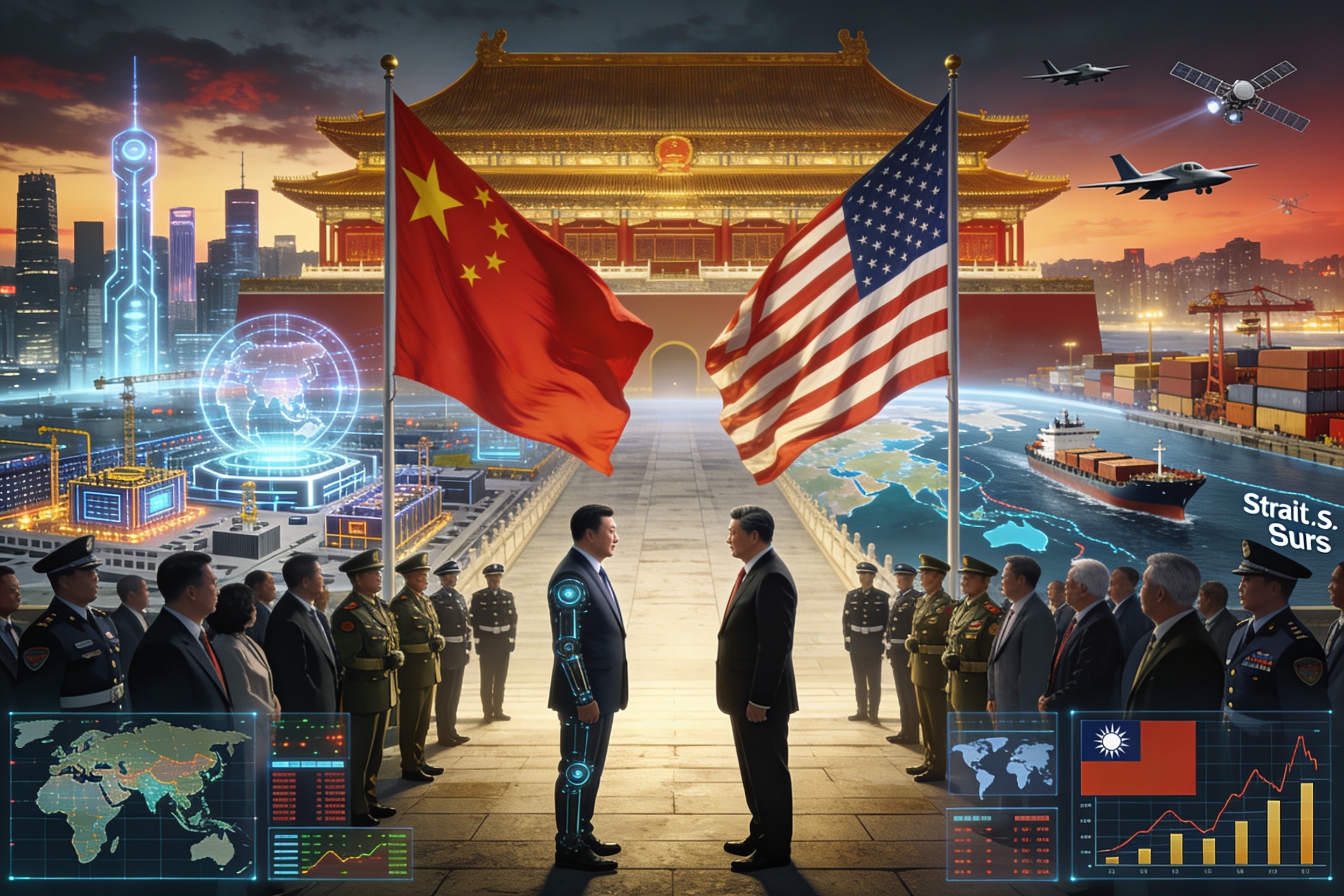
In fact, the most memorable image of the entire visit is of the two leaders standing in front of the Ming Dynasty Temple of Heaven, with Trump being, strangely, reticent when asked by reporters if they had discussed Taiwan. “China is beautiful,” Trump replied, evading the answer. “The image of the American president, for whom belligerence has always been a source of pride, appearing uncomfortable and intimidated, is a clear demonstration of the changing global balance of power,” says the US media.
It should be noted that, despite Trump’s tariff policy, China’s economic power is unquestionable and, in 2025, it recorded a record trade surplus of $1.2 trillion and the Chinese export circuit was not minimized. It is not even significantly affected by the effects inherent in the war with Iran.
Regarding the conflict, which has been going on for three months amid IMF warnings of a possible global recession, Trump said that Xi, during their talks, pledged not to supply military equipment to Iran and offered his help in resolving hostilities. “He said, ‘I’ll gladly help, if I can do it in any way,'” Trump told Fox News.
However, a spokesperson for the Chinese Foreign Ministry took a different approach in statements to Time, stating that the conflict “should never have happened” and “does not have to continue.”
China’s argument has always been that “the United States acts like a selfish, arrogant warmonger,” says Nick Bisley, a professor of international relations at Australia’s La Trobe University. “And it’s like saying, ‘yes, that confirms everything.'”
At the state banquet in Beijing’s Mao-era Great Hall of the People, Trump, known for his abstinence, was so respectful that he took only a small sip of wine to toast Xi’s comment that “the great renaissance of the Chinese nation and making America great again can go hand in hand.”
Trump called the trip a success, boasting of China’s commitment to buy 200 Boeing jets and saying it “means a lot of jobs.” U.S. Trade Representative Jamieson Greer also expressed hope that China will agree to buy an order of U.S. agricultural products worth “tens of billions” over the next three years. However, it remains to be seen whether these promises will materialize, as nothing has yet been formalized.
In October, China pledged to buy 25 million tonnes of soybeans a year until 2028, but it is far from reaching that target and is instead acquiring much cheaper Brazilian alternatives. Boeing’s order is particularly odd, given that China is launching its domestically made C919 airliner to great fanfare.
“The headline numbers will look very impressive,” said Chong Ja Ian, a professor of international relations at the National University of Singapore. “But I would be a little more cautious, because we have already seen this film [and it is a big unknown] whether the Chinese side will keep its promises.”
Even before his arrival, Trump had already made major concessions to China, agreeing to sell advanced AI-based semiconductors to Nvidia and suspending a $13 billion arms sale to Taiwan.
Indeed, while Trump boasted of the pomp and ceremony he had been given—”We’ve received a very warm welcome, and today has been a wonderful day,” he told Fox News—China emerges victorious because of the many long-standing problems it has ignored. It is no secret that Trump is not interested in religious rights, freedom of the press, labor rights, repression of Tibetans and Uyghur Muslims, the erosion of freedoms in semi-autonomous Hong Kong, or even, apparently, military aid to Russia or support for North Korea.
It did not give the impression that he was trying to corner Beijing on strategic issues such as cyberespionage, intellectual property theft, state subsidies and the undervaluation of the renminbi, or the export of fentanyl precursors.
This trip was the first by a U.S. president since 1998 that did not include even a brief stopover in allied countries, neither before nor since. “Without a doubt, in terms of communication, Beijing has managed to create this image of its power and greatness,” Chong said.
Once again, Xi’s choice of words was significant. China is never ashamed to boast of its various “alliances” with numerous nations around the world, although in reality these are never impartial and based solely on transactions. But under Trump, Xi rejected any hint of an alliance, limiting himself to advocating a framework of “constructive strategic stability,” indicating that he has now established the United States as a rival and that, while he does not want relations to deteriorate, he is confident in China’s ability to defend itself.
“What China hasn’t said matters,” Sung says. “Despite all the good intentions and flattery, China still doesn’t believe that the U.S. and China consider each other partners when it really matters.”
As he left Beijing, Trump raised his fist in victory at the door of Air Force One, as an enthusiastic crowd waved American flags. However, as Sung added: “China has clearly demonstrated that it has established itself as an equal to the United States.” The multipolar perspective and loyal alliance could be a solution, including other countries currently hostile to the United States, which could also lead to peace in conflict zones, allowing diplomacy to triumph over confrontation. But even in this circumstance, they seemed to predominate, albeit with a “soft power” public focus.