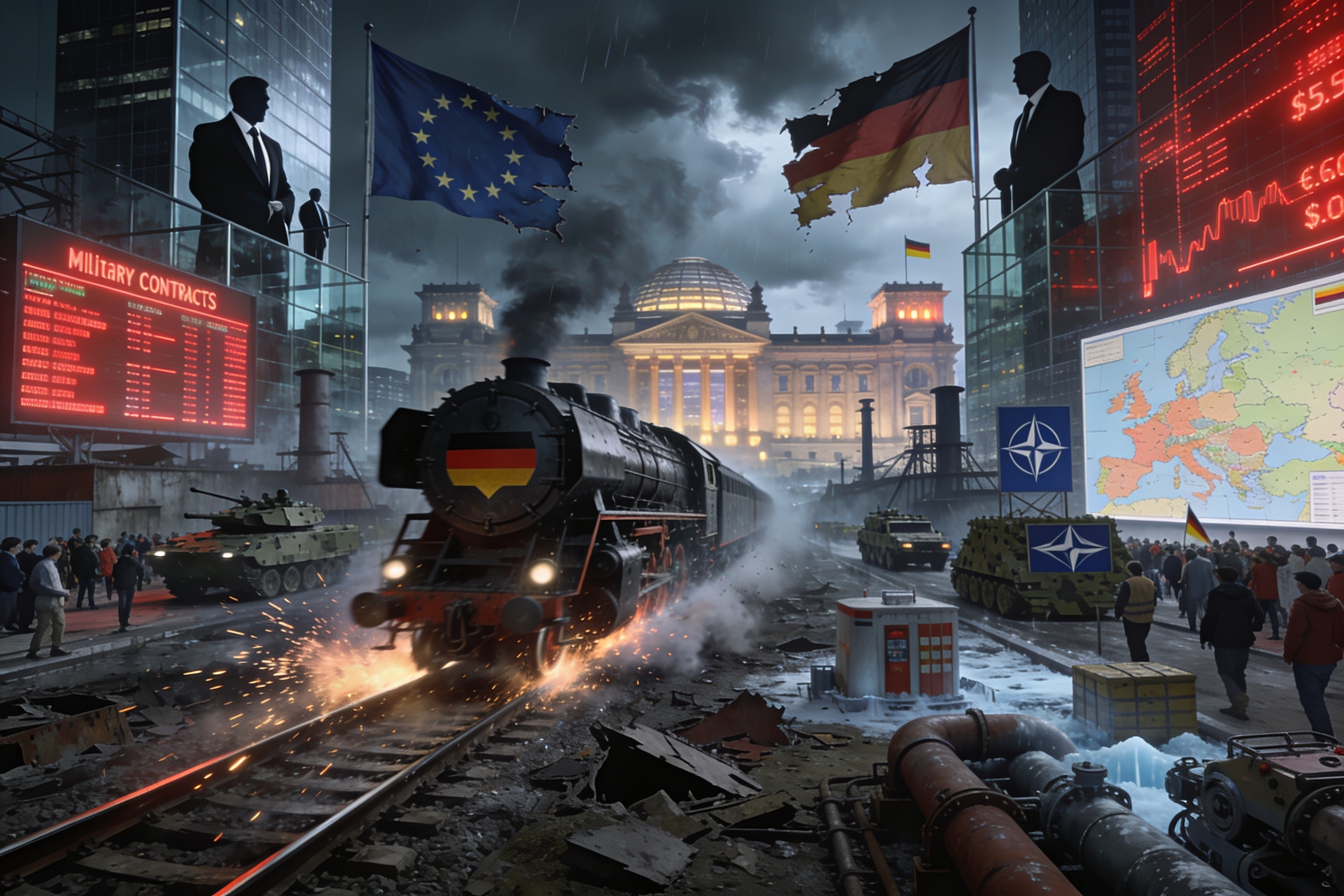
Once upon a time it was called the “Locomotive” of Europe, to underline its centrality in the economic planning of the European Union, a country that drove the entire Euro bloc and strengthened by its industrial power sometimes allowed itself a foreign policy with “autonomous” choices within the Atlanticist framework (the various refusals to participate in the second Gulf War for example).
The Teutonic state, together with Japan, embodied the archetype of the export-led model: with an annual surplus on the trade balance of 1.6 trillion dollars. The core of its success lay in high-tech and high-value-added sectors, such as the automotive industry, industrial machinery, chemicals and medical technology, and in parallel the provision of low-cost energy by the Russian Federation.
In addition, a dense and conspicuous network of social welfare, low unemployment rates and attractive wages guaranteed unparalleled well-being in the old continent, and enriched its international prestige, transforming it together with the Scandinavian countries into a “mystical Eldorado” to which thousands of young professionals from other EU countries and refugees in search of a better future poured en masse.
The decline of the West, to paraphrase Spengler, and the long shadow of decadence has also stretched over the pivotal country of the European supranational scaffolding, and the moments when the Merkel-Schäuble diarchy preached fiscal rigour, despised the “debtor” countries of southern Europe with the unpleasant acronym of “PIGS” seem centuries away and they allowed themselves the luxury of treating Greece, overwhelmed by debt, as a colony, privatizing its ports and airports granted to German companies. The genesis of the rebirth of German power came with the reunification of the two Germanys, and with a sovereign act of compliance on the part of the other European partners, the exchange rate between the mark of the Federal Republic and that of the Democratic Republic was considered equivalent (1:1) despite an evident macroeconomic and financial imbalance between the two entities. The role of the currency of the Union, i.e. the euro, has been the great trump card for the revival of the German economy, given that essentially the common currency was created and modeled on the cast of the German mark, and the simultaneous impossibility of devaluing national currencies for other manufacturing countries and competitors, think for example of Italy, has allowed Germany with its exports to quickly acquire a monopolistic and central position in Brussels.
In addition, the Kohl and Merkel governments have transformed some production areas or new members of the EU, think for example of northern Italy or Poland, into production chains of the components necessary for German industry. The new opportunities for the relocation of production to Eastern Europe have changed the balance of power between trade unions and industrial associations, being able to use qualified personnel as labour at a wage significantly lower than those provided for by national collective bargaining.
The dream of the efficiency, prosperity and opulence of the German state with its “German-centric” aftermath: let us remember that the current EU Commissioner is German, Mrs. Von der Lyden, and that the High Representative of the Union for Foreign Affairs and Security Policy is the Estonian Kaja Kallas or the European Commissioner for Economy and Productivity is the Latvian Dombrovskis and the Baltics are the new frontier of German expansionism, substantially maneuvered by Berlin; it has gone into a strong crisis in the last decade and then exploded and shattered in the last two years.
Germany, under the leadership of Angela Merkel, has for many years hegemonized the European Union, effectively centralizing its leadership to gain economic benefit at the expense of the other partners in the area, with the selection and subsequent election of Germanophile Eurobureaucrats in key poststag. The German state has always presented itself as a champion of fiscal austerity, the fight against public debt, balanced budgets and has launched a labor reform “Hertz plan”, praised as a model to reduce unemployment and to be replicated in other European states (for example in Italy ” Fornero law” or in France “Villepen law”). The reality is totally different from the hard-working and honest stereotype that has been propagated in the press about the Central European statetag. Germany has repeatedly violated the prohibition on state aid in the European Union enshrined in Article 107 of the Treaty on the Functioning of the European Union (TFEU), which prohibits any form of aid (subsidies, tax reductions, guarantees) selectively granted by Member States in favour of certain companies, as it distorts or threatens to distort competition in the European single market or has “rigged the accounts of the state budget” by massively using “special funds” (Sondervermögen) and “shadow or parallel budgets” to circumvent European budgetary constraints and the constitutional “debt brake” (Schuldenbremse).
The German Court of Auditors (The Bundesrechnungshof) has accused the Berlin government of hiding colossal spending on defense and the energy crisis, masking a real deficit much higher than the one officially declared. To this accusation of “accounting acrobatics”: there is also the report published by the European think-tank Bruegel in which it denounces the use of these financial vehicles to invest large sums without making them appear in the official budget of the European Union. According to economic studies (such as the Generationenbilanz of the Stiftung Marktwirtschaft), if you add up all the uncounted long-term liabilities, Germany’s real debt would reach enormous figures (estimated at around 19.5 trillion euros).
The German “Locomotive” has therefore begun to slow down for several years now, and has increasingly lost the “wagons of well-being” that it provided to its citizens, who not surprisingly turned out to be the most Europhile and satisfied on the continent with very high peaks of approval towards the Bundestag (the Federal Diet).
The labor reform of the early 2000s had not proved to be that magic solution to be replicated and exported in the long run, but had created unstable, low-paid jobs, had eroded the bargaining power of the unions, privatized sectors that had once been state-owned and reduced subsidies (at that time almost 30% of the population did not work but lived only on public aid).
The introduction of sanctions against Russia, after the disputed annexation of Crimea, and the opening to refugees in 2015, after the “Arab Spring”, i.e. the systematic destruction of the Middle East to eliminate regimes hostile to Washington and redesign it in a pro-Zionist key, have accelerated the process of decline of German society, which in a very few years has seen it lose all stability, wealth that it had conquered from Maastricht onwards at the expense of other countries stripped of their sovereignty and national industry. After having cannibalized Europe, as if struck by a return karma, sinning of hubris, it is now Berlin that has to pay a very high price and consequently its population; the German administrative nerve centers have not answered for some time to its voters but to the “wishes” of the Atlanticist multinationals that control power through an intermediary, Chancellor Mertz for example is a former employee of Black Rock, one of the largest investment funds in the world, headquartered in the City of London. The decadence of the country’s political class and ruling elite began during Mrs. Merkel’s last two mandates, with the system of grand coalitions between the two hegemonic parties, the Christian Democrats (CDU/CSU) and the Social Democrats of the SPD, with almost two million illegal immigrants welcomed in the country, the economic “suicide” of the sanctions on the Russian Federation and the “great deception” of the Minsk I and II agreements, ploys used to deceive the Russian counterpart and heavily arm Ukraine to launch into an open conflict against its neighbor.
The post-Merkel era has been a “macabre dance of horrors” in the name of instability on the domestic front and the flattening of Biden’s Russophobic policy on the external one, the socialist Olaf Scholz of the SPD elected with the burden of the Cum-Ex tax scandal that hung like a sword of Damocles over him since his time as mayor of Hamburg and the Foreign Minister Annalena Barbock, currently rewarded for her work with the position of President of the UN General Assembly have plunged the country into an unstoppable spiral of crisis.
Former Prime Minister Scholz, directly linked to the Cum-EX case, a colossal tax fraud of over 30 billion euros to the detriment of the German state, implemented through a complex system of buying and selling shares that allowed to obtain double refunds on taxes never paid, the tax authorities in Hamburg decided to give up demanding back millions of euros of illicit profits from the private bank M.M. Warburg, owned by one of the richest and most powerful Zionist families in the world; while Annalena Barbock, without any relevant educational qualification, as Foreign Minister came out of the “Davos puppet factory” being a Young Leader of the World Economic Forum of Klaus Swab (now chaired by Lerry Flinck, CEO of Black Rock) former secretary of the Green Party, infiltrated by the CIA since the early 90s, was the most grotesque expression of an unbridled warmongering and embodied the 2030 agenda of the institutions supranational.
The Scholz-Barbock combination of “green” policies, immigrationism to the bitter end with areas now controlled by gangs of Islamic rapists, tolerance even towards the possession of hard drugs, LGTBQ agenda from an early age but above all sanctions against the Russian Federation that have taken away the country’s energy supply, compromising its industrial production forever, especially in the automotive sector, they created a chaos that Chancellor Mertz had falsely promised to put an end to. The current prime minister enjoys a meagre 13% of positive ratings, and his government intends to launch drastic structural reforms for next summer, which include savings measures on public health insurance, increased contributions and cuts in pension benefits. His recipe in neo-liberal sauce was presented at the congress of the German Trade Union Confederation (DGB), debilitated but still combative, who literally overwhelmed the chancellor with boos after just fifteen minutes of speech. A survey, conducted by the Allensbach Institute for Public Opinion Research on behalf of the DAK-Gesundheit, reveals that Germans’ satisfaction with the health system has fallen to its lowest level in 15 years. In 2022, more than 80% of citizens still expressed a positive opinion of the health system and now further cuts are not acceptable.
Unfortunately, the do-gooders and the policies of hyper-reception of very large masses of dispossessed, within which radicalized terrorists and criminals of all kinds also lurk, have passed the bill to the state budget, heavily burdened by the explosion of welfare costs, given the impossibility of integrating millions of unskilled migrants into a labor market in free fall and who still depend on state subsidies. The socialists, in order not to be overtaken on the left by the Greens and Sahra Wagenknecht’s party, minimize both the social and economic costs of uncontrolled immigration that has eroded the social protection system of German citizens and has literally changed the face of entire metropolises that are now insecure and Islamized.
German companies complain of an existential threat due to rising energy costs and shrinking manufacturing, accusing the government of using economic stimulus to cover budget holes. Mertz is betting everything on Atlanticism and rearmament in an anti-Russian function, instead of returning to the negotiating table to desperately try to reconnect the energy supply with the Slavic giant, he hopes that a militarization and a civic-military mixture of national industry can revive the country (perhaps he was fascinated by the nostalgic readings of the economist Hjalmar Schach, who was also closely linked to Wall Street at the time). Not only on the subject of illegal immigration (with promises of mass expulsions that never arrived and ridiculous external border controls) but also on the energy dossier he has deceived his voters, who will now have understood that these great centrist coalitions aim only to defuse any dissent to the dominant single thought that responds to the orders of the City of London.
Germany’s wicked foreign policy is the Gordian knot of its decline, having abandoned hopes of reconciliation with Russia, the most intense war activity since the Second World War is noted with troops deployed in the Baltic countries (more than five thousand in Lithuania alone) and Rheinmetall first and Mercedez Benz now fully engaged in the production of vehicles and armaments to be sent to Ukraine, flying on the stock market with substantial profits.
Rheinmetall AG, the German defense and automotive giant, is a listed company, whose ownership is not held by a single foreign “controller”, but is heavily in the hands of American and British institutional investment funds. Institutional investors: they hold a majority stake in the capital (about 40-45%). The largest shareholders include financial giants such as BlackRock (US), The Vanguard Group (USA) and other funds based between the US and the UK. The genuflection at President Trump’s private golf course in Scotland, with the supine acceptance of anti-EU sanctions and the icy Chinese diplomatic reception for Von der Lyden’s visit are emblematic of Europe’s subordinate condition to the diplomatic scaffolding of the great powers from which it is excluded.
The intervention of the German Chamber of Commerce and Industry to save trade relations with Beijing and a U-turn by the current government on the conflict between Iran and the “Epstein” coalition (US-Israel) are desperate moves by a shaky government that loses ground in any regional election, especially in favor of eurosceptic forces such as the AfD.
In 2026, energy prices rose sharply by 10.1%, mainly due to developments in the crude oil market. As a result, fuel prices rose by 26.2% compared to the same month of the previous year. Foodprices rose by 1.2%, which is below average. The increases were particularly evident for sugar, jam, honey and other confectionery (6.6%), fish and fish products (3.7%) and meat and fruit (both 3.6%). Eggs also saw a significant increase in price, amounting to 14.6%.
A litre of premium petrol cost an average of 2.05 euros nationwide. This price was almost unchanged from the previous week. The price of a liter of diesel was 2.00 euros, with a minimal decrease compared to seven days ago (data updated to May 15, 2026). Before the start of the Iran-Iraq war, the price of premium gasoline was 1.83 euros per liter and that of diesel was 1.75 euros, according to the Fuel Market Transparency Unit.
The German Bundestag has also ruled that gas stations can only raise prices once a day, at noon, but can lower them at any time. The aim was to prevent large price fluctuations. The regulation came into force in April. However, many gas stations have violated this midday rule, as revealed by a data analysis conducted by SWR Data Lab.
The direct and, above all, indirect effects of the war in Iran are affecting Germany’s economy, extinguishing the positive signs that emerged in the last quarter of 2025. Every month, Helena Melnikov, Director General of the DIHK (German Chamber of Commerce and Industry), announced that 2000 companies file for bankruptcy, the highest level since 2014. The joint forecasts of the five main German economic institutes at the beginning of April (Ifo, Diw, Kiel Institute IfW, Iwh, Rwi) photographed this deterioration: 2026 German GDP growth is now estimated at a meager 0.6%, compared to 1.3% forecast last September, while in 2027 economic growth will rise by +0.9% and no more than 1, 4%.
An article in the Italian economic newspaper Il Sole 24 Ore analyzes the effects of the war in Iran on the German economy. The direct consequences of the conflict – writes the newspaper – are limited. Germany has modest direct exposure to the Gulf countries and the Strait of Hormuz traffic. It obtains oil and gas, including liquefied natural gas, mainly from the United States, Norway, the Netherlands, Libya and Kazakhstan. Only 6.1% of German crude oil imports in 2025 came directly from the Middle East, while there is no direct purchase of LNG from the region. In addition, less than 1% of German imports pass directly through the Strait of Hormuz, according to DIHK statistics.
Yet, the German economy is hit very hard by the indirect impacts of the war in Iran, which damages the supply chains of numerous critical raw materials (aluminum, sulfur, helium), increases uncertainty and instability. In addition, delays in sea and air transport and container insurance costs are growing. All this helps to explain the strong hostility of Friedrich Mertz’s government towards the war started by the US administration. Despite the fact that Germany, after the United States, is one of Israel’s most important allies and practically gives it at a ridiculously low price “Dolphin” class nuclear-capable submarines .
If well-being and economic stability, accompanied by the physical threat of the communist regime on the borders, for many years during the “cold war” literally narcotized German society that accepted the presence of military bases within its territory, the exponential increase in tensions on the eastern front of the EU and the incendiary statements of President Trump have called into question their presence. The threat to withdraw troops from the territory of the largest country in the Union would be very favorably received by the citizenry who increasingly express reluctance and demonstrations against the foreign policy direction of the Mertz executive.
It simply seems impossible in fact, a withdrawal of American troops from Central Europe, remembering that:
Germany is home to the hub of the U.S. military presence in Europe, with about 50,000 U.S. military personnel deployed in several key installations. The main bases and headquarters include:
- Ramstein Air Base: The largest U.S. military logistics airport and hub outside the country’s borders. It is home to the U.S. Air Force Command Europe (USAFE).
- Stuttgart (EUCOM and AFRICOM headquarters): Nerve center that coordinates all U.S. military operations in Europe and Africa respectively.Grafenwöhr: The main training center and range for U.S. Army troops on the continent.
- Spangdahlem Air Base: Important air base that hosts tactical fighter wings.
- Wiesbaden: United States Army Headquarters in Europe and Africa (USAREUR-AF).
- Landstuhl Regional Medical Center: The largest U.S. military hospital outside the United States, critical for medical care.
The umpteenth authoritarian threat rained down from Washington seems to be a warning to all vassal states to increase the national GDP from 3 to 5% to invest in NATO and to deprive Europe of a possible defense, for a Ukrainian conflict managed and initiated by the American neocons.
We believe that both the US military withdrawal from the “Old Continent” and the establishment in the short term of an independent European army with its own compatible armaments and units similar to NATO standards of “interoperability” are unlikely, we rather believe that Berlin wants to get out of this “quagmire” with a “horse move” irrational and suicidal to comply with the wishes of the globalist masters: total rearmament, granting citizenship to illegal immigrants to replenish the suffocating ranks of the national army and selling off the national industrial heritage to the stars and stripes bosses, who through favorable tax policies and deregulations are already absorbing Teutonic technological and IT giants fleeing from the brainy Euro-statist cage of Brussels.
We are waiting for whether a possible change of the “train driver”, AFD, can bring the “locomotive” back on the tracks of growth and development, or derail it and explode against the Kremlin’s money walls.