Reality always imposes itself. Resisting it, especially when it is adverse, only worsens its consequences. That is what happens to Lebanon, a country that since its birth is, in reality, an impossible utopia, hence its stormy history and also its possible end, sooner or later.
The Long Road to Perdition
Lebanon is composed, roughly, of 30% Christians who are mostly Maronite Catholics (plus Greek Orthodox and Catholics, Armenian Catholics and Orthodox, Syriac Orthodox and Catholics, Assyrians, Chaldeans, Copts, Evangelical Protestants and Roman Catholics), 64% Muslims (31% Sunnis and 32% Shiites) and 6% Druze.
The country was part of the French Mandate of Syria and Lebanon, proclaiming itself the State of Greater Lebanon in 1920, in which the Maronites were privileged by the French due to their religious affinity, enjoying greater power than the Muslims; using a somewhat biased interpretation of Article 95 of the 1926 Constitution that contemplated equitable representation.
Since the aforementioned Constitution, Lebanon’s institutional structure is based on a difficult, unstable and very possibly impossible balance of power between the predominant religions: Sunnis, Shiites and Maronites, so that the President of the Republic must be a Maronite, the President of the Council of Ministers or Prime Minister a Sunni and the President of the Chamber of Deputies a Shiite. As for parliamentary representation, the rule of six Maronite deputies for every five Muslims was applied.
When it acceded to its independence, through the so-called National Pact –a verbal agreement between Maronites and Sunnis, in which the Shiites did not participate–, it did so somewhat artificially due to a host of circumstances of which its ethnic and religious diversity was the main one; the absence of the Shiites in the aforementioned pact laid the foundations for their marginalization in the institutional structures of the State, among other things removing them from the highest levels of power, being practically relegated to positions in the local administration in the Bekka Valley and the south of the country, all of which are the source of conflicts that are still ongoing today.
As a result of this, the great political blocs emerged: the Maronite –the Lebanese Phalanges (1936), the National Bloc (1943) and the National Liberal Party (1958)–, the Druze –Progressive Socialist Party (1949)–, the Sunni –Al-Mourabitoun Movement (1957)–, the multi-confessional –Syrian National Social Party (1932)– and more recently in 1974 the Shiite –Movement of the Dispossessed–, the latter just before the outbreak of the civil war, whose armed wing was Amal.
The stability that was achieved for a few decades between such disparate groups, brought with it for a certain time, due to the industriousness of the Lebanese, remarkable benefits and development, leading Lebanon to be described as the “Switzerland of the Middle East”, but the deep and latent reality was very different because it was not possible to: a) create a unified citizenship with a consciousness of a common nation and homeland, b) to approve a single civil code, prevailing the codes linked to each religion, c) inequality in access to health, education or employment that remained in the hands of the religious leaders of each community and d) it could never be prevented that due to the geographical location of Lebanon, with borders with Turkey, Syria and Israel, their various communities were instrumentalized by the interests of such countries, but, because they are in the Middle East, an area as unstable as it is geopolitically complicated, they will not cease to be so by the great powers.
In 1975 the civil war broke out that would last, with varying intensities, until 1990, the main factors being: a) the exponential Muslim demographic growth, mainly among the Shiites, at the same time as the decline among Christians, which led them to demand greater quotas of power, b) the arrival in southern Lebanon of the Palestinians (PLOs) expelled from Jordan after the Black September of 1970, that practically created a state within the state, whose cause the Muslims, especially and mainly the Shiites, welcomed as they saw in it an effective tool of pressure to favor their own. The civil war between the two blocs, the Christian and the Muslim – within which there were also internal civil wars –, brought with it the ruin of Lebanon and the opening of deep wounds that are very difficult to heal, two consequences that persist today.
While the aforementioned civil war was taking place, in 1982 a third factor began to emerge that would completely dislocate the already complicated situation: Hezbollah.
Partly because of the dispute between the Palestinians and the Shiites for control of southern Lebanon, and partly because of Iranian expansion in its intention to wipe out Israel, not to mention the various invasions carried out by it, not only as a defense against Palestinian attacks, but also with the intention of manipulating one or the other for its own benefit, Hezbollah, with Iranian backing, gradually managed to establish itself as the only actor in the south of the country, which it turned into an exclusive fiefdom thanks also, not to be forgotten, to the implementation, in addition to its battle-hardened militias, of an extensive and effective network of social assistance never before existed that came to alleviate the serious shortcomings of all kinds –health, educational, work, etc.– in such a punished and depressed area of Lebanon.
The civil war also brought with it the almost total control of Lebanon by Syria, whose troops (up to 30,000 troops), under the mandate of the Arab League, it should not be forgotten, occupied almost the entire country or at least its nerve centres and areas, making common cause, in their enmity against Israel, with Hezbollah; this process was called the “Pax Syriana”, and Damascus came to appoint presidents and ministers. The reasons for the seizure of the country by Syria were: a) ideological, since Syria had been part, together with Lebanon, of the French mandate, so it considered Lebanon part of it, seeing no reason for its independence that prevented it from consolidating its aspiration to a Greater Syria, b) geostrategic, since in its struggle against Israel, Damascus needed and used Lebanon as a defensive buffer, as well as as a base of operations, and c) economic, because the ports of Beirut and Tripoli, as well as the Lebanese financial system, similar to the Swiss in terms of opacity, served Damascus to dodge economic sanctions.
In 2005, the assassination of President Rafik Hariri provoked the “Cedar Revolution” that put an end to Syrian domination of Lebanon. Accused of being the perpetrator of the assassination, Lebanon was divided into two: the anti-Syrian Alliance of March 14 (date of the attack) that brought together sentiment against the Syrian occupation and the pro-Syrian Alliance of March 8. The result was the definitive evacuation of Lebanon by Syria.
But nothing changed in substance, because Lebanon was once again plunged into division between the main religious groups, violence of all kinds and suffering from excessive Israeli interventions that constantly intensified as Hezbollah’s attacks persisted.
Lebanon in free fall
Such a tortuous history brought with it the virtual economic and social ruin of what was once the jewel of the Mediterranean. Some data, the most significant, on the years of corruption, misgovernment, economic inefficiency, lack of control of the public debt, etc., and of course civil strife and invasions, mainly Israeli, yields the following balance:
- A GDP of 55,000 million dollars fell to 20,500 million, 37%.
- Inflation already at 84.3% has reached 130%
- The Lebanese pound lost 90% of its value.
- A public debt of 171% (40% of the national electricity company (Électricité du Liban).
- Foreign exchange reserves of 30,300 million dollars remained at 16,000 million, preventing the import of even basic necessities.
- More than 50% of the population living below the poverty line.
- 48% of the population with difficulties in meeting their basic needs.
- An unemployment rate of 40%.
- As Lebanon depends on 98% of oil imports to cover its energy needs, all of the above has led to obsolescence due to lack of maintenance of its energy infrastructures, so that the main problem with its electricity grid is that it does not have the capacity to produce the energy demanded by the country, which explains why for years there has been no national supply that covers 24 hours a day.
Summary of its current situation
Due to its geostrategic location and internal configuration, the evolution of the most recent events in the Middle East has caught Lebanon in the middle of all the fires, that is, of all the interests of one and the other, not only of the countries of the area, but also of the interests of external powers, which has surprised it at one of the worst moments in its history; so much so, that we could practically even talk about its practical self-dissolution.
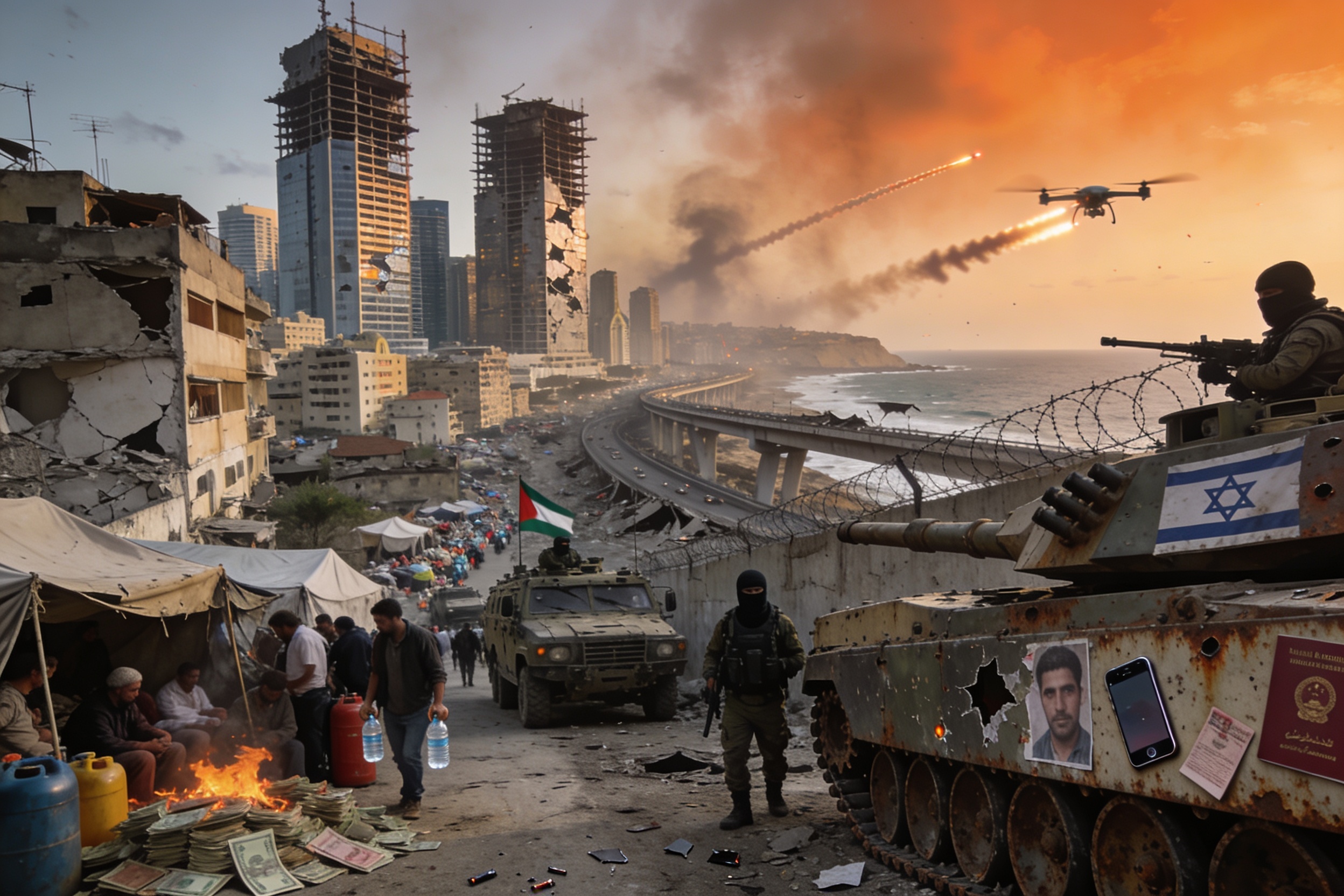
A new Israeli invasion, the umpteenth, has brought much of the south of the country under Tel Aviv’s control. Hezbollah, although diminished, is still in force, although with its main backer, Iran, which is practically only focused on surviving. The installation of Al Julani in power in Syria, with Israeli protection, of course, opens the possibility of a new intervention by Damascus, as happened in the past. Turkey is not as neutral as it wants to appear, because it has its ambitions.
The Gulf countries that at times helped Lebanon to alleviate some of its financial woes are now paying full attention to preventing the war against Iran from being revived. As for the US, Russia and China, they care little about Lebanon when issues of vital importance for the geopolitical future of such an essential region, for their economies and for the world economy are at stake in the Middle East. Finally, it is necessary to make a reference, albeit minimal, to the UN interposition forces deployed for years with the supposed mission of avoiding confrontations with Israel, which are as ineffective as usual.
Lebanon is not the main arena where global and regional powers such as Israel, Saudi Arabia, Iran, the United States and now also Syria, settle their hegemonic disputes, but there is no doubt that it has its importance. The war between Israel and the United States against Iran marks, of course, a before and after, especially because of the new and very deep Israeli penetration into its territory and the isolation to which it is located it tries to subjugate the south of the rest of the country having declared that its objective is to establish definitively and by force a buffer or security zone that extends from the border to the Litani River, that is, practically what had been a private and private fiefdom of Hezbollah; of course this is a new and resounding violation of Lebanese sovereignty, while violating UN Resolution 1701, but that does not matter to Israel, as always and as on so many other occasions and things, and also to the international community because it is precisely Israel.
Hezbollah remains, therefore, as an excuse and piece of discord:
- On the one hand, let us remember that according to the Taif Accords (1989), all the paramilitary factions in the country were dissolved, except for Hezbollah, which was granted the status of a “legitimate resistance force” to combat the Israeli occupation of the southern strip, in force at that time–, those who are clamoring for its disappearance, mainly the Christian and Sunni communities, they maintain that Hezbollah’s arsenal seriously threatens the very essence of the State by snatching away its monopoly on violence and usurping its functions in matters of national defense, involving the country in foreign conflicts without parliamentary authorization, also alleging that as long as the militia continues to operate, internal political stability will not be possible, much less that the international economic sanctions that suffocate the country will be lifted.
- On the other hand, Hezbollah’s supporters and allies argue that the very existence of the Lebanese state depends inexorably on the group’s weaponry, arguing that the meagre Lebanese national armed forces are incapable of deterring or containing Israeli invasions, an opinion that is not only evident throughout history, but also has the unwavering sociological support of the Shiite population who consider Hezbollah as the only one that he can protect them from being exterminated by Isarel; and this not only because of its military effectiveness, but also and even more, as has been said, because Hezbollah has been a very effective parallel state since its creation in the social sphere, providing health, education and infrastructure services where the Lebanese central administration does not reach and has never even arrived, nor has it had any interest in doing so.
As a result, Lebanon is now facing an existential crossroads in light of (a) the ongoing Israeli invasion, (b) the persistence of harsh conditions imposed by global financial institutions, which link any bailout to the liquidation of Hezbollah, (c) the decisions of the Lebanese government that has outlawed all armed groups outside the national army, it has ordered the seizure of its arsenals and is trying to deploy its troops in the south –which the Israelis hinder as much as they can–, d) it has arrested and expelled “agents” allegedly belonging to the Iranian Revolutionary Guards, and e) the reaction of Hezbollah which has branded all of the above as high treason, accusing the Government of leaving Lebanon defenseless and has declared itself in open rebellion against that Government by mobilizing all its armed resources and population available against him, within his means due to the Israeli presence.
The possible future of the neverland
The future is unpredictable for men, and in the case of Lebanon much more so because of the accumulation of internal and external factors and circumstances that fall on it, even so, we will try to specify some of the most probable.
If the Israeli strategy does not change, which could happen depending on the outcome of the next elections, in the event that Netanyahu and his allies are ousted from power, or that the current prime minister resigns due to illness, Lebanon will de facto, although not de jure, lose its southern area that Israel will keep under its direct or indirect control with the excuse of Hezbollah. Turning that Lebanese area into “its buffer or security zone”, whose dominance, as happened with the Golan Heights, will never be ceded. To do this, of course, he will apply to that region the same brutal medicine that he has used with Gaza and the West Bank. To this end, Israel will count on the sure support of the United States, whoever its president is, as well as at least on the complicit silence of Europe, although on this continent some contrary voices may emerge more or less openly, but without weight to make others change their position.
As Iran, despite surviving its current regime, will suffer intense isolation and not a few adversities, it will not be able to provide its feudatory, Hezbollah, with the support of all kinds that it needs, so the future of this group is also quite bleak, losing operational capacity, although this will not mean its disappearance. but only to remain active as much as possible and attentive and waiting for a future change of circumstances that favor him.
The European Union has no real capacity to be a determining factor in Lebanon’s future, because its current decline, which has been dragging on for a decade or two, is not going to stop. A possible initiative to create a force of its own to accompany or replace the UN mission is a complete chimera, and in any case only a way of appearing, of looking good in the eyes of the international community, but nothing more; as for the UN mission, it will continue in its usual lethargy, since the UN, today practically disappeared, virtual, has already been quite evident and it is very possible that we will see its disappearance or profound transformation, although that does not mean that it will be taken into consideration again.
As for Spain, as a European country, and if, as it seems, Pedro Sánchez can very well repeat his mandate after the 2027 elections, he will continue outside the European picture as far as Lebanon and the Middle East are concerned, but without more transcendence, or influence, or willingness to go beyond mere statements in front of the gallery and the occasional unimportant measure, but only and only to give some credibility to his position.
The big losers will continue to be the Lebanese Christian communities, as in general those of the Middle East, because in addition to the decline in the birth rate that they continue to experience, with all that this means at the political and social level, they are disorganized and disarmed, without the will to go beyond declarations and requests for help that will continue to be ignored not only by the international community in general, but also by the international community in general.
But also and worse by the Christians of the world themselves, with small exceptions almost at a particular level, suffering harassment not only from Muslims; curiously we have to break a lance in favor of Iran where Christians enjoy exemplary tolerance so far, but also from Israel, whose hatred of Christians is visceral, which is in crescendo as it sees itself closer to neutralizing its only declared enemy, which is Iran, once it has eliminated all the others in different ways, and dreams more and more every day with that chimera that is Greater Israel.
All of the above, plus its constant internal crises that for the reasons pointed out in this article are not going to cease, we may even see a Lebanon “cut up” with its parts placed under new “mandates” from its neighbors: Israel, Syria and Turkey, or the United States, although these from afar, so that that never-never country can disappear, sooner or later, as we have known them.