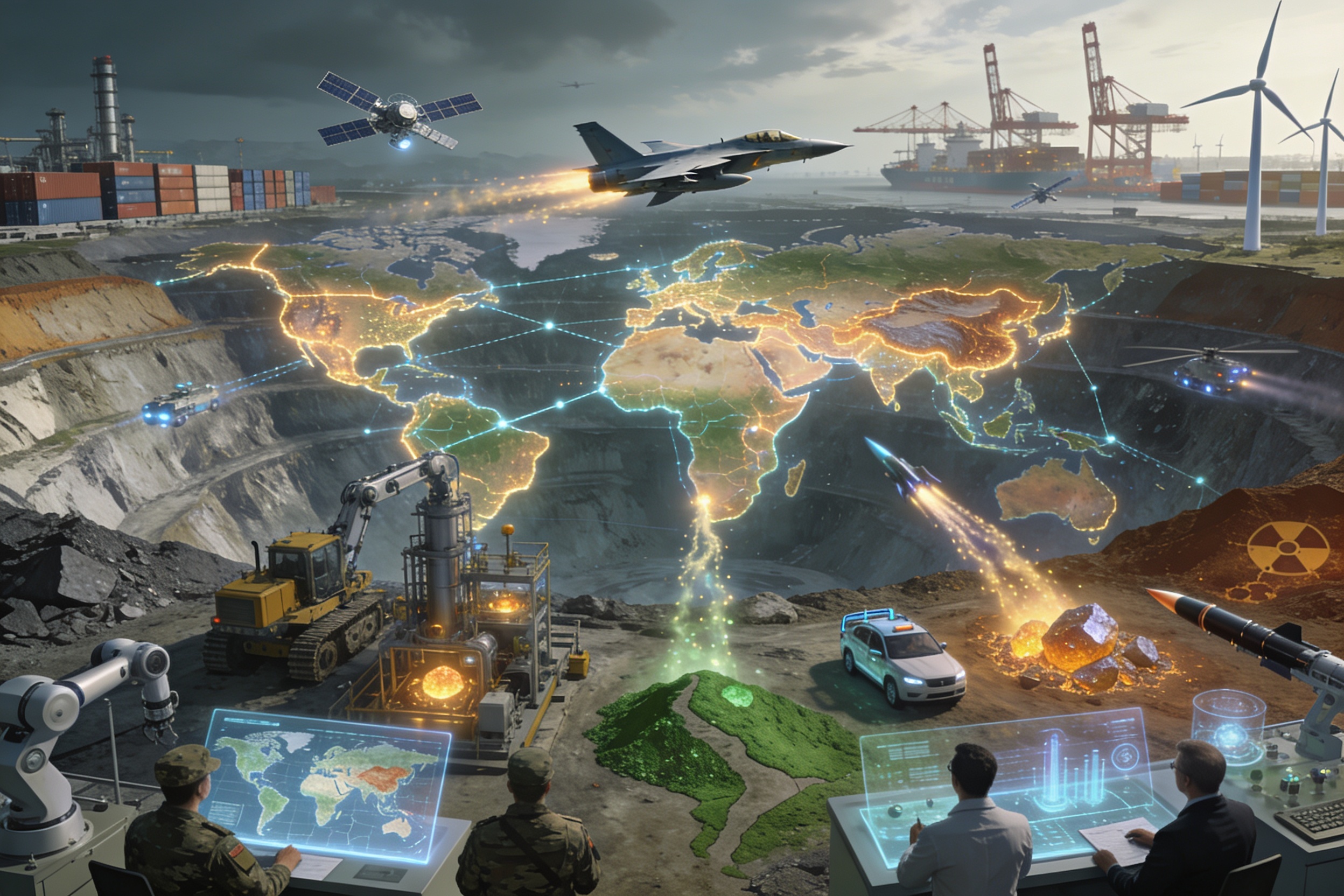
The dispute over rare earths in the Americas ceased to be a technical debate and became a strategic race for control of technological and military power in the 21st century. What just a few years ago seemed like an academic concern about dependence on China, today has become a national security priority for Washington and a historic opportunity for South America.
So-called rare earths — 17 essential elements for making missiles, radars, wind turbines, electric vehicles, and artificial intelligence systems — are not really scarce. The real problem lies in finding them in profitable concentrations and, above all, in processing them industrially without depending on Beijing.
Currently, China dominates about 60% of global extraction, but retains more than 85% of the refining capacity and almost 90% of the world’s production of permanent magnets, critical components for the aerospace and defense industry. That supremacy has set off alarm bells throughout the Western Hemisphere.
The strategic axis of North America
In the United States, the Mountain Pass mine in California became the centerpiece of Washington’s industrial autonomy strategy. Although the deposit produces significant volumes of bastnasite, for years the country continued to depend on China for the separation and final refining of minerals.
The U.S. priority now is to rebuild the entire value chain within its territory: from the extraction to the manufacture of neodymium-praseodymium magnets, indispensable for fifth-generation fighters, guided missiles and electric vehicles.
Canada, for its part, seeks to position itself as the great pole of “clean” refining in the West. Its hard rock deposits, including Nechalacho, are among the richest and most complex on the planet. Ottawa is betting on becoming NATO’s strategic metallurgical hub, combining critical mining with advanced environmental standards.
The awakening of the Southern Cone
As North America accelerates its industrial rearmament, South America is beginning to emerge as an unexpected player in the new mineral geopolitics.
Brazil appears as the sleeping giant. It has the world’s third-largest reserves of rare earths and concentrates key projects in Araxá and Catalão, as well as enormous prospects in ionic clay deposits. The Brazilian challenge is not in geology, but in developing industrial separation technology that allows it to avoid the traditional role of simple exporter of raw materials.
Chile is also beginning to gain prominence. Although the international focus tends to be on lithium, the country is quietly entering the strategic map of rare earths thanks to deposits of ionic clays in the Biobío region.
This type of deposit offers a decisive advantage over the hard rock predominant in North America: it allows for cheaper extraction with less environmental impact. Minerals can be leached by simple salt solutions, avoiding massive crushing processes and highly corrosive reagents. In addition, these clays often contain heavy rare earths such as dysprosium and terbium, essential for high-thermal strength magnets used in advanced military technology.
The real battle: refining
The big bottleneck is not in the mines, but in refining and metallurgy capacity. The real geo-economic war is being played out there.
Western dependence on China creates a critical vulnerability for defense. AESA radars, aero engines, submarines, satellites and guidance systems rely on advanced alloys derived from rare earths. Without its own metal reduction and magnet manufacturing plants, America maintains a dangerous strategic fracture line.
At the same time, the industry is facing increasing environmental pressures. Traditional processing generates acidic waste and radioactive materials such as thorium and uranium. For this reason, new American projects try to differentiate themselves through ESG standards, tailings recycling and circular economy models that allow them to obtain social legitimacy and access to international financing.
Added to this competition is a real subsidy war. The U.S.-led Inflation Reduction Act (IRA) offers multimillion-dollar tax credits for critical minerals produced in allied countries or with free trade agreements, attracting investment and reshaping the continent’s industrial map.
The dispute over rare earths is no longer just a mining issue. It is a struggle for control of the technological chains that will define the global balance of power in the coming decades.