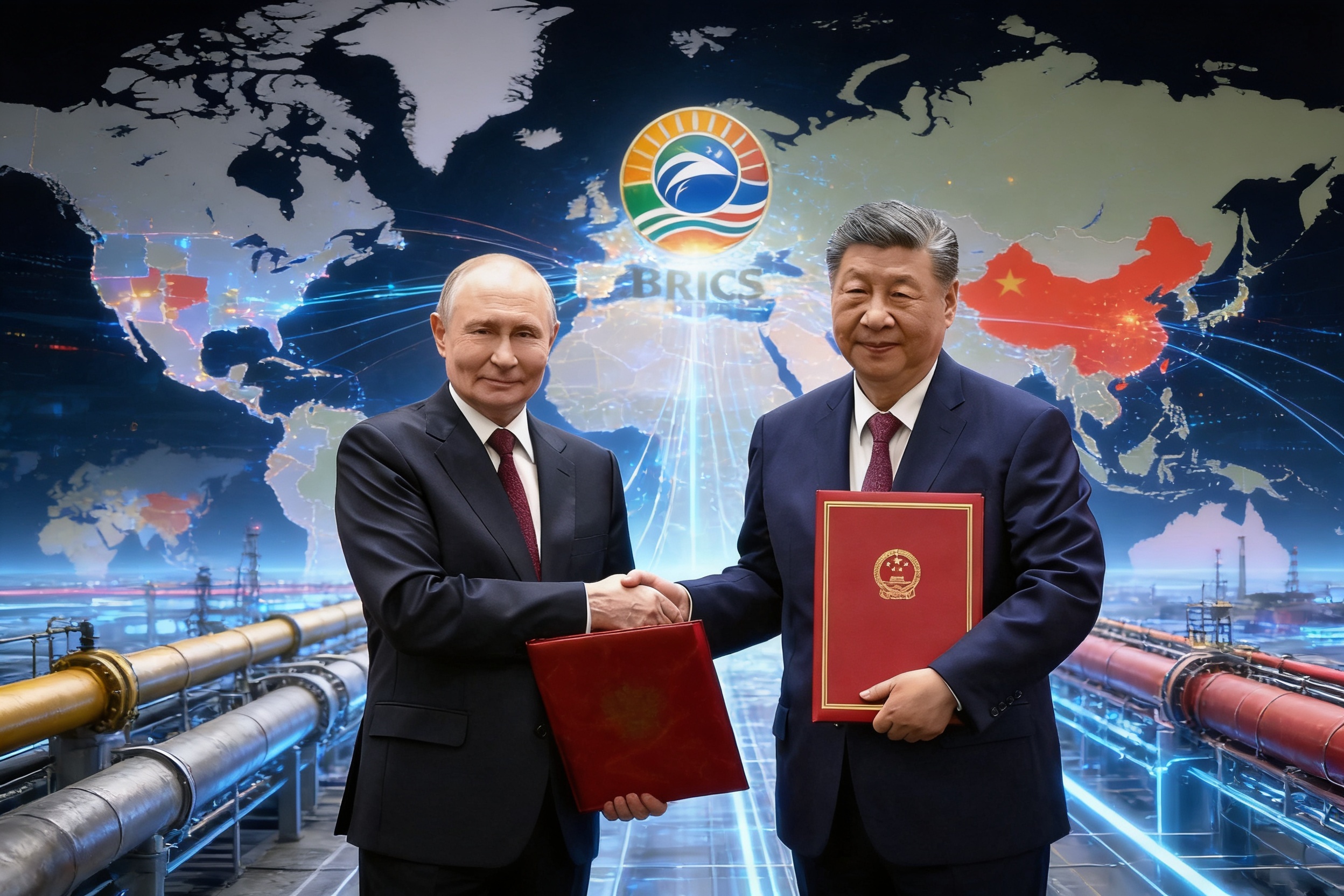
The summit between Xi Jinping and Vladimir Putin (19–20 May 2026 in Beijing) confirms a major historical shift: the post-Cold War world is coming to an end.
For nearly eighty years – and particularly over the last forty – the United States has exercised almost unchallenged dominance over the political, military, financial and cultural balance of power across the globe. Today, however, a new international order is attempting to emerge.
The Sino-Russian rapprochement is one of its main driving forces.
The indicators are now numerous and converging: the development of the BRICS, increased energy trade between Moscow and Beijing, the growing use of national currencies instead of the dollar, strengthened commercial, technological, diplomatic and even military cooperation, Eurasian infrastructure projects, and a clear determination to bypass Western-dominated channels. In short: a growing part of the world now refuses to depend on a single centre of political, economic and cultural power.
For many Europeans committed to national sovereignty, this development may seem like good news.
It does indeed reflect the gradual weakening of a unipolar system that was expansionist and aggressive, often characterised by external interventions without a mandate, extraterritorial sanctions, cultural standardisation and a form of ideological hegemony that had become oppressive. Many peoples now wish to regain greater freedom of decision-making and strategic autonomy.
But it would be dangerous to view this shift with naivety, romanticism or militancy. For the multipolar world taking shape today is by no means being built around France, nor around Europe… Worse still: it is being built without them!
Europe could, however, have become one of the great balancing powers of the 21st century, and this was undoubtedly its natural calling. It possessed industrial power, culture, science, history, diplomatic capabilities and even a certain vision of civilisation.
But it has gradually relinquished its strategic and cultural autonomy. At the same time, its irrational break with Russia, and its excessive policy of sanctions and Russophobia, has pushed Moscow towards Beijing, thereby strengthening a Eurasian alliance that is certainly pragmatic, but hardly natural.
However, another, more serious point deserves to be highlighted. China is a vast, ancient, powerful, rapidly developing and respectable civilisation. Yet it remains profoundly different from Christian Europe. Still ruled by the Chinese Communist Party, its relationship to the state, to freedom, to spirituality and to the individual is not that of France or the Old Continent. We share very few values or civilisational traits.
And Russia – despite its assertive return to its traditional and Christian values – has been pushed by the EU’s vacuity and corruption, as much as by American machinations, towards a partnership whose balance could become difficult to maintain in the long term.
It is likely that Russian leaders and intellectuals are, moreover, being influenced and manipulated against their will to take this direction. Moreover, let us make no mistake: the fact that Xi is receiving the American and then the Russian presidents in succession demonstrates Beijing’s desire to appear as the world’s indispensable diplomatic hub.
The real issue, however, is not to replace one dependency with another, nor to shift from an American fascination to a Chinese one. The real challenge, for France and for Europe, is to rediscover their true selves: sovereign, rooted in their heritage, conscious of their Christian, cultural and historical legacy, capable of engaging freely with all the major powers, without submitting to any of them.
And above all, to finally set about building a genuine Europe of nations, stretching from Finistère to the Bering Strait, and which would no longer have any connection with the tyrannical globalist technocracy currently operating in Brussels… Otherwise, France (and Europe) are heading not only for their political demise, but also for their cultural, economic and demographic annihilation. And this, in the very short term, right now.