For decades, Latin America held a secondary place in India’s foreign policy. New Delhi’s attention was focused on its immediate neighborhood, the Indian Ocean, and the great powers of Asia. However, India’s rise as a global player is changing this equation and placing Latin America on the strategic map of one of the most dynamic nations of the 21st century.
The reason is simple: India has become the most populous country on the planet, surpassing even China. A population of more than 1.4 billion, a growing middle class and an accelerated process of industrialization generate an ever-increasing demand for energy, food and natural resources.
Finding resources to sustain growth
As with China in recent decades, India’s economic development requires ensuring access to strategic raw materials and minerals abroad. In this context, Latin America emerges as a partner of enormous relevance.
The region has what India needs to sustain its economic expansion: oil, copper, lithium, iron, food, and abundant water resources. It is no coincidence that trade between the two sides has multiplied since the beginning of the 21st century.
Brazil, Mexico, Argentina, Chile and Peru have become India’s main trading partners in the region. While New Delhi exports generic medicines, automobiles, chemicals and computer services, it imports oil, copper, lithium, soybeans and other agricultural products essential for its development.
Energy and Critical Minerals: The New Geopolitics of Resources
The energy dimension is particularly important. Venezuela and Brazil have been relevant suppliers of hydrocarbons for the Indian economy. At the same time, the so-called “Lithium Triangle”, made up of Chile, Argentina and Bolivia, acquires extraordinary strategic value in a world that is moving towards electromobility and the energy transition.
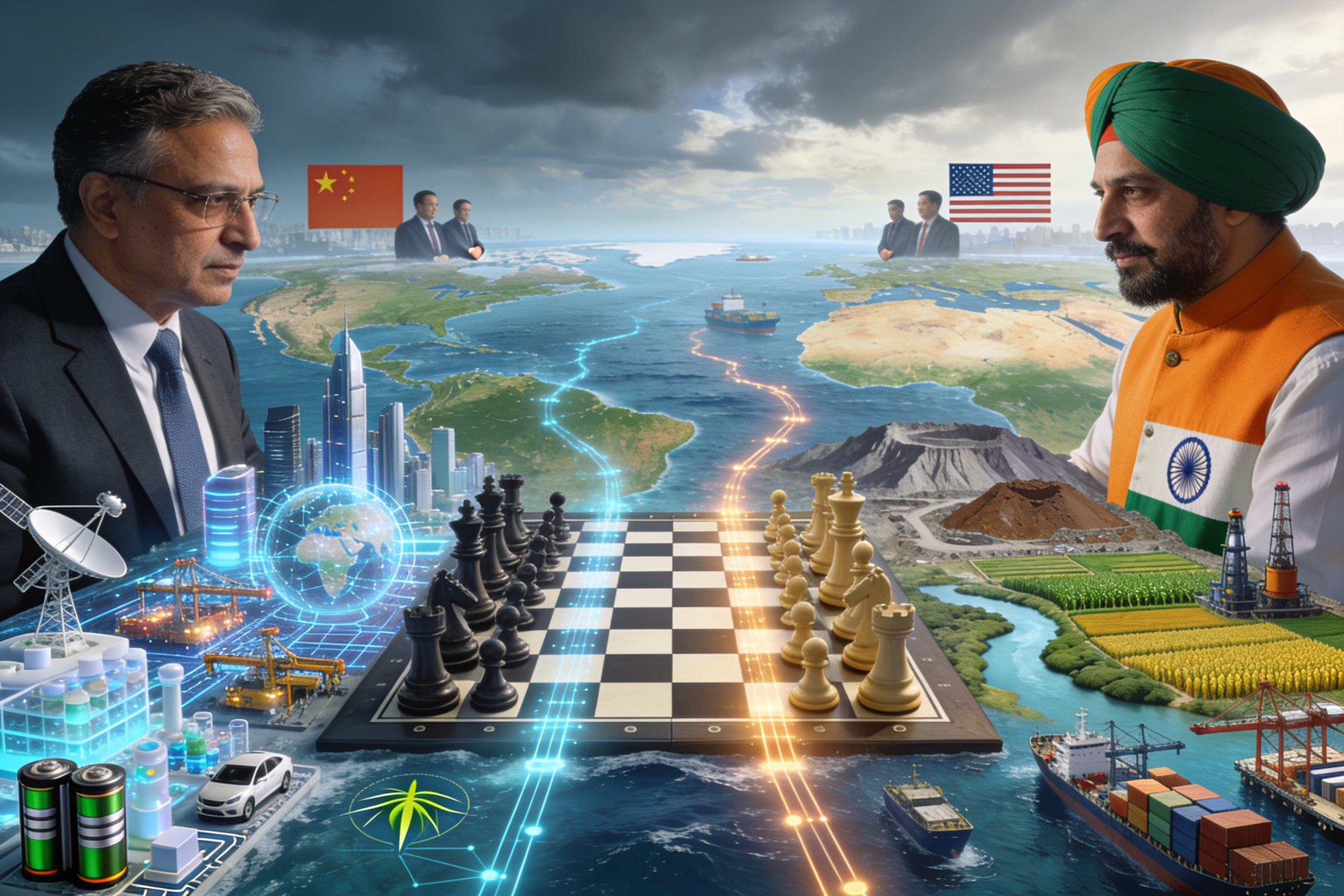
Chilean copper, Andean lithium and South American energy resources are part of a geo-economic chessboard that is increasingly relevant to New Delhi’s aspirations.
Technology, pharmaceuticals and vaccine diplomacy
But the relationship between India and Latin America is not limited to natural resources.
India has established itself as a leading technological and pharmaceutical power. Its companies have increased their investments in the region in sectors related to information technologies, digital services, the pharmaceutical industry and renewable energies.
The so-called “vaccine diplomacy” during the COVID-19 pandemic also allowed New Delhi to improve its image and increase its political presence on the continent.
The geopolitical dimension: the global south as a space of projection
From a geopolitical perspective, India’s strategy pursues several simultaneous objectives: to diversify alliances, reduce its dependence on Asia and the Middle East, obtain support in multilateral organizations and balance China’s growing influence in Latin America.
However, India’s approach has different characteristics from those of Beijing. New Delhi is progressing more gradually, has fewer financial resources and favours an approach based on business and technological cooperation and political affinities with numerous democracies in the region.
Brazil: the indispensable strategic partner
Within this framework, Brazil occupies a special place.
The relationship between Brasilia and New Delhi is probably the most important political axis of India’s presence in Latin America. Both countries are members of the BRICS, defend a reform of the international system and promote a greater role for the Global South. In addition, they cooperate in areas as diverse as agriculture, defense, and technological innovation.
Chile and the opportunity for a strategic partnership
For Chile, for its part, India represents a major opportunity. Its gigantic market, the growing demand for copper and lithium and the potential for cooperation in digital technologies and renewable energies offer a space for linkage that is still far below its possibilities.
The deepening of the relationship with India could become one of the pillars of a Chilean foreign policy oriented towards the diversification of markets and the strengthening of strategic autonomy.
Looking ahead to 2030: the Indian landing in Latin America
All indications are that India’s presence in Latin America will continue to expand. It is likely that investments in mining and energy will increase, trade agreements will deepen, and New Delhi’s diplomatic and business presence in Latin America’s Pacific countries will be strengthened.
India’s growing projection is not intended to replace China or the United States. Rather, it configures a third vector of linkage with the Global South, based on energy security, access to strategic resources, technological cooperation and the construction of a more multipolar international order.
An opportunity for Latin American strategic autonomy
If the last decades were marked by the arrival of China in Latin America, the next ones could be defined by the progressive landing of India.
For the region, this represents a historic opportunity: to diversify its alliances, expand its margins of strategic autonomy and participate with greater prominence in the reconfiguration of world power. On the new geopolitical chessboard of the 21st century, India is no longer a distant actor, but an emerging power that has begun to look towards Latin America with growing interest and strategic ambition.